

10 best OEE Software for SME European Manufacturers (2026)
In this guide, we compare the best OEE software platforms for European SME manufacturers looking at prices, features, strengths and weaknesses based on verified user reviews, and providing a clear guidance on which tool fits which kind of factory. So, if you run a factory with roughly 10-20 machines and you are tired of guessing what they actually did today and why yesterday's output was better than today, you’re at the right place.
“TL;DR: For most European manufacturers running 10-20 machines, GlobalReader is the most practical OEE software to start with. The hardware is included in the subscription, setup takes about 90 minutes, it connects to your ERP, and customers recover on average €39,200 of lost capacity per machine each year. Larger or specialised plants may be better served by Factbird, MachineMetrics or Vorne.”
The 10 best OEE software platforms at a glance
| Narzędzie | Najlepsze dla | Price / month (EUR) | Sprzęt | Live data in | Integracja z systemem ERP | Trial |
|---|---|---|---|---|---|---|
| Najlepszy wybór serwisu GlobalReader | 10 to 20 machine EU plants (wood, metal, food) | From €125 per machine, all included; no site fee, no machine minimum | Yes, bundled | 90 min setup | Bi-directional ERP connectors (add-on) | Free demo account |
| Evocon | Small plants wanting a guided trial | €190 to €330 per machine, 1 year minimum commitment + €21 per month device rental | Rented, ships separately; sensors extra | Hours + shipping | Paid add-on (Pro and up) | Free trial, guided |
| Factbird | Nordic premium, compliance heavy plants | €350 per line + €875 per site platform fee per month | DUO edge device per line; sensors and camera extra | Hours | Paid add-on, API | 30 days |
| Fabrico | Maintenance first teams in PL/CEE | Quote based; free plan (1 user, 10 machines) | Via PLC, IoT device or camera (project based, not bundled) | Dni | API, SAP partner | Freemium |
| Symestic | SMEs wanting a full cloud MES | €850 to €935 per month (platform + machines); gateways €350 to €450 one time | Optional gateway, one time purchase | Godziny do dni | REST API and OPC-UA included | Free trial |
| Vorne XL | Capex buyers wanting a scoreboard | €3,930 to €4,370 one time per machine | One time appliance | 8 hours, self install | XL API, limited | Free 90 day trial |
| FourJaw | UK machining SMEs | €105 to €210 per machine, 5 machine minimum; Pro bundle from €22,300 per year (10 machines) | Included on Pro; €235 one time on Standard | Hours | Read-only API | Demo |
| Teeptrak | Multi plant enterprises | Quote based | Own plug and play modules | 48 hours claimed | SAP, Oracle, APIs | 60 day guided pilot |
| MachineMetrics | Large US CNC shops with IT teams | Quote based (volume per machine, no published prices) | Mostly none needed (native CNC); edge gateway option | Days to weeks | Native ERP connectors | Demo |
| Guidewheel | US plants wanting clip on power sensors | From €13,100 per year, first 10 machines included | Clip on sensor, included | Dni | SAP, Oracle, Epicor | Demo |
Important to note:
1) The most expensive OEE software is the one you never manage to deploy.
2) For a 10-20 machine European factory, hardware included and a same week go live matter more than a long feature list.
3) ERP integration is the make or break point in most buying decisions. Ask about it first, not last.
4) Across 200+ GlobalReader factories, the average gain is +27.4% OEE and roughly €39,200 recovered per machine each year.
What a good OEE software should do
OEE software measures Overall Equipment Effectiveness: how much good product a machine makes compared with what it could make.
It monitors three things:
Availability (is the machine running when it should)
Performance (is it running at the right speed)
Quality (how much comes out right the first time).
Good tools detect stops automatically and turn them into a live picture, so nobody has to reconstruct the night shift from paper in the morning.
If you want to dig deeper, our OEE handbook explains how measurement works in practice.
How we evaluated these tools
Buying production monitoring is all about whether the thing actually goes live, whether your operators accept it, and whether it changes a single decision you make next month. So we judged every tool on the four things we get asked about the most in demo calls with SME European manufacturers:
Total cost to value: Hardware, setup and integrations included, not just the software line item.
Time to live data: A six month rollout rarely survives contact with a busy factory.
ERP integration: The fear of double data entry stops more deals than price does.
Operator adoption: A tool the floor does not trust becomes shelfware within a quarter.
Why this matters
Unplanned downtime now costs the world's 500 largest manufacturers about 11% of their annual revenues, according to the Siemens True Cost of Downtime study (2024). And while Deloitte's 2025 Smart Manufacturing Survey found that 78% of manufacturers now put over a fifth of their improvement budget into smart factory tools, Eurostat data shows only 73% of EU SMEs have reached even basic digital intensity, against 98% of large enterprises.
In other words: if your factory still runs on paper and Excel, you are actually in the majority. The opportunity is that the capacity you need is usually already on your floor.
Across our GlobalReader European customer base, the average OEE gain has been +27.4% and the average availability gain +22.8% against each factory's own pre-installed baseline. That works out to roughly €39,200 of recovered capacity per machine per year. Read the stories behind these numbers in our customer case studies.
The 10 best OEE software platforms in 2026
1. GlobalReader: best for 10 to 20 machine manufacturers in Europe
GlobalReader is OEE monitoring built specifically for SME European factories with 10-20 machines running two or more shifts. The Scoutbox sensor comes bundled in the subscription, connects to any machine regardless of brand or age, setup takes about 90 minutes. Everything is designed so a production manager can get trustworthy numbers without an IT project.
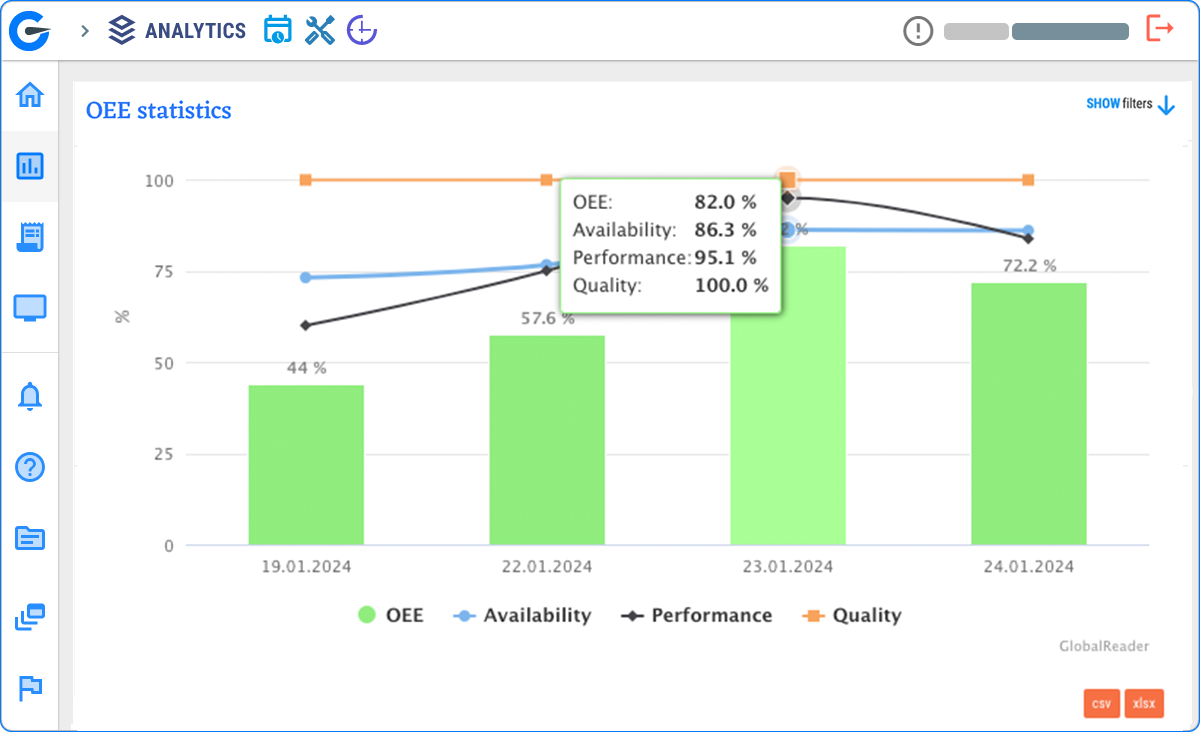
GlobalReader Analytics Dashboard OEE statistics overview
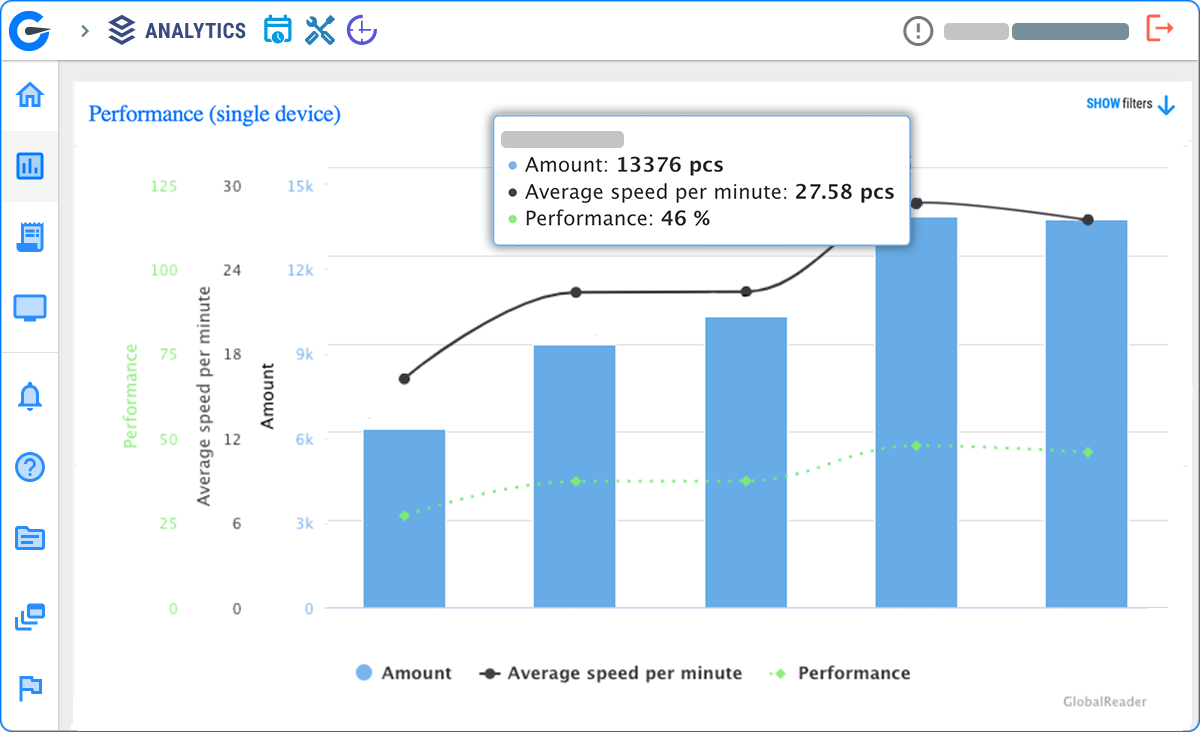
GlobalReader’s Analytics feature view - performance (single device)
Cennik
From €125 per machine per month with hardware, software, support and installation guidance included. Billing is monthly with no lock-in, and paying yearly upfront takes 5% off. There is no extra software fee and no machine minimum, and feature modules and add-ons are priced per machine so you only pay for what you use. Full details on the pricing page.
Implementation
Hardware installation is €137 (one-off charge per device) and setup takes about 90 minutes. Most factories see live data the same day the Scout Box arrives. There is no big IT project: the Scoutbox attaches to any machine regardless of brand, age or protocol, and many customers install it themselves with the GlobalReader’s onboarding team guiding remotely. Sensors and cabling are part of the service. GlobalReader’s technician brings a full kit and installs whatever each machine needs (photo-eye, induction, relay, scrap, temperature/humidity, vibration) with nothing billed separately. If you need extra sensors down the line, GlobalReader typically just ships them and your own team fits them from a photo.
Because the Scoutbox is part of the subscription rather than something you buy, hardware upkeep is on GlobalReader. If a device ever fails, a replacement is shipped at no cost.
At Balti Spoon, the plant's own technical department fitted the sensors in waves of about five machines, growing to 29 connected lines. At JABS Sokółka, the team wired up a fleet where half the machines are over 20 years old: “We installed everything ourselves. It's quite easy if you have somebody who knows how the machine works.”
GlobalReader’s OEE features that matter for a 10 to 20 machine factory
Everything in Monitoring Core comes in the monthly per machine price: Scoutbox hardware, the live OEE dashboard, downtime tracking, analytics, production statistics, shift details, instant notifications and support.
Real-time OEE and downtime monitoring: The Analytics module shows live availability, performance and quality per machine with automatic stop detection, so nobody reconstructs the night shift from paper and output swings stop being a mystery. At JABS Sokolka, the data even caught a paint line belt that had slowed from 3.8 to 3.5 metres per minute: “First we thought something was wrong with GlobalReader. But GlobalReader was okay. The belt speed had dropped, costing us 50 to 100 traverses a day!”
Reporting you can shape and export freely: A full report builder with saved views, a loss-waterfall breakdown, scheduled email reports, and one-click export to CSV, Excel, PDF and PNG.
One sensor, nine standard measurements: As standard, the Scoutbox measures pieces, meters, weight, work time, temperature, humidity, electricity, cost, noise/vibration and volume (m³/l). The production counts feed your OEE directly, the rest means the same device tracking your Availability, Performance and Quality can also show the energy spent producing versus idling and watch the environment around the process. At JABS Sokółka, amperage per machine feeds their efficiency picture: producing more in the same time while saving on electricity, with ventilation no longer running for nothing. At Tere Põlva, 21 temperature and humidity sensors, including specialised minus 50°C storage sensors, made the plant BRC audit ready in 14 days.
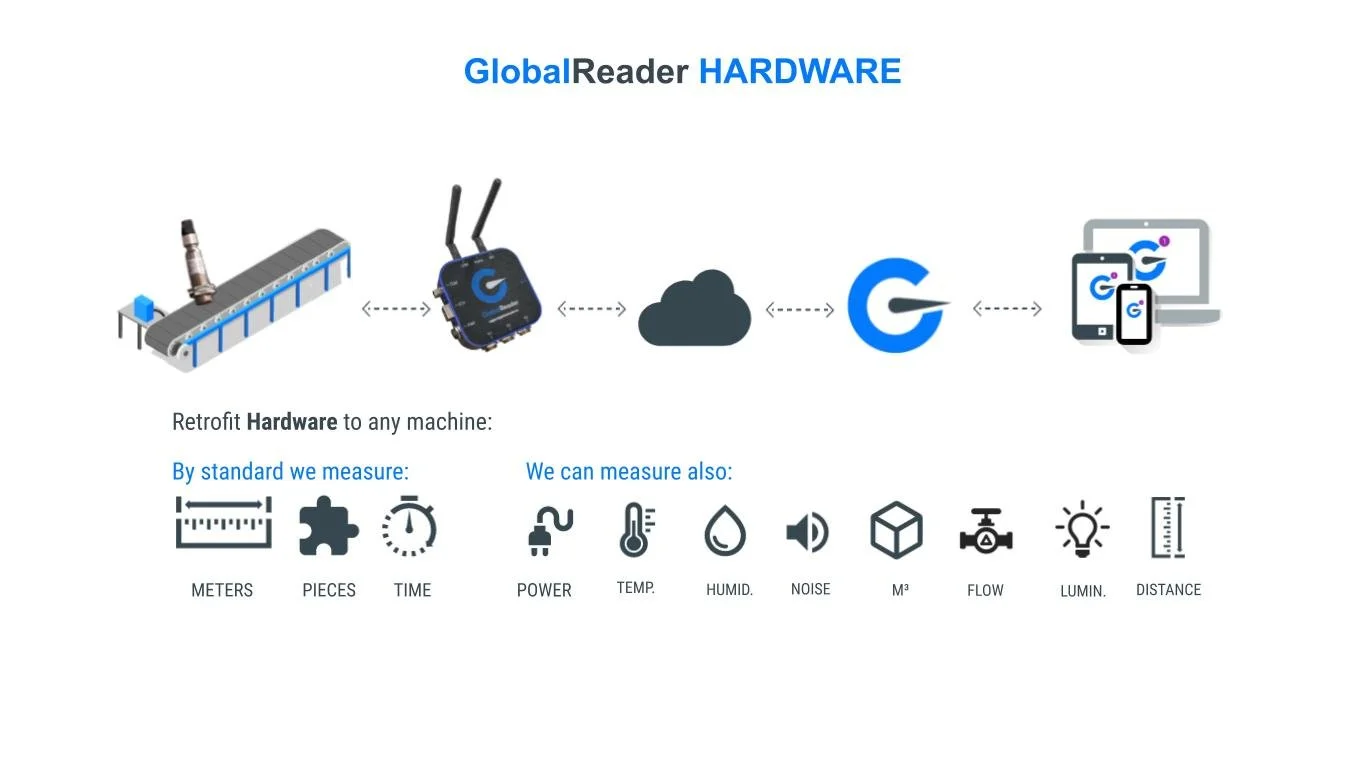
GlobalReader hardware explained - By stdard we measure meters, pcs, time. Info sent via scoutbox to our cloud based OEE software
Scrap and quality tracking: GlobalReader captures scrap two ways: a dedicated scrap sensor the technician can fit on the line, or operator-entered scrap at the workstation. The Quality leg of OEE is based on real reject counts, not estimates. Those counts flow back to your ERP for materials accounting, so the good-versus-scrap split is reconciled where your costing lives.
Production statistics and shift details: Output per machine, per product and per shift, so the night shift and the morning shift finally compare like for like. When Monday produces less than Tuesday, you can see why instead of guessing.
Operator module, designed to help the shop floor: A fast and fair way for operators to record what really happened on a shift, in their own language, with comments that flow straight to the people who can act. Quality Manager Ingrid L. at Balti Spoon: “What I like most is that you can leave comments everywhere. I can't get to every operator every day to ask how things are going, but through those comments, I get so much valuable information.”
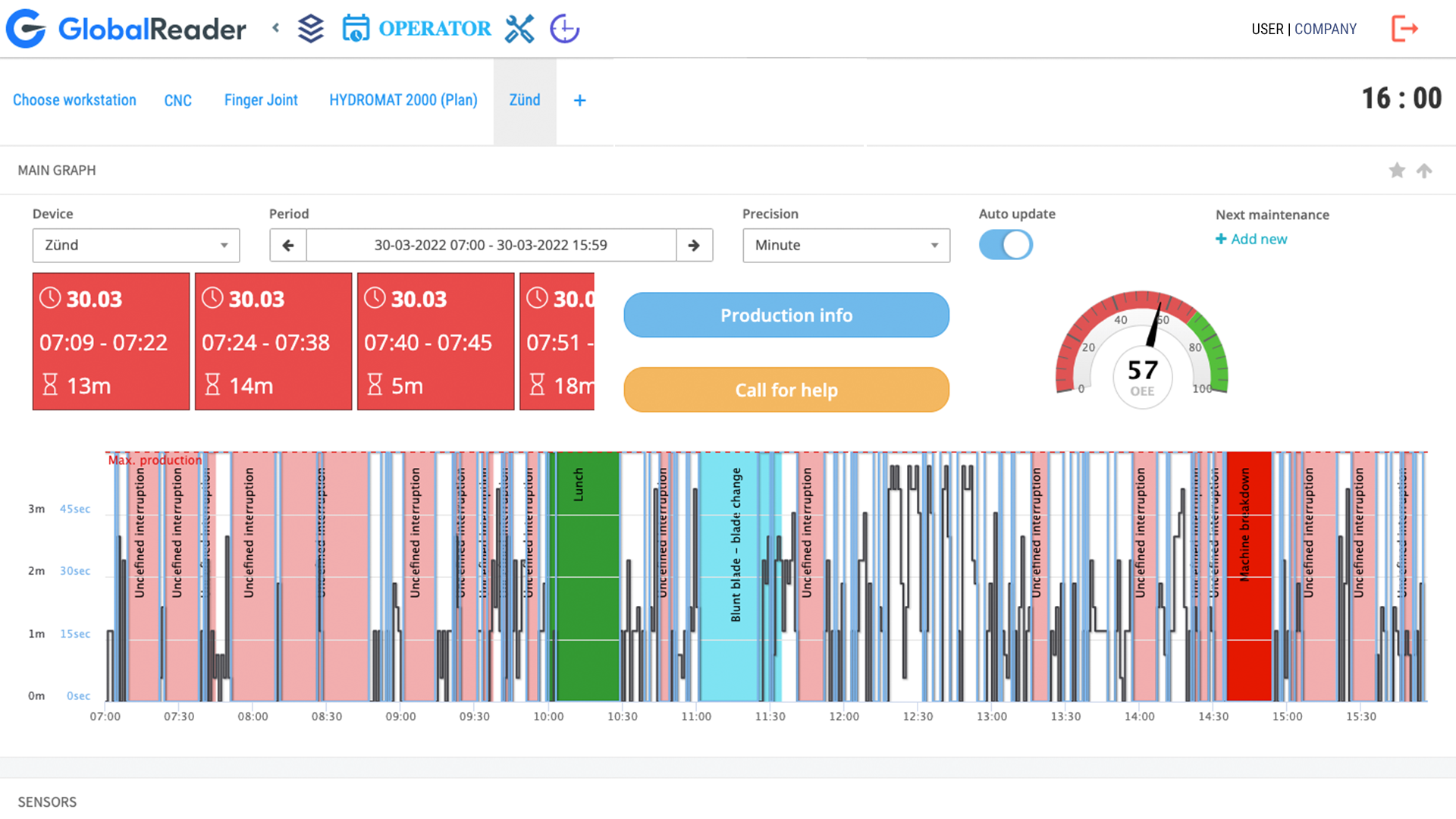
GlobalReader Operator feature dashboard view
Barcode and QR scanning on the floor: Operators clock in, start a product or order, and log downtime reasons with a single scan from a printed, multilingual, icon-based reason sheet. The codes attach to the job sheets factories already print, so nothing in the operator's workflow has to be rebuilt. GlobalReader adapts to the floor, not the other way round.
Maintenance on runtime, checklists and quality checks: Preventative maintenance scheduled on actual running hours rather than the calendar, plus shift-start checklists and recurring quality prompts. Balti Spoon: “The operator checklist and reporting have helped us significantly reduce breakdown points.”
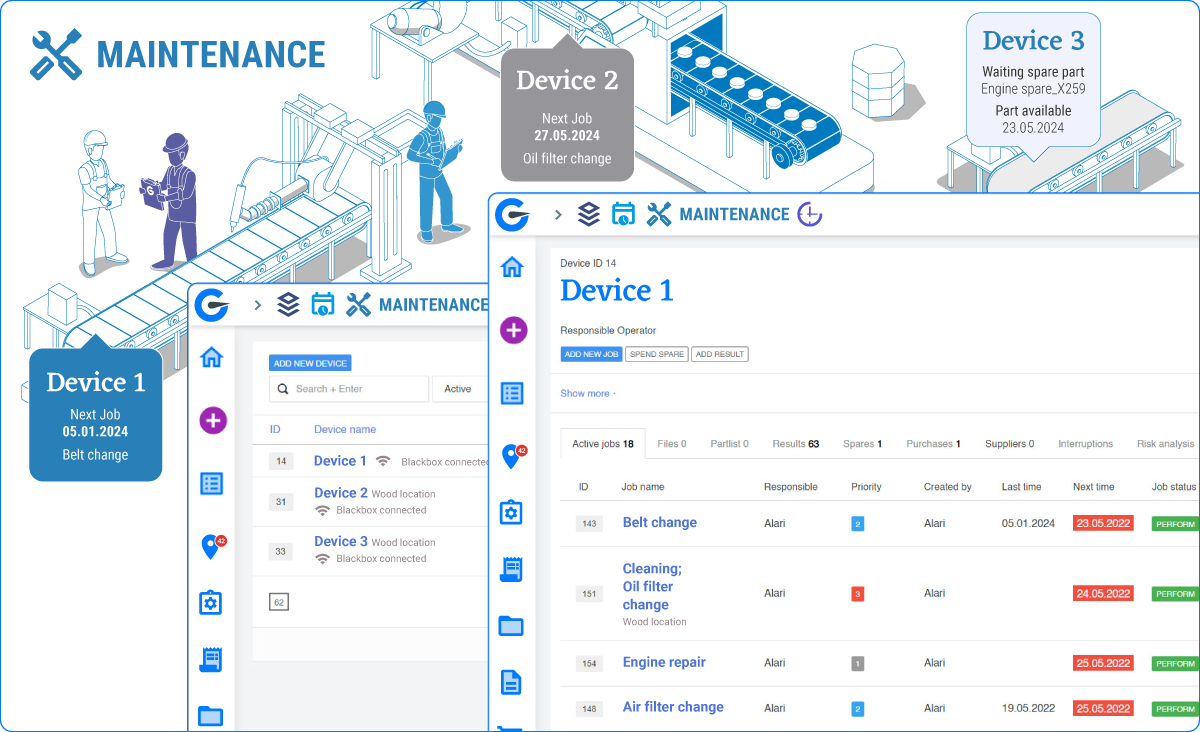
GlobalReader Maintenance Feature different dashboard views
ERP integrations (Smart Factory add-on): Bi-directional sync with Microsoft AX, NAV, SAP, Monitor, Noom and Directo, among others, so cycles, downtime reasons and quantities flow into the system you already use, with no double entry. Operator and user accounts sync automatically from your ERP or MES as well, so there is no separate user admin to maintain. And you don't have to wait for a full integration to start: when an ERP connection isn't live yet, you can print a QR code carrying the order details ( batch, product, quantity) straight from your own system, and the operator scans it to create the order in GlobalReader automatically. Here's what that looks like in practice: I&T Metall moved from paper, Excel and guesswork to true product cost by piping shop floor data into Noom ERP, and at Avoti, “the more precise the data we get, the more precise the price we can set for our products.” Full list on the ERP integrations page.
Capacity and utilization insights: See how hard each machine is really working, so you know whether to invest or optimise. At JABS Sokołka the bottleneck machine sat at ~95% utilization: "We can now go to our boss and say: we already have 95% usage on this machine. If we want to produce more, we need to invest in an extra machine."
Production planning against real capacity (Planner module): Drag-and-drop scheduling built on what machines actually do, not Excel guesses. Give it an order and it plans the job end to end, tells you when it'll finish, and replans when a shift drops out. Planner proposes, your planner approves (you set how much to automate). Maintenance windows are designed to sit inside the schedule, so downtime is planned for.
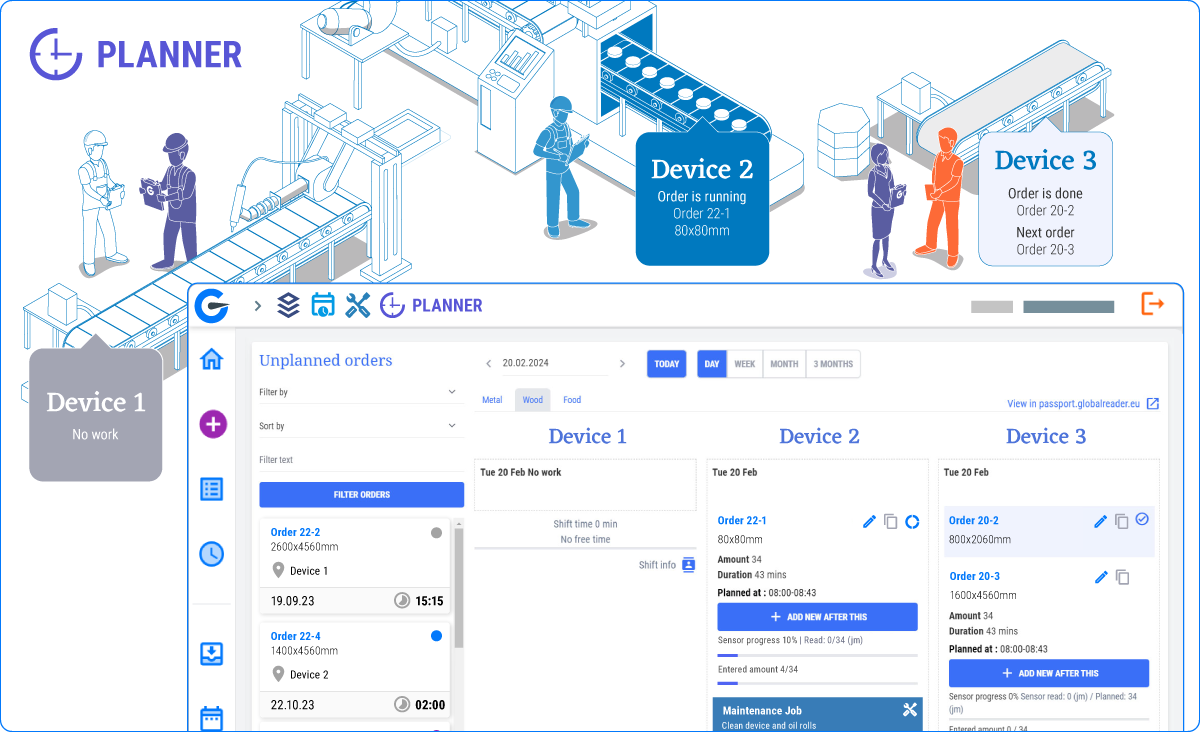
GlobalReader’s Planner Feature: Drag-and-drop scheduling built on what machines actually do, not Excel guesses.
Instant notifications, with Call for Help as an add-on: Machine status alerts reach your phone the moment a line stops, included in the core price. The optional Call for Help add-on goes further: one tap replaces walkie-talkies and hunting for the foreman.
Live screens on the floor (Smart LiveView add-on): Real time output, pace and stop reasons on shop floor TVs, so the whole team sees the same numbers all shift.
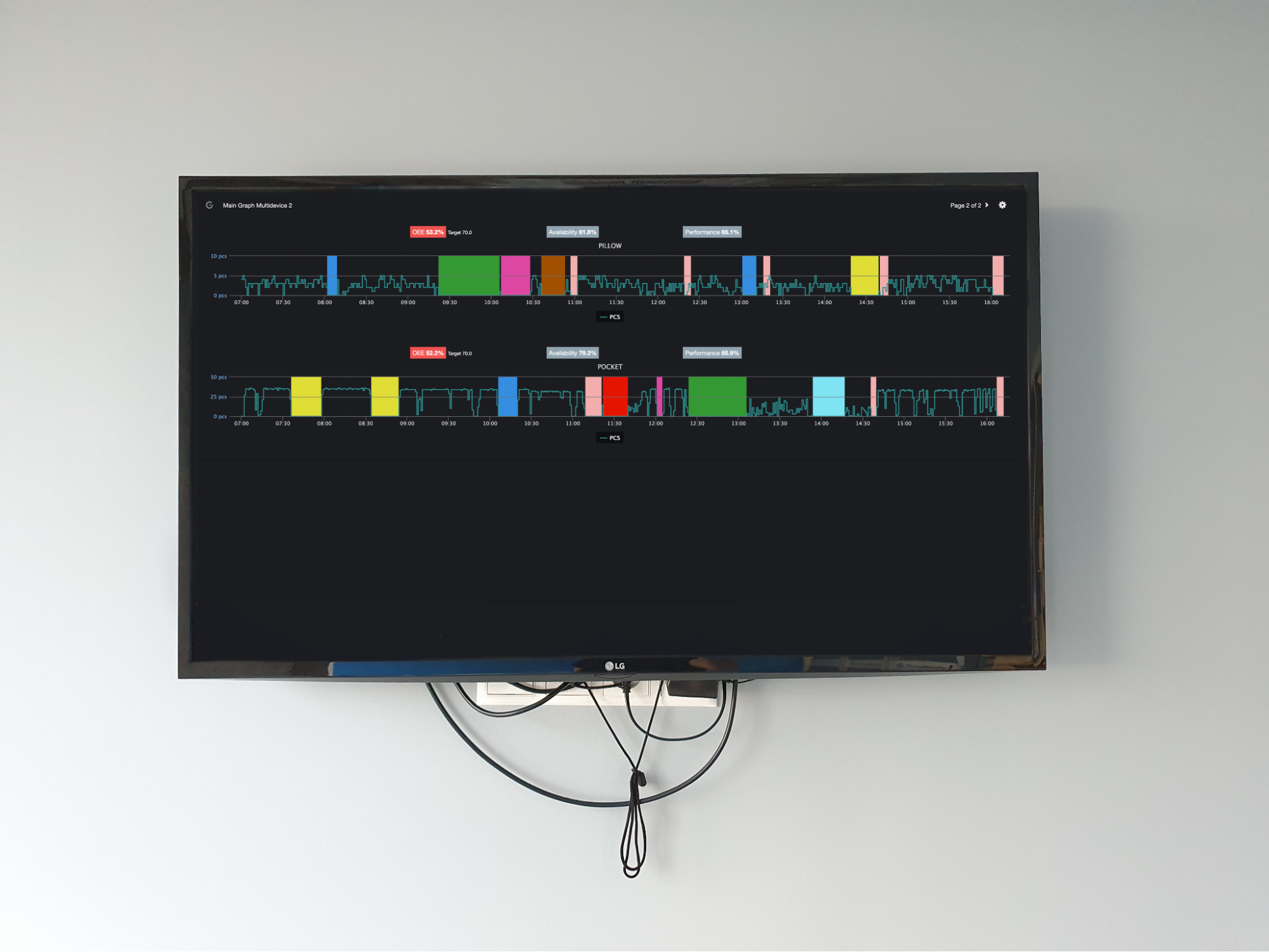
GlobalReader Smart Live-View for quick glance over shop floor production lines.
Strengths
Hardware bundled into the subscription, nothing to buy, rent or ship separately.
Live data the same day, with a roughly 90 minute setup and no IT project.
Lowest cost of entry among the full featured platforms here: from €125 per machine per month, billed monthly with no lock-in, no machine minimum, no site fee and no annual commitment. Every other paid tool on this list requires at least one of those.
Works on any machine, new or 70 years old. GlobalReader reads modern, connected machines directly over open standards (OPC UA, MQTT) and retrofits sensors on older equipment that won't give up its data (non-CNC, hydraulic, decades-old presses, etc.). Whether your machine talks or not, you get the data one way or another, so you monitor 100% of a mixed fleet instead of the third that happens to be connected.
Real tangible customer outcomes across 200+ European factories: +27.4% OEE and +22.8% availability on average against each factory's own starting baseline.
GlobalReader can run fully on-premise, on your own server/infrastructure, working without an internet connection.
Hardware replaced for free. If a Scoutbox fails, GlobalReader sends a new one at its own cost.
Every sensor and cable included: the technician arrives with a full kit (photo-eye, induction, relay, scrap, temperature/humidity, vibration and more) and fits whatever your machines need at no extra charge. Later add-ons are usually just shipped for your own team to fit.
Keeps recording even when the network drops. Every Scoutbox ships tri-connected (Wi-Fi, LTE/SIM and LAN) and switches to mobile data automatically if Wi-Fi fails. A dropped connection means its readings are buffered but never lost, just delayed until they sync.
Dedicated local support in five languages: English, Estonian, Latvian, Finnish and Polish, with an allocated account manager who knows manufacturing.
GlobalReader platform + Operator app available in 8 languages: English, Estonian, Finnish, Latvian, Russian, German, Polish and Romanian
Limitations
Not the deepest AI platform on this list. If built in machine learning is your headline requirement, weigh that honestly.
Built for discrete manufacturing with 10 or more machines across multiple shifts. If you run a continuous process line, or a small single-shift shop where you can see every machine from your desk, simpler tools may serve you better.
Who is GlobalReader the best fit for?
GlobalReader is the best OEE software for you if you run roughly 10-20 machines (or are growing into that range) across two or more shifts, your fleet mixes old and new equipment, you make discrete products in wood, metal, food or similar, and you want a software that pays for itself in one day.
If that sounds like your factory, here is what factories like yours have already achieved with GlobalReader: JABS Sokółka lifted daily output from 280 to 340 windows, 12,000 more windows a year with no new machines and no new hires. Balti Spoon grew output on connected lines around 20% year on year and exposed up to 8 hours a week of hidden lost time between two seemingly identical lines. Across the GlobalReader customer base, that pattern averages out to €39,200 of recovered capacity per machine per year.
2. Evocon: best for small plants that want a guided free trial
Evocon is a production monitoring platform that was recently acquired by ERP vendor Syspro. It monitors production in factories across 60+ countries, with references including Saint-Gobain and Valio. Generally speaking, Evocon is an easy way to put OEE software on a real machine quickly.
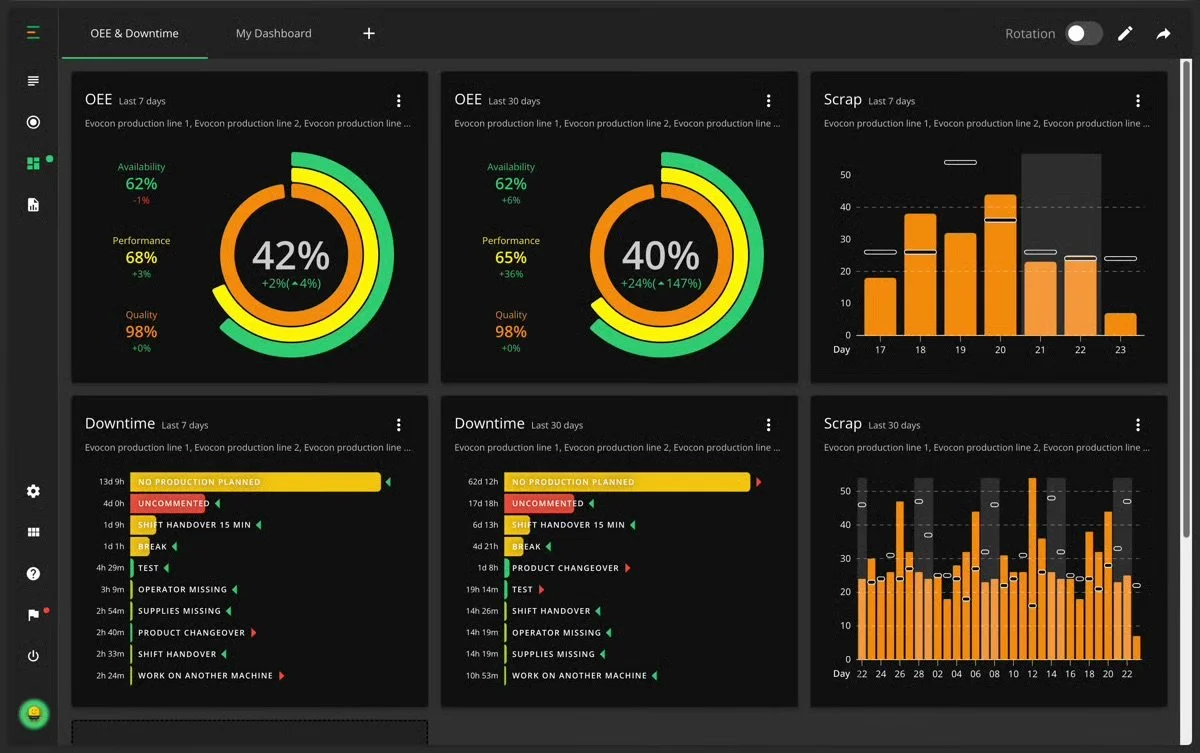
Evocon OEE dashboard - Image credit: G2.com
Cennik
Evocon charges €189 to €319 per machine per month, with a one year agreement as the minimum commitment. There is no month to month option, and a three year agreement brings the rate down. Add €15-€19 per month per rented IIoT device. Sensors, cables and displays are purchased separately, and integrations are a paid add-on.
Implementation
The rented IIoT device ships to you and connects to machine signals without a technician; reviewers describe an easy installation and onboarding guided by Evocon's team, with one reviewer “up and running in 3 weeks on our first machine” including shipping. Evocon also offers a guided free trial to see how the software works.
Evocon’s OEE features that matter for a 10 to 20 machine factory
Real-time OEE dashboard: Availability, performance and quality per machine, with a clean shift view that operators can learn fast.
Downtime tracking with reason codes and comments: Operators tag stops as they happen, so losses get named instead of estimated.
Reports and trend analytics: Loss analysis over time, plus a gated benchmark report drawing on 3,500+ machines for comparing your OEE against industry ranges.
Plug and play IIoT device: The rented sensor unit works across most machine types without controller access.
API and enterprise security: API access on Pro and Enterprise plans, with SSO and SCIM for larger organisations, and a developing Syspro ERP integration story post acquisition.
Strengths
Operator friendly interface: Easy to use, operators typically learn to use it in a couple of minutes.
Installation: Simple, technician free installation and fast time to first data.
Attentive support: Customer service is praised by independent online reviews and includes regular check in calls.
Limitations
Integration effort: According to independent online reviews, Evocon’s integration with ERP systems requires time and is not so simple. Another recurring complaint across multiple reviews is that the integrations with other systems (ERP, MES) are not deep enough.
Gaps in job and quality tracking: Reviewers point out that there is no good way to follow a single job's progress through the production line, and that analytical quality entries and reporting are missing from the platform.
Rising cost: Since the Syspro acquisition, pricing has moved upmarket with a one year agreement as the minimum, the IIoT hardware is rented rather than owned, and integrations are priced case by case rather than published upfront.
Who is Evocon the best fit for?
A small plant that wants to trial OEE monitoring on one or two machines with a guided, low risk start, values a polished operator experience over deep integrations, or already runs Syspro ERP and wants to stay inside that ecosystem. If you run 10-20 machines, want the hardware owned inside the subscription rather than rented, and need ERP data flowing without case by case integration pricing, that is the gap GlobalReader was built to fill, at roughly 40-60% lower all in cost.
3. Factbird: best for premium and compliance heavy plants
Factbird is a manufacturing intelligence platform with enterprise references including Novo Nordisk and Danfoss. Originally an OEE tool, it has grown into a broad suite covering quality, compliance and paperless execution, which shows in both its capabilities and its price point.
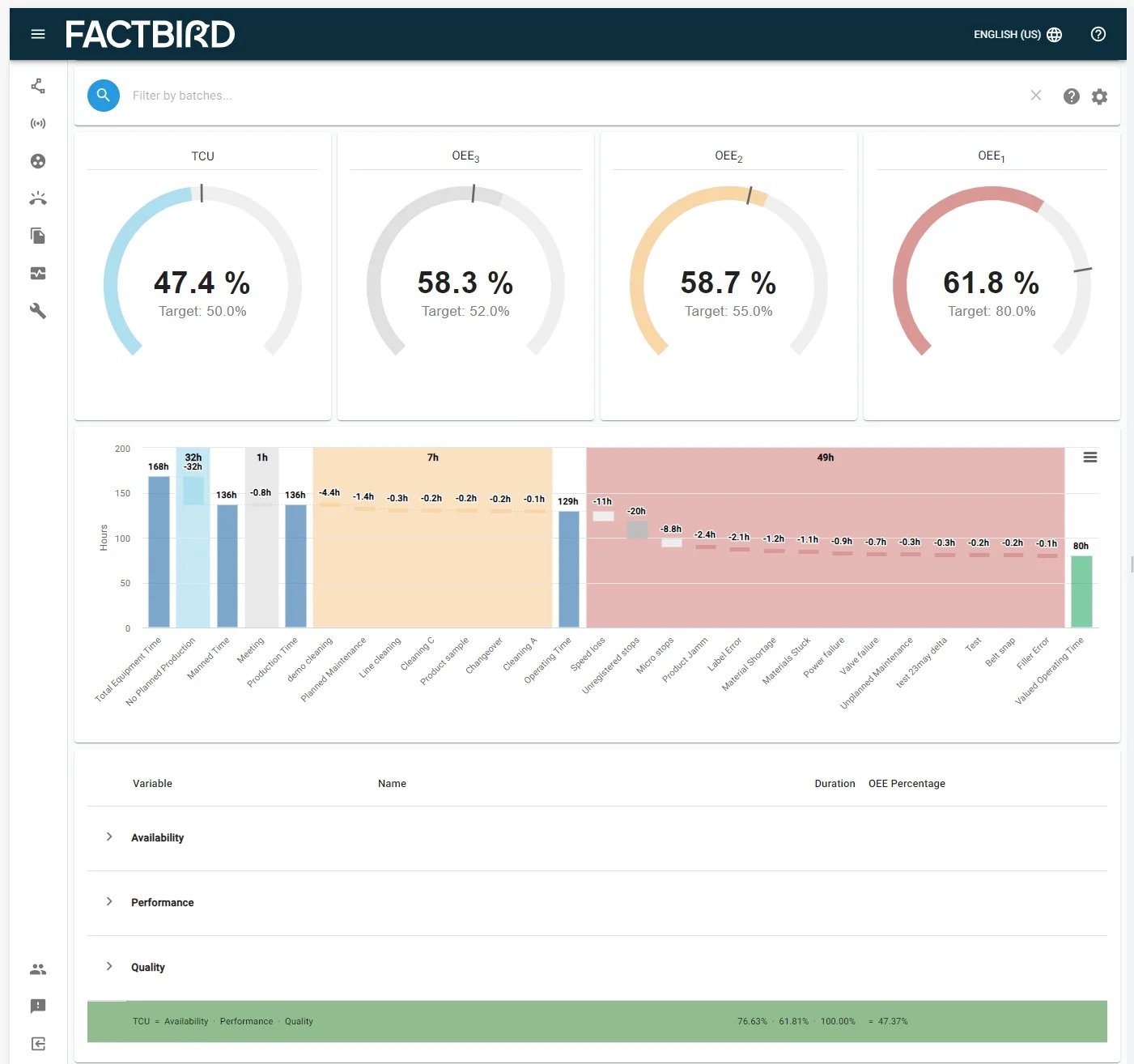
Factbird OEE dashbord - Image credit: G2.com
Cennik
Factbird’s headline rate is about €350 per line per month for Production Insights, but the real entry cost is higher: a required platform fee of roughly €875 per site per month, plus a 2% support fee. The €350 per line covers one measurement point. Counting the same line in a second place, adding sensors, or adding their camera all cost extra, and connecting Factbird to your ERP or pulling data out through their API are paid add-ons too.
Implementation
The Factbird DUO edge device comes with each line and installs plug and play. Online reviewers report being up and running within a few hours per production line. A 30-day free trial is available. The system is cloud dependent, so an internet connection is required to access your data on Factbird.
Factbird’s OEE features that matter for a 10 to 20 machine factory
Real-time OEE per production line: Live availability, performance and quality via the DUO edge device, with automatic stop registration and downtime cause tracking.
Quality and compliance modules: Launched in May 2026, adding digitised quality checks and audit ready documentation, a genuine criteria for pharma and food plants under regulatory pressure.
Camera based verification (Factbird VIEW): An optional camera add-on that pairs video with stop data, useful for diagnosing recurring stops nobody can explain.
Reports and BI connectivity: A dedicated reports module plus exports toward Power BI and Tableau, with a GraphQL API and SDK for teams that build their own analysis.
Paperless shop floor execution: Digital work instructions and batch records alongside the monitoring layer.
Strengths
Intuitive interface: Ease of use is the most praised theme across online reviews, with clear dashboards operators and managers both read comfortably.
Fast plug and play installation: Reviewers consistently report first lines live within hours.
Responsive support: Factbird’s customer service and support responsiveness gets recurring praise by its users.
Real results: One online reviewer credits Factbird with improving packing capacity by around 20-22%.
Limitations
Learning curve and terminology: According to independent online reviews, terms inside the product can be unclear and tutorials are thin, with several reviewers describing a difficult learning curve despite the polished interface.
No mobile app: Reviewers note the absence of a native mobile app, and small workflow frictions like needing a screenshot to reuse an OEE graph in a presentation.
Limited customisation: Dashboards and reports offer fewer configuration options than reviewers would like.
Premium total cost: The per line price plus the required site fee and 2% support fee adds up quickly, and reviewers themselves observe it is "not the cheapest supplier out there." Hardware beyond the included input is extra.
Cloud dependency: No internet connection means no access to your information.
Who is Factbird the best fit for?
A larger Nordic or DACH plant, especially in pharma, food or other audit heavy industries, that thinks in production lines rather than individual machines and has the budget for a premium, expanding suite. If you run a 10-20 machine factory, count machines rather than lines, and want the hardware and support inside one per machine price with no site fee, GlobalReader might be a better option, at roughly a third of the total cost.
4. Fabrico: best for fixing maintenance before anything else
Fabrico is a maintenance management platform (CMMS) that has grown into production monitoring and OEE, with customer references such as Latecoere and VIDEOTON. Its OEE product is young, but the maintenance side is well liked and the free plan makes it a low risk starting point.
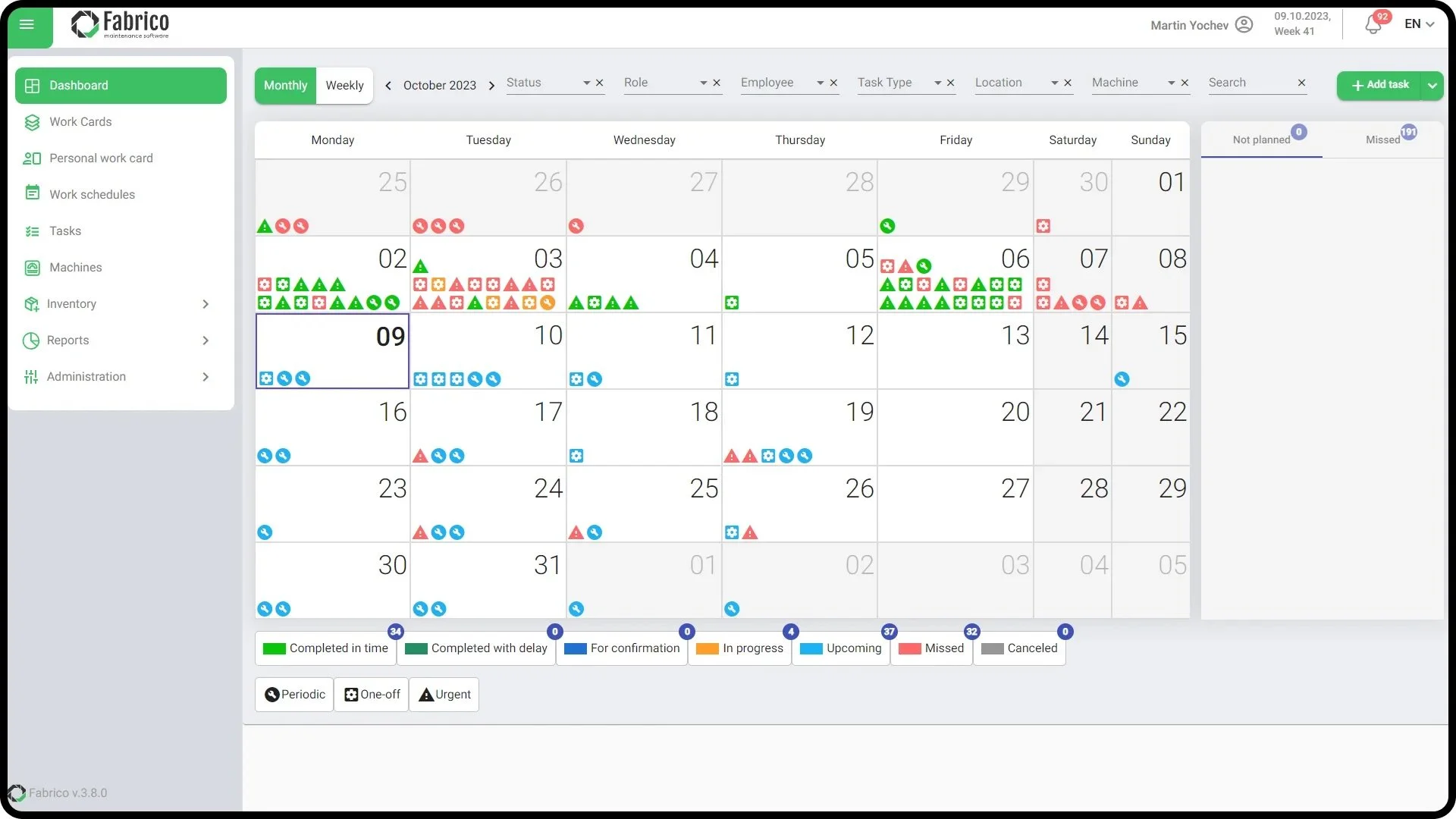
Fabrico OEE dashboard- Image credit: G2.com
Cennik
Quote based, no prices are publicly published. There are four plans (Free, Light, Full and Enterprise) with a choice of per user or per plant pricing, and online reviewers specifically praise the per factory model as good value. The free plan covers one user, up to ten machines and core features with self onboarding.
Implementation
Fabrico advertises a pilot site operational in days, and an online reviewer confirms this saying that they "managed to integrate the solution in a week" with users onboarded fast. Machine connectivity is modular rather than bundled: existing PLCs where machines have connectivity, IoT devices with external sensors where they don't, or camera based computer vision for machines sensors cannot read. Reviewers do note the initial data load takes real time (see limitations below).
Fabrico’s OEE features that matter for a 10 to 20 machine factory
Machine connectivity three ways: PLC integration, IoT devices with external sensors, or camera plus AI for machines that can't be sensored, so older equipment isn't excluded.
Availability and downtime tracking: Machine status and downtime reasons feed OEE calculations, with mandatory work order closures tying maintenance events to downtime records.
Computer vision layer: Cameras detect stops sensors miss, validate micro stops and link visual events to machine records, the most distinctive capability in their stack.
Preventive maintenance engine: Automated scheduling, work orders, QR code scanning at the machine and spare parts management, the platform's original core.
Production planning and multi site views: Planning against machine data plus standardised templates across plants for groups.
AI add-ons: An inefficiency analysis module and AI assistant layered on top of collected data.
Strengths
Mobile first workflows: The app with QR code scanning at the machine is the most praised feature, letting technicians pull up history and log work on the spot.
Preventive maintenance that runs itself: Reviewers describe automated scheduling and alerts as "like having a personal assistant."
Value for money: Per factory rather than per user pricing is repeatedly called out as the reason teams chose Fabrico over better known alternatives, alongside responsive local support open to customisation requests.
Fast, painless rollout: Integration within a week with quick user adoption, per reviewer accounts.
Limitations
CMMS first, OEE second: The production monitoring product is less than two years old, and reviews overwhelmingly discuss maintenance workflows rather than OEE results. If production monitoring is the core job, the depth is not proven yet.
Slow initial setup of data: According to independent reviews, loading machine and asset information into the system at the start is time consuming.
Reporting still maturing: Reviewers note that some special reports and filters need improvement.
Process control gaps: Online reviews point out that work orders can still be edited even after they have been completed and closed, which weakens them as audit evidence for plants that need tamper proof maintenance records.
Who is Fabrico the best fit for?
A factory whose burning problem is maintenance: reactive repairs eating the week, no preventive schedule, paper work orders. The free plan makes trying that use case genuinely risk free. If your burning problem is production: knowing what your machines actually did last shift and proving it with data, then purpose built monitoring with included industrial hardware is the sturdier foundation. GlobalReader also schedules maintenance on actual runtime rather than the calendar, so the maintenance angle is covered as you grow.
5. Symestic: best for SMEs that want a full cloud MES
Symestic is an established manufacturing software company offering a cloud native MES (built on Microsoft Azure), with references including Brita, Eberspächer and Flowserve.
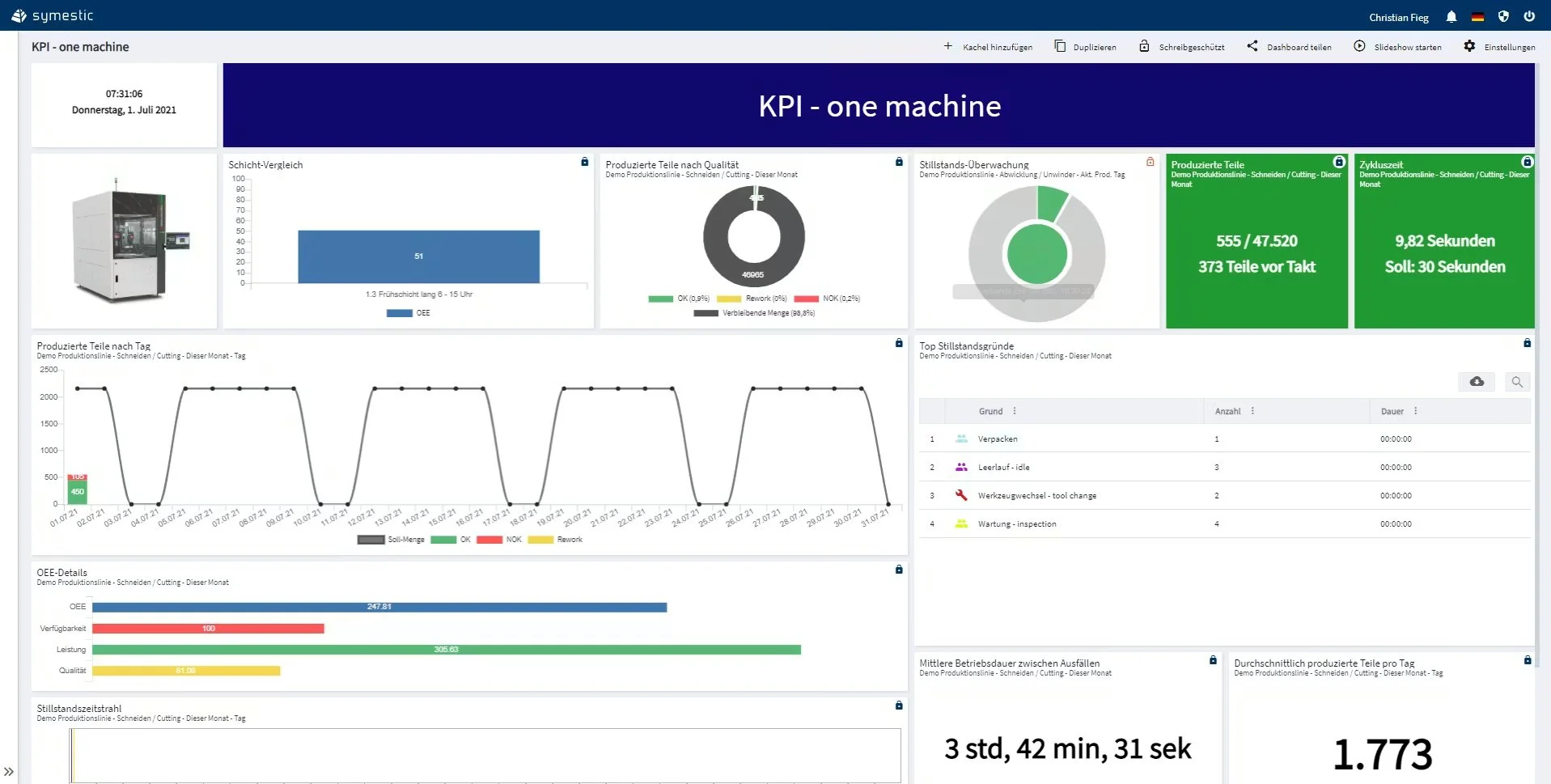
Smestic OEE dashboard - Image credit: softwareadvice.com.au
Cennik
The Professional plan runs about €850 to €935 per month (a €500 platform component plus a €350 machines component, billed annually), with volume pricing that lowers the per segment cost as you add machines. If your machines lack modern connectivity, IoT gateways are a one time purchase of €350 to €450 per device, with one DI gateway covering up to 16 machines. Enterprise is a flat rate per plant, by quote.
Implementation
Symestic claims factories can be productive in just a few hours, and machine connection is often software only: an OPC-UA or Modbus client talks to newer machines without any hardware at all, with the gateways covering older equipment. A free trial covers one machine and one IoT edge device.
Symestic’s OEE features that matter for a 10 to 20 machine factory
OEE and machine data collection: Automatic capture of availability, performance and quality from the machine layer, via software clients or gateways.
Full MES scope around it: Order management, traceability and quality management in the same system, which is the actual reason to choose an MES over a monitoring tool.
ERP integrations included: REST API plus documented integrations with Dynamics 365, SAP S/4HANA and proALPHA, included in the Professional plan rather than sold as add-ons.
All modules in one price: No feature tier ladder; the published plan includes the suite.
Eight languages supported: The product is available in German, English, Polish, Dutch, Italian, Czech, Hungarian and Spanish.
Strengths
No hardware needed for modern machines: Software based connection via OPC-UA or Modbus keeps entry cost down when your fleet is newer.
Integrations included: ERP connectivity comes with the plan.
Enterprise grade references: Big brands like Brita and Flowserve suggest the platform holds up at serious scale.
Price transparency: The of the few vendors on this list that you can budget for without talking to sales.
Limitations
MES scope overshoots a monitoring need: If the job this year is seeing and recovering lost machine hours, orders and traceability modules are the weight you carry, not the value you use.
Cost stacks up at SME fleet sizes: Around €935 per month is a fair price for a full MES, plus €350 to €450 one time per gateway if older machines need hardware to connect. But if what you mainly need is OEE monitoring, most of that money goes toward order management and traceability modules you may never open.
Who is Symestic the best fit for?
An SME that has genuinely outgrown monitoring: you already measure OEE, and what you're missing is order tracking, traceability and quality records in one system, ideally with a newer machine fleet that connects without hardware. If that's you, Symestic is one of the more honest ways to buy an MES. If what you need this year is to see and recover lost machine hours, focused OEE monitoring with included hardware gets you there for a fraction of the cost, and you can still grow into MES scope later.
6. Vorne XL: best for plants that want to own the hardware, not subscribe to software
Vorne is the veteran of this list: the company has been measuring production for over 50 years, with more than 30,000 installations. The XL is a hardware appliance you buy once and own outright, with a bright scoreboard above the line and no subscription.
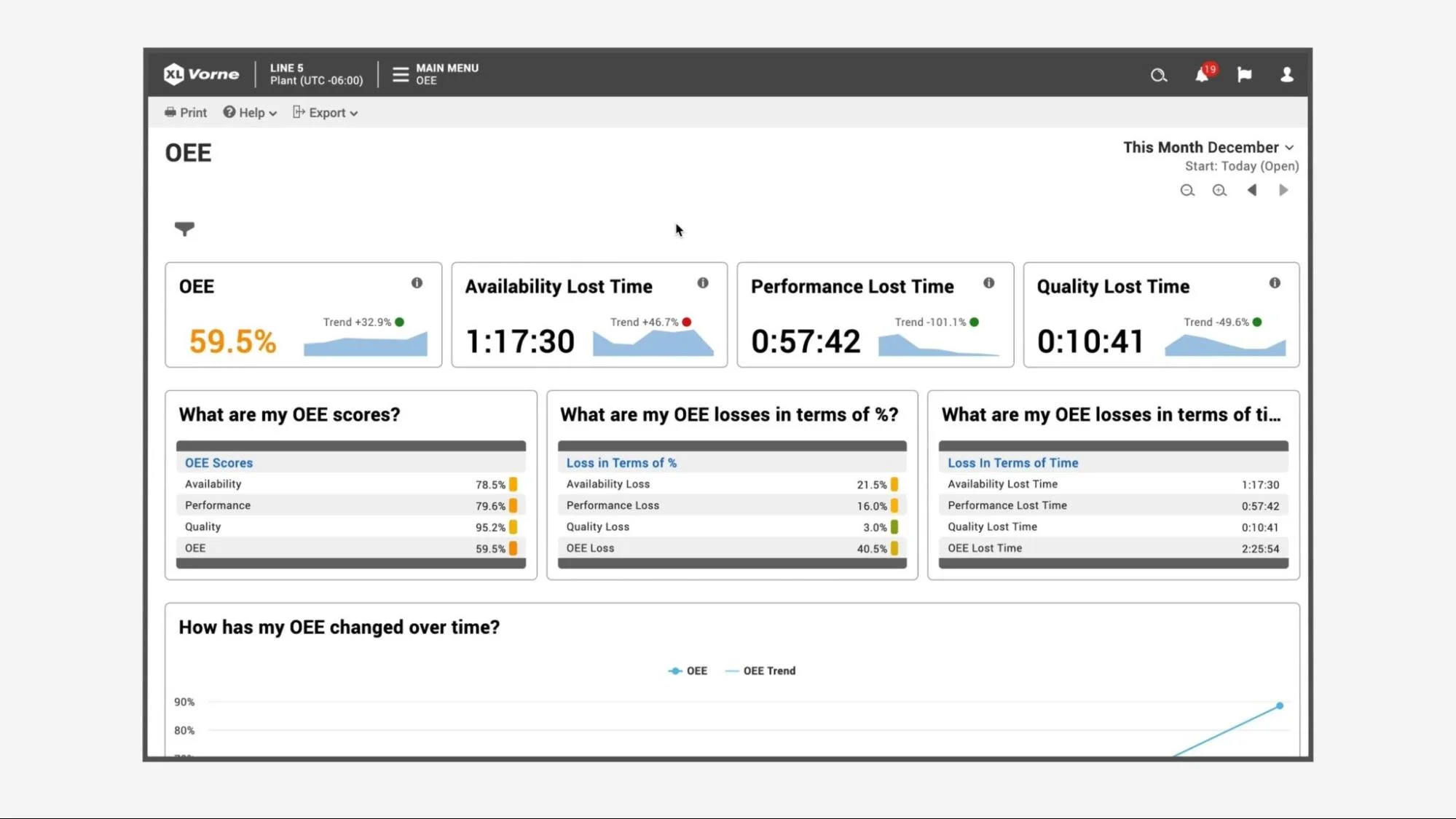
Vorne XL OEE dashboard - Image credit: softwareadvice.ie
Cennik
One time purchase per machine, no recurring fees: the current product lineup runs from €3,930 to €4,370. Barcode kits for tagging parts and reasons cost extra (about €260 to €875), and there is a free 90 day trial where you pay nothing unless you keep the unit.
Implementation
Self-install in about 8 hours (as per Vorne’s website), and reviewers back the speed up with some claiming that their factory was online in two days. The unit connects to one or two simple sensor inputs (photo eye, relay, proximity sensor or encoder) with no PLC changes, and all processing happens on the device itself, so it works even without a cloud connection.
Vorne XL’s OEE features that matter for a 10 to 20 machine factory
Real-time scoreboard above the line: Live OEE, the pace needed to meet demand (takt) and where the count should be right now (target), visible to the whole floor. Vorne pioneered this approach and it’s the main reason to buy a hardware unit instead of software: everyone on the floor sees the numbers without opening anything.
On-device OEE calculation: Availability, performance and quality computed on the unit from sensor inputs, with no cloud dependency.
Down, changeover and reason tracking: Stop reasons and part tagging, with optional barcode kits for faster coding.
XL Enterprise cloud (free): Basic centralised reports and alerts across units, included at no charge.
XL API: For teams that want to pull data into their own systems, though integration is do it yourself.
Strengths
Support that reviewers rave about: Support quality is the most consistently praised aspect in independent reviews, with several reviewers rating it the best technical support they have encountered from any vendor.
Genuine long term value: With no recurring fees, reviewers call it "unbeatable long term value for money" over multi year horizons.
Documented OEE results: Some reviewers report an increase in OEE from 40% to 70% over years and a company wide OEE gain of 14%.
Simple and self contained: Plug and play hardware that non technical teams get running in days.
Limitations
Connectivity quirks: Independent reviews mention occasional difficulty getting the devices talking to servers and PLCs during setup.
Integration is manual work: Connecting to legacy systems or an ERP may require custom development. There is no ready-made bi-directional ERP flow.
Complex events are hard to capture: Reviewers specifically flag the inability to record downtime within a changeover and a lack of options for rotating shift patterns.
Appliance per machine limits the big picture: Cloud analytics, multi-site views and fleet wide trend analysis are lighter than subscription platforms, and reviewers note scaling across a large corporation can be tricky.
Who is Vorne XL the best fit for?
A plant that strongly prefers a one time capital purchase over subscriptions, where a visible scoreboard above each line covers most of the need, and where simple stop detection fits the process. The 90-day free trial makes it genuinely risk free to find out. If you want continuous cloud analytics, ERP data flowing both ways and improvement measured in euros across the whole fleet over time, a subscription model serves you better, and there is no €4,000 per machine cheque on day one: at €125 per month, three years of GlobalReader on a machine costs about the same as one XL unit, with the analytics, integrations and support evolving underneath you the whole time.
7. FourJaw: best for UK machine shops
FourJaw is a machine monitoring platform from the UK, built for machine shops that want to know how much their machines actually run. A small sensor called MachineLink clips onto any machine's power supply, new or decades old, and reads its activity from the electrical current, so the cloud dashboard shows live running, idle and stopped time without touching the machine's controls. On the Pro tier, an operator tablet at the machine
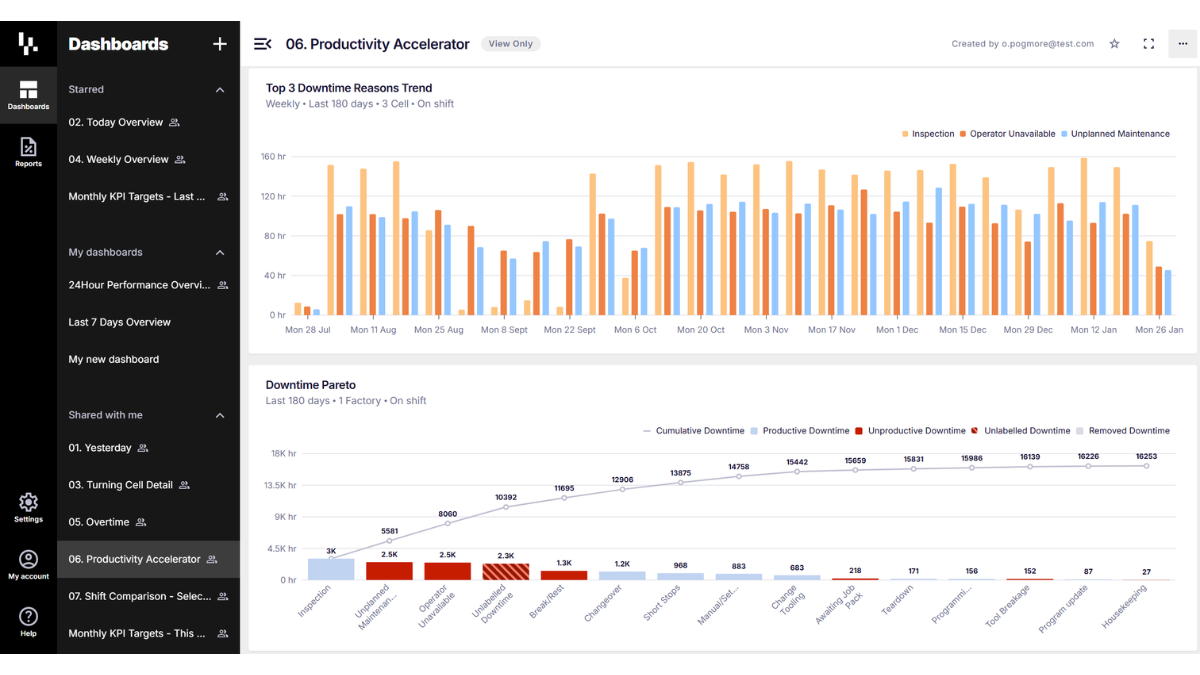
FourJaw OEE dashboard - Image credit: capterra.com
Cennik
Two tiers per machine per month: Standard at about €105 (£90, or £72 billed annually) plus a one time MachineLink sensor at about €235 per machine, and Pro at about €210 (£180, or £144 annually) with the sensor and an operator tablet included. There is a five machine minimum, volume discounts from ten machines, and the current headline offer is a Pro bundle from about €22,300 per year (£19,000) covering the first ten machines with a day of on site onboarding.
Implementation
The MachineLink is a non intrusive current sensor, so it clips in without touching the machine's controls and teams install it themselves. Reviewers report connecting seven machines in a couple of hours and going from first conversation to a running system within four weeks. A 4G option covers shops without reliable floor Wi-Fi.
FourJaw’s OEE features that matter for a 10 to 20 machine factory
OEE and machine utilisation monitoring: Live running, idle and stopped status read from the power signal on any machine regardless of age, now extended into full OEE tracking rather than utilisation alone.
Downtime monitoring with alerts: Stops are captured automatically and operational alerts notify the right person when a machine goes down, so short stops get attention before they stack up.
Operator tablet for downtime reasons (Pro plan): Operators tag why a machine stopped, turning raw utilisation into explained downtime.
Job tracking and shift planning: Jobs can be tracked against machines, with live machine views, production and shift planning, and instant messaging between the office and the floor.
Energy and carbon monitoring: Energy use, energy costs and carbon footprint per machine from the same sensor, useful for costing jobs and sustainability reporting.
Read only API: Utilisation and downtime data can be pulled into other systems, though only in one direction.
Strengths
Fast, painless installation: Reviewers consistently describe the current sensors going in within hours, with no machine downtime and no technicians needed.
Responsive support: Support speed draws repeated praise, including from customers.
Quick, intuitive insights: Reviewers say the dashboards surface useful findings almost immediately after connection.
Energy visibility built in: Reviewers value the energy and cost data as a working feature.
Limitations
Reporting locked to standard views: According to independent reviews, custom reports cannot be built inside the product and configuration options are limited overall, so analysis beyond the standard views ends up in Excel.
Data export limits: Reviewers note that raw data cannot be exported for further use, which compounds the reporting constraint.
No two way ERP integration: The API is read only, so machine data can be viewed elsewhere but orders, quantities and downtime reasons do not flow between FourJaw and an ERP.
Price for the smallest shops: Several reviewers consider the pricing high for startups, and the five machine minimum sets a floor on entry cost.
UK centric footprint: References, support hours and language are built around the UK. There is no local language support beyond English, as of July 2026..
Who is FourJaw the best fit for?
A UK machine shop with five or more machines, especially CNC and machining environments, that wants fast visibility of machine time, jobs and energy without an IT project. On model and speed, FourJaw is the fairest head to head comparison with GlobalReader on the list. For a factory in the Baltics, Finland or Poland, the deciders are local language operator screens, regional references and support, and ERP data flowing both ways rather than a read only API. That is the ground where GlobalReader is the stronger fit.
8. Teeptrak: best for multi plant enterprises with a project budget
Teeptrak is a French performance monitoring company whose plug and play modules measure output, quality and process data without touching the machine's controls. It claims 450+ factories across 30+ countries, with blue chip references including Stellantis, Safran and Kraft Heinz.
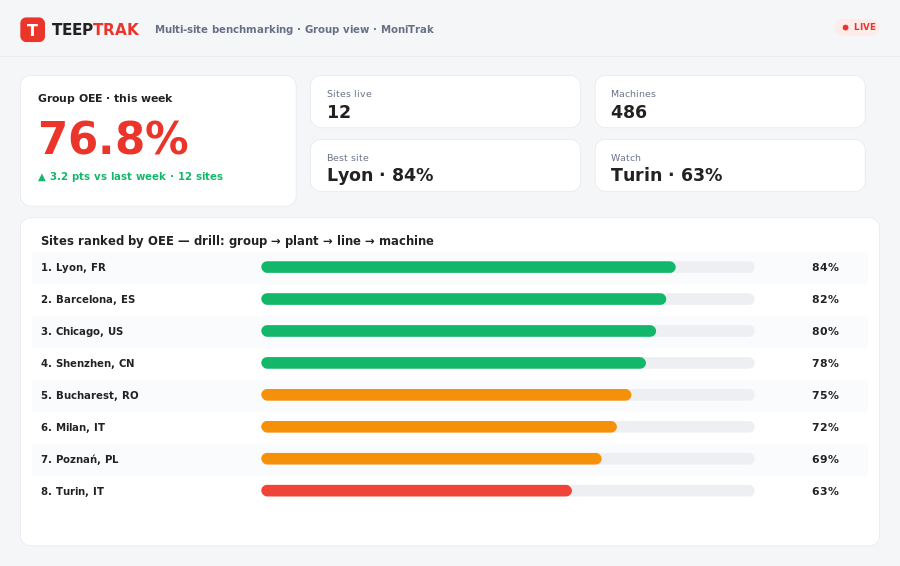
Teeptrack dashboard - Image credit: capterra.com
Cennik
Quote based. There is no public price list and no per machine rate. Teeptrak's own online materials describe first year plant level projects in the range of roughly €83,000 to €200,000, which is enterprise project territory. The 60 day guided pilot is the counterweight: one line equipped and engineer guided, and if they find less than 10% in hidden losses, you pay nothing.
Implementation
Plug and play sensor modules that need no PLC access and no machine modification, on equipment of any age. The company claims a machine connects in under an hour and a factory can be live in 48 hours, with under two hours of installation per line. The units also run autonomously when the network drops, so data survives Wi-Fi outages.
Teeptrak’s OEE features that matter for a 10 to 20 machine factory
PerfTrak performance monitoring: Real-time OEE, output and downtime tracking per machine or line, with operator input on stop reasons.
QualTrak quality tracking: Scrap and defect capture alongside performance, feeding the quality component of OEE.
ProcessTrak process parameters: Temperature, pressure and similar process data linked to production, useful where process drift causes losses.
Offline autonomy: Modules keep recording locally through network drops, a practical advantage in plants with patchy connectivity.
Standard APIs and integrations: Connections toward SAP, Oracle and Power BI for moving data into enterprise systems.
Strengths
Simplicity: Reviewers highlight how simple the system is to install, configure and use day to day.
Works without a stable network: The offline autonomy is specifically praised as a reliability advantage.
Flexible across machine types: One reviewer notes it adapts well to machines both with and without defined cycle rates.
Responsive technical support.
Limitations
Depth of analysis: One of the reviewers notes missing functionality for deeper technical analysis.
No pricing transparency: Budgeting requires a sales process, and the company's own project figures put a first year at €83,000 or more at plant level.
Enterprise orientation: The module family, project pricing and reference list all point at corporate rollouts rather than a 15 machine plant buying directly.
Who is Teeptrak the best fit for?
A corporate group planning a monitoring rollout across several plants, with a project team to run it and a budget that treats six figures as a line item. For that buyer, the guaranteed pilot is a genuinely low risk way to start, and Teeptrak belongs on the shortlist. For an independent SME that wants a clear per machine price on a public pricing page and results without a project team, quote based selling is itself the answer: GlobalReader publishes its pricing, starts at €125 per machine per month, and needs no procurement process to try.
9. MachineMetrics: best for CNC heavy fleets that need controller level data
MachineMetrics is an American machine data platform specialised in CNC machining. Instead of adding sensors, it connects natively to the machine's controller, over 1,000 controller types including Fanuc, Haas, Mazak and Siemens, and reads exactly what the machine itself knows: cycles, alarms, feeds, speeds and faults.
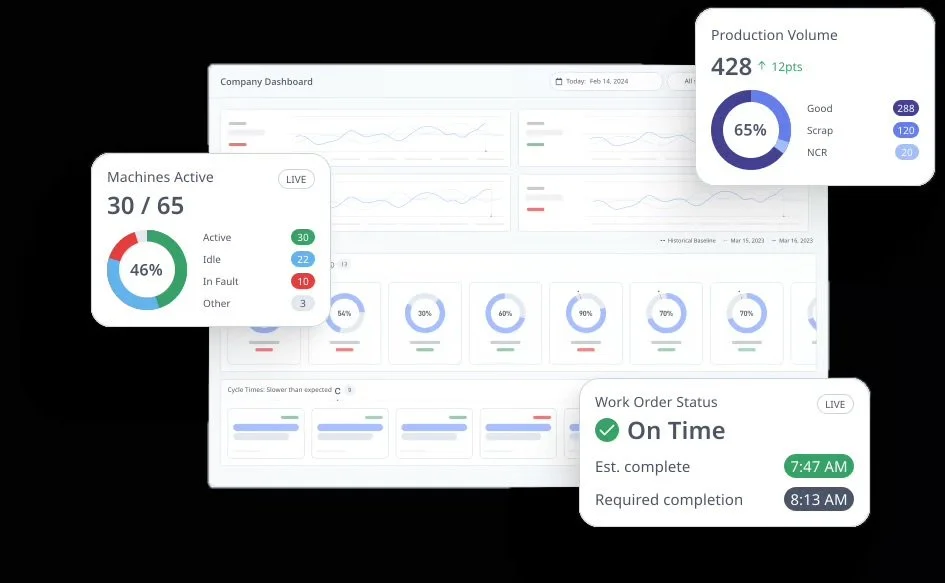
Machinemetrics OEE dashboard - Image credit: G2.com
Cennik
No published prices available. The three tiers (Core Platform, Intelligent MES and Enterprise) are each quote based on a volume per machine model, so budgeting requires a sales process. There is no free trial, evaluation starts with a demo. Quotes come in USD.
Implementation
For machines with modern controllers, often no hardware is needed, an edge gateway (one per roughly 50 machines) or a virtual connector covers the rest. The company positions deployment as weeks rather than months, with IT involvement expected, though it also cites customers connecting first machines within a day. Realistically, this is a system that assumes an IT resource on your side.
MachineMetrics’ OEE features that matter for a 10 to 20 machine factory
Native CNC controller connectivity: Direct data from 1,000+ controller types with no sensors to fit the platform's defining capability.
Automatic downtime and fault diagnostics: Stops arrive already labelled with the machine's own alarm and fault codes, cutting out manual reason coding for machine caused stops.
OEE and utilisation reporting: Standard availability, performance and quality views across the fleet.
Predictive and diagnostic analytics: Deep condition data supports spotting failures and process issues before they stop production.
Production scheduling and work orders (Intelligent MES tier): Order tracking against real machine capacity.
Bi-directional ERP integration: Native connectors including Infor and Epicor, plus open APIs, on the higher tier.
Strengths
Depth of machine data: Reviewers describe the per machine diagnostic detail as exceptionally deep, well beyond what sensor based tools capture on CNC equipment.
Breadth of platform: Reviews credit it as a robust system covering monitoring through scheduling and work orders in one place.
Genuine CNC specialisation: The controller level approach is consistently what reviewers value most.
Limitations
Real learning curve: Independent reviews describe the system as powerful enough that learning it properly takes weeks. The more a platform can do, the longer it takes your people to do it.
Slight data lag: A reviewer notes a small delay between machine operation and the real time view.
Built for scale, priced for scale: The company targets shops with 50 or more machines, and with all pricing unpublished, smaller plants cannot even benchmark the cost without entering a sales cycle.
US centred support and presence: Support hours, references and key market they operate in are American. There is no European sales or support motion, no local language operator screens, and quotes in USD add currency exposure for a euro budget.
Who is MachineMetrics the best fit for?
A large, CNC dominated fleet, realistically 50 machines or more, with its own IT team, where controller level diagnostics justify a US support relationship and an enterprise sales process. If that's your plant, it earns its place on a shortlist even from Europe. For a mixed fleet European SME with 10-20 machines, some of them older or non CNC, it is heavier than the job requires on three counts at once: deployment, support geography and procurement. A sensor based system, like GlobalReader, with local support gets you live data this week instead, and works on the machines a CNC only platform cannot see.
10. Guidewheel: best for instant machine visibility from the power line
Guidewheel is a US company that turns any machine's power cable into a data source. A clamp sensor clips around the power line and reads the machine's electrical draw, and the cloud platform (styled as AI powered FactoryOps) interprets that signal into running, idle and stopped time, alerts and OEE. Because it never touches the machine's controls, it works on any equipment, old or new.
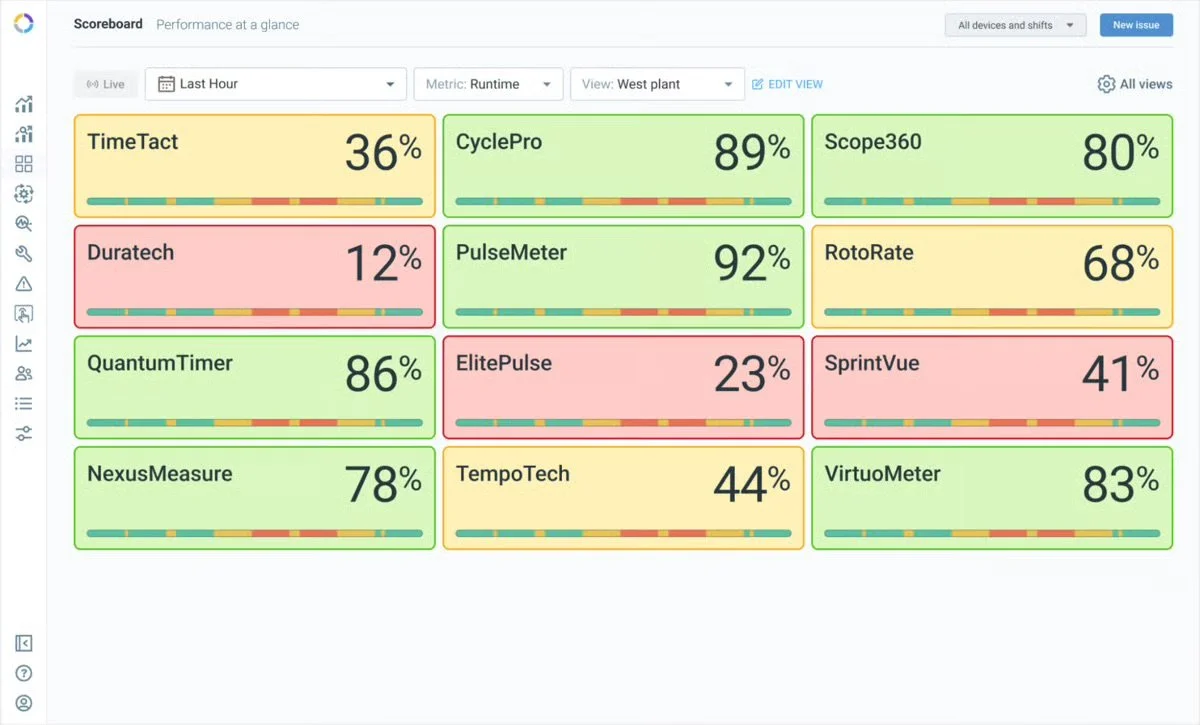
Guidewheel OEE dashboard - Image credit: G2.com
Cennik
A single annual plan starting at about €13,100 per year ($15,000), covering the first ten machines with all hardware and infrastructure included. That works out to roughly €125 per machine per month at ten machines, close to GlobalReader's entry price, though the casual per sensor entry point their model used to offer is gone, and the commitment is annual. No free trial, evaluation starts with a demo. Quotes in USD.
Implementation
The clamp sensor installs without an electrician stopping production, connecting over Ethernet, Wi-Fi or LTE, with installs "in as little as a day" per the company website. Reviewers confirm the ease overall, though some note that setup and integration took more effort on older equipment.
Guidewheel’s’ OEE features that matter for a 10 to 20 machine factory
Clip on power sensing: Machine activity read from electrical draw, with no controller access and no process modification, on any machine.
Automatic run/idle/stop detection: The power signature itself flags when a machine stops, with operators tagging the reasons.
Alerts and FactoryOps workflows: Real time notifications when machines go down, plus AI assisted pattern spotting across the fleet.
Energy monitoring built in: Power and energy metrics (down to kWh per ton) come free with the sensing method itself.
ERP and systems integrations: Connections toward SAP, Oracle and Epicor plus an open API and Workato based connectors.
Strengths
Outstanding support: The most repeated compliment across online reviews by a wide margin, with the customer success team praised by name.
Fast, easy installation: Reviewers consistently describe the clip on setup as quick and painless.
Affordable entry into machine data: Reviewers frame it as a cost effective way into OEE data compared with systems costing hundreds of thousands.
Live view of every machine: The whole plant on one screen is called out as an immediate, daily value.
Limitations
OEE accuracy depends on operator discipline: According to independent reviews, duplicate downtime tags can be created, which makes OEE look artificially lower than it is. This is a structural trait of power signal monitoring: the sensor knows the machine stopped, but only people can say why, and the tagging workflow is where accuracy lives or dies.
Reporting constraints: Reviewers note report date ranges are capped at 30 days, and exported or printed graphs lose their data values.
Setup on older equipment: Some reviewers found initial setup and integration challenging in plants with older machines.
North American centre of gravity: Support hours, references and the market they operate in are US focused, with no European sales or support motion, no local European language operator screens, and USD pricing for a euro budget.
Who is Guidewheel the best fit for?
A plant that wants every machine visible this month with minimal fuss, values energy data as much as production data, and can live with operator dependent downtime tagging and a US support hours. At ten machines the per machine cost lands near GlobalReader's, so for a European SME the decision is not price but architecture and proximity: a purpose built production sensor measures the process itself rather than inferring it from power draw, reason capture happens on the line in the operator's own language, ERP data flows both ways, and support answers in your time zone.
Which OEE software is right for your factory?
“TL;DR: Under 10 machines: you may not need software yet. 10-20 machines in wood, metal or food in Europe: GlobalReader. Want a guided trial on a real machine first: Evocon. Maintenance first: Fabrico. Premium compliance suite: Factbird. One time purchase, no subscription: Vorne XL. 50+ CNC machines with an IT team in the US: MachineMetrics.”
Under 10 machines and the owner can see the whole floor: honestly, you may not need software yet. Revisit when shifts multiply or the machine count grows.
10-20 machines, mixed age fleet, wood, metal or food, and you want fast ROI plus ERP flow: GlobalReader. This is exactly the factory GlobalReader is built for. If you run a 15 machine furniture factory and have been wondering which of these tools fits, this is the OEE software for you.
You want to trial something on a real machine quickly: Evocon's guided free trial ships sensors to you. If you would rather trial hardware with no commitment at all, Vorne's 90 day version is hard to beat.
Maintenance is the burning problem: Fabrico's free plan is a low risk start.
A larger plant with compliance requirements and premium budget: Factbird.
You'd rather buy a hardware unit once than subscribe to software: Vorne XL.
50+ CNC machines in the US with dedicated IT: MachineMetrics.
If your answer is GlobalReader, the fastest next step is to put your real machine list in front of us. Sign up for a free demo account and see how it works.
How much does OEE software cost?
TL;DR: OEE software typically costs €100 to €370+ per machine or line per month for the software alone, plus hardware (often a separate purchase or rental) and setup. GlobalReader starts from €125 per machine per month with the hardware bundled in, so the total is a predictable operating cost rather than an upfront capital project.
| Cost element | What to expect across the market | Where GlobalReader differs |
|---|---|---|
| Software | €100 to €370+ per machine or line per month, sometimes plus a site fee (Factbird €875/month); several vendors quote only | From €125 per machine per month, public pricing page, no site fee |
| Sprzęt | Separate purchase (Factbird), rental (Evocon, €21/mo), one time gateway (Symestic €350 to €450) or one time appliance (Vorne €3,930+) | ScoutBox + all sensors and cabling included in the subscription; installation €137 one time per device; replaced free if it ever fails |
| Integracja z systemem ERP | Recurring paid add-ons, project work, or read-only APIs | Bi-directional sync with 7+ ERPs via the Smart Factory add-on, one off charge (see integrations) |
| Setup and training | Hours to weeks, sometimes with consultants or IT | About 90 minutes setup; most customers are live the same day |
One way to sanity check any quote: at a running cost of €100 or more per factory hour, recovering a single lost hour per machine per month already covers the €125 GlobalReader subscription. That is the arithmetic behind our customers' average of €39,200 recovered per machine per year. And the numbers don't stay stuck on a dashboard, because every report exports cleanly to Excel, PDF or PNG and can land in your inbox on a schedule, the capacity you recover is something you can actually put in front of a manager or a board, not just glance at on a screen.
Is there free OEE software?
Some vendors offer free tiers or trials. Fabrico has a free plan for one user and ten machines, Evocon runs a guided free trial with shipped sensors, and Vorne offers a 90 day trial of its appliance. GlobalReader offers a free demo account with a guided tour, no commitment, so you can see the product with factory data.
The bottom line
Every tool on this list can help you see your factory more clearly, and the most expensive option is usually the quiet one: staying with Excel and gut feel while recoverable capacity slips away shift after shift.
If you run a larger or specialised plant, Factbird, MachineMetrics or Vorne may be your best home, and we mean that.
If you are a 10 to 20 machine manufacturer in Europe who wants live data this week, hardware in the subscription and software that pays for itself in one day, GlobalReader was built for you. Read GlobalReader's customer stories to see what factories like yours found hiding in their machines, or create a free demo account.
