
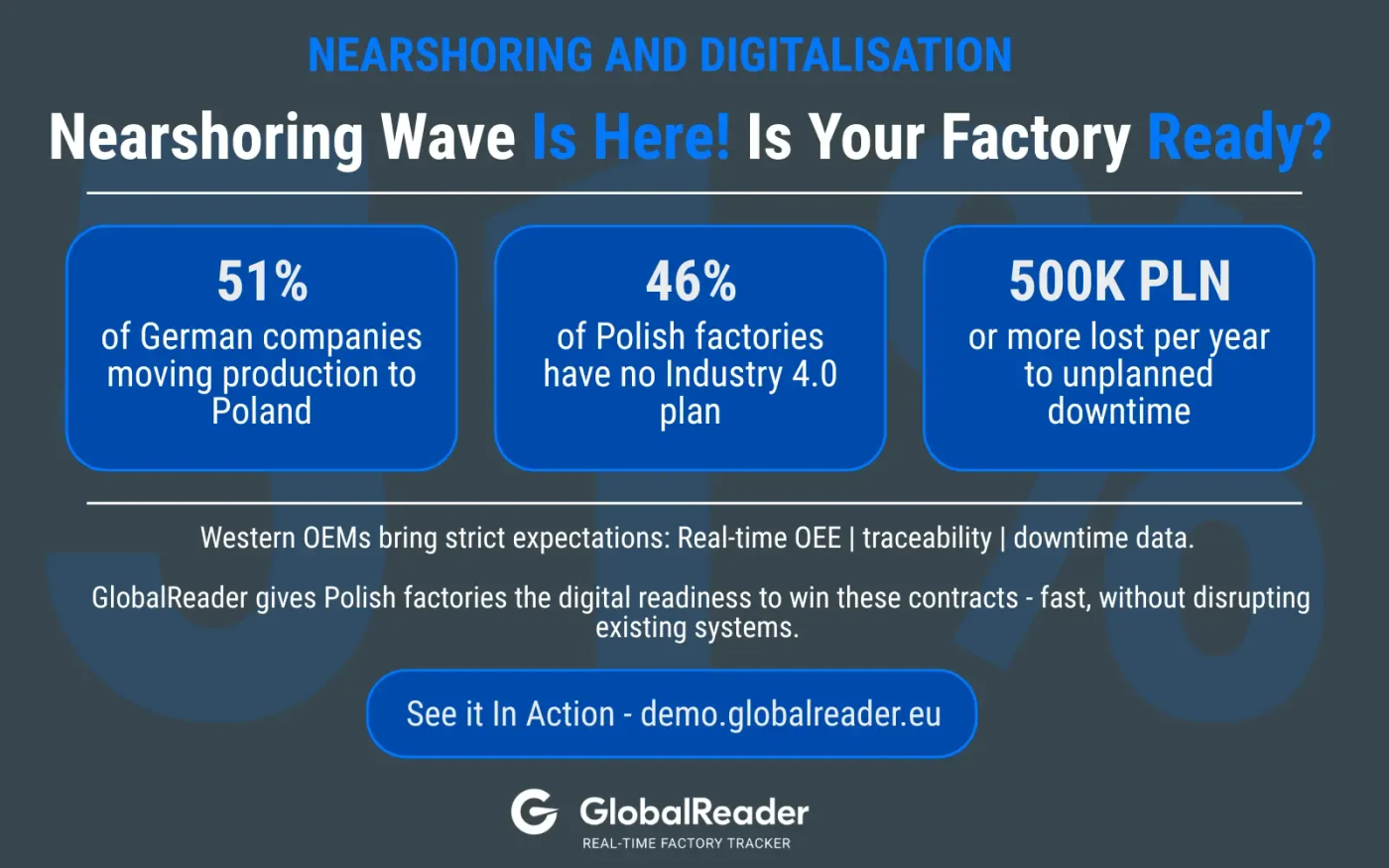
Over the last few years, Poland has turned into one of Europe’s most attractive production locations for German and Western European manufacturers. More than half of German companies that plan to relocate production to Central and Eastern Europe (nearshoring) now choose Poland as their first-choice destination.
Miele is moving washing machine assembly from Germany to Ksawerów near Łódź, and Knorr‑Bremse is transferring a large part of its brake production from Saxony to Poland. These big companies show how seriously German industry considers Poland as a production location. Also, Polish‑German trade reached roughly €90 billion in just the first half of 2025, a historic record that underlines how tightly integrated both economies have become.
For Polish manufacturing, this is the opportunity of a generation. However, it is not “free growth”. These OEMs are arriving with very specific expectations: high and stable quality, strict traceability, data‑driven efficiency, and transparency in real time. Factories that cannot meet this digital bar will see the nearshoring wave pass them by and land in the plants of better‑prepared competitors.
What OEMs Really Expect Today
For Tier 1 and Tier 2 suppliers, standards such as IATF 16949 and advanced ISO‑based quality systems are no longer a “nice to have” but a minimum entry ticket to the RFQ stage. OEMs want much more than a good price and a promise of on‑time delivery. They increasingly ask for:
Real‑time or daily OEE reports on key machines and lines
Full traceability of what was produced, when, where, and on which machine
Clear visibility into downtime causes and corrective actions
Shift‑level performance and quality data that proves process stability
In practice, this means that an Excel file updated days or even weeks after production is no longer enough. Yet a surprisingly large share of Polish factories still rely on spreadsheets, whiteboards, and manual notes as their primary source of production truth.
Recent surveys show that while 88% of Polish companies believe Industry 4.0 technologies have a positive effect on competitiveness, 46% have no plans at all to implement them. Only about 20% are actively preparing for adoption.
By contrast, manufacturers in Nordic and Baltic countries have already reached a much higher level of digital intensity; in many segments 40–70% of firms operate with advanced digital tools on the shop floor. When a German OEM benchmarks suppliers, that gap in maturity becomes immediately visible.
The Real Cost of Staying Analog
At the same time as OEM expectations rise, the economic environment has become much tougher. After a strong rebound in 2025, Poland’s industrial production fell by around 1.5% year‑on‑year in January 2026, with manufacturing output dropping by more than 3%. The manufacturing PMI has been below 50 for nine consecutive months, signaling ongoing contraction despite a more optimistic 12‑month outlook. For many plants, there is no room left in the margin for “invisible” losses.
Globally, unplanned downtime now consumes an estimated 11% of annual revenue for large manufacturers, up from around 8% before the pandemic. Industry analyses put the typical cost of an hour of unplanned stoppage in the tens of thousands of dollars, and in sectors such as automotive even above $2 million per hour. A typical big plant loses roughly 27 hours per month to unplanned downtime.
Polish estimates point to more than 500,000 PLN in unplanned downtime costs per factory per year, even for mid‑sized operations. When margins in some sectors, such as furniture, have fallen toward 5% operating profitability, those losses can mean the difference between surviving a difficult year and sliding into the red.
Without real‑time data, most of this cost remains hidden. Management sees lower overall output or missed delivery windows but cannot clearly explain why. Different departments argue about whether the problem lies in maintenance, planning, or operators. Investments are made based on intuition, not on facts. And when an OEM asks for hard numbers on OEE or downtime structure, the answer is often a manually assembled report that nobody fully trusts.
GlobalReader as the Fast Bridge to Digital Readiness
Traditional MES projects can in theory solve some of these issues, but they are often slow, expensive, and risky. Implementation may take 6–12 months, require deep ERP integration, and demand scarce internal IT resources. For many Polish mid‑market manufacturers, that is simply not a realistic starting point.
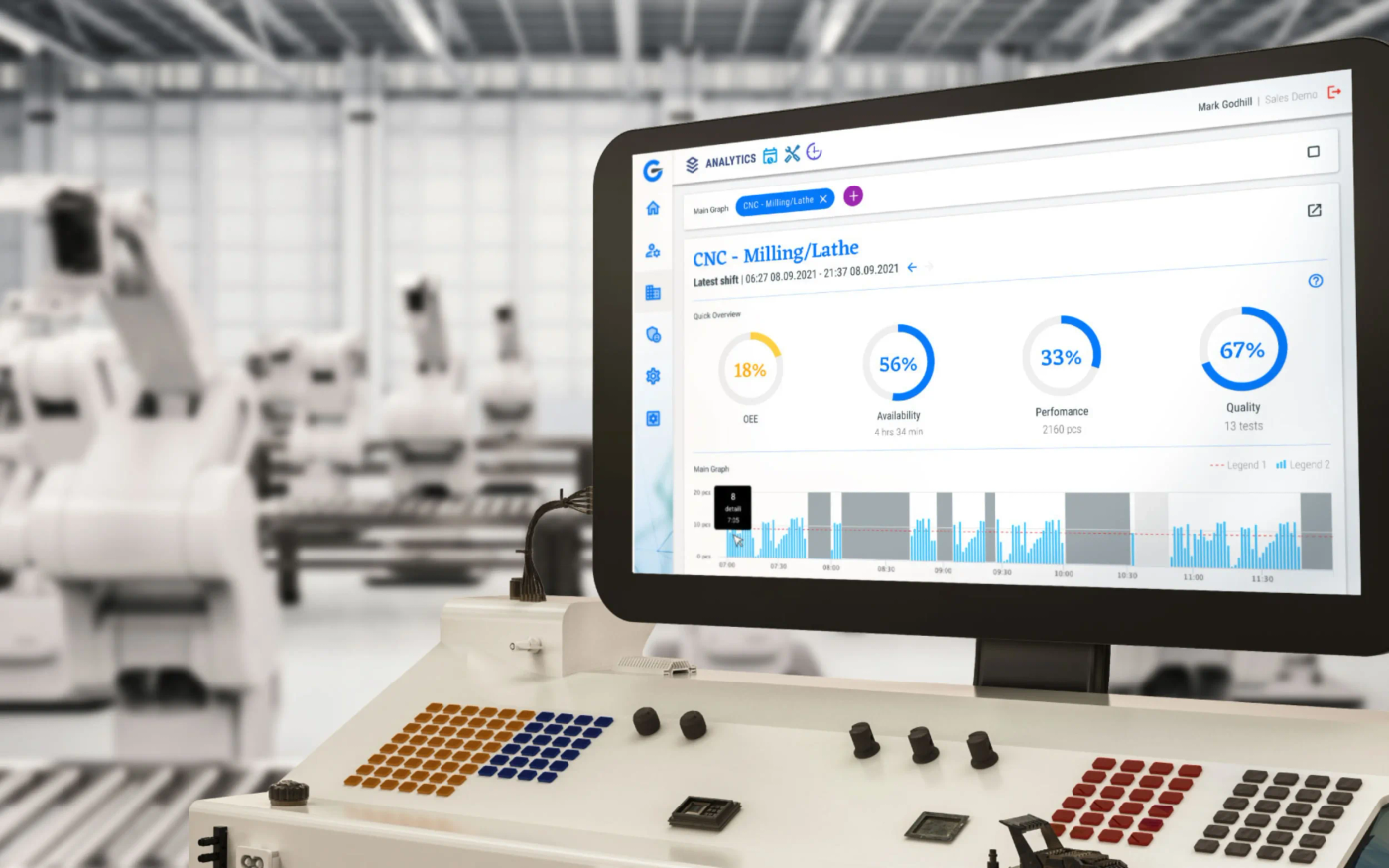
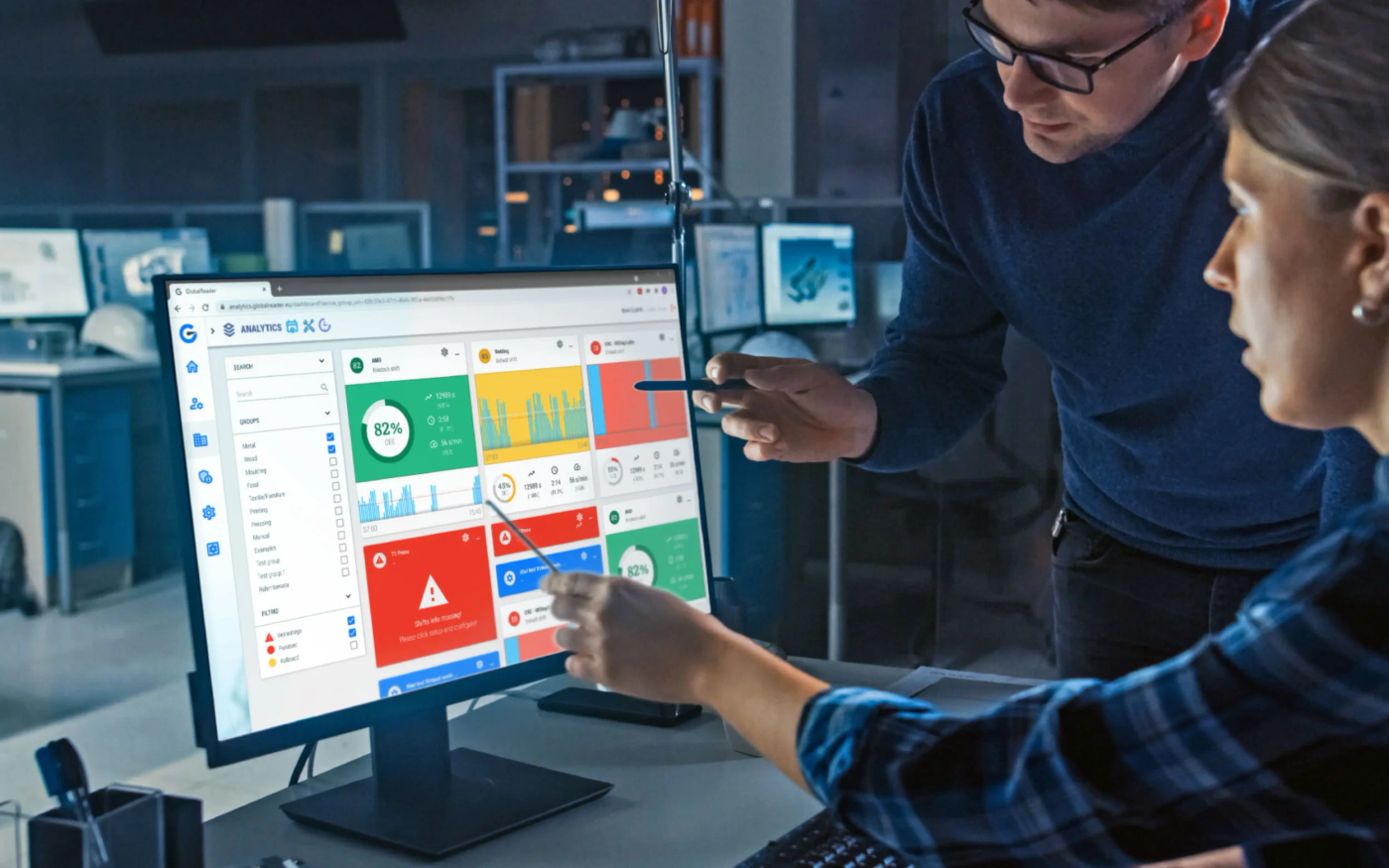
GlobalReader takes a different approach. It is the best hardware‑enabled SaaS solution designed to give factories fast, low‑risk access to real‑time production data without disrupting existing ERP and planning systems. IoT sensors are installed on key machines and lines and start sending signals directly to a secure cloud platform. This data is then presented in intuitive dashboards that production managers, maintenance teams, and C‑level executives can all use.
Several aspects make this model particularly well suited to Polish manufacturers under nearshoring pressure:
Plug‑and‑play deployment – connecting the first machines can usually be done within hours, not months, with minimal support from internal IT.
No ERP replacement – GlobalReader runs alongside existing systems and focuses on what they typically do not cover well: real‑time machine behavior, downtime reasons, and OEE.
Subscription model – a monthly fee per machine instead of a big upfront one‑time investment in long‑term assets at the start of a project, which reduces risk and makes it easier to start with a pilot.
Proven references – customers across the Baltic and Nordic region in wood, metal, furniture, automotive, food, plastics, and rubber have already used the system to gain 8–15% OEE improvements and clear visibility into downtime. In Poland, JABS Sokółka, one of the leading manufacturers of wooden windows and doors, is already seeing the benefits of GlobalReader’s real-time factory tracking system. The company started with 16% of availability of the Factory. Within a few months came an increase up to 40% and over one year compared they are now over 70%. That’s basically an OEE score increase of 14% to 65%.
For an OEM evaluating suppliers, this kind of evidence is compelling. A factory that can present clear OEE trends, traceability logs, and structured downtime analyses from a system like GlobalReader looks much more mature — and therefore much less risky — than a competitor that still collects data on paper.
From Data to Decisions: What Changes on the Shop Floor
Connecting machines to GlobalReader is not just about “having a dashboard”. The real value comes from the behavioral and organizational changes that follow when everyone finally sees what is actually happening in real time.
In the first days and weeks, production teams often discover that a significant part of downtime was previously recorded as “unknown” or not recorded at all. Once operators start logging reasons with a few taps, patterns emerge: a particular machine that stops repeatedly for tool changes, a shift that consistently runs slower than others, or a material grade that triggers more quality issues than the rest.
After a month or two, shift‑to‑shift and machine‑to‑machine comparisons become routine. Team leaders can see, for example, that two lines running the same product have a 10–15% performance gap, and then dig into causes instead of speculating. Maintenance departments use the detailed history of unplanned stops to move from firefighting toward planned interventions, targeting exactly those machines and components that generate the most disruption.
Over a three‑ to six‑month horizon, many factories see their OEE improve by high single digits or even double‑digit percentages once they start acting systematically on these insights. Importantly, most of this gain comes without buying new machines. It comes from better planning, faster reactions, and proactive maintenance — all fueled by granular data.
For OEMs, this is exactly the kind of culture they are looking for in long‑term partners: not perfection, but the ability to measure, understand, and continuously improve.
Why the Timing Is Critical: EU Funding Meets Nearshoring
The macroeconomic environment in Poland adds another strong argument for acting now. Poland is the largest beneficiary of EU Cohesion Policy, with more than €76 billion allocated for 2021–2027, alongside €59.8 billion from the Recovery and Resilience Plan.
Within this framework, the government has launched specific new instruments: the Critical Technology Support Fund (PLN 4 billion budget, grants for digital, deep tech, and clean technologies) and the Digital and Environmentally Friendly Transformation Fund (PLN 792 million in preferential loans at just 0.5% interest for Industry 4.0 and green investments, with up to 15% loan forgiveness). Loan applications for the latter open from mid-2026.
At EU level, Poland also benefits from a combination of €23.9 billion in RRF grants and €12.1 billion in RRF loans, a large part of which targets modern industrial capabilities and digital infrastructure. For manufacturing companies, this means that a well‑structured digitalization project — such as deploying real‑time production monitoring on key lines — can often be co‑financed to a significant degree.
When this funding environment is combined with the current nearshoring wave, it creates a unique window:
OEM demand for reliable, data‑driven suppliers is rising.
Tools like GlobalReader make it possible to reach that digital level quickly and with limited risk.
Public funding can offset a large part of the investment.
Factories that move now position themselves as first‑choice partners for the new generation of nearshored projects. Those that postpone digitalization risk finding themselves squeezed between more advanced local competitors and highly automated plants in Western Europe
See It in Action
The good news is that making the first step does not require a multi‑year IT project. A focused pilot on a limited number of critical machines is enough to demonstrate whether real‑time monitoring and OEE tracking can deliver tangible results in a specific factory context.
GlobalReader offers an online real-time production tracking demo environment with realistic production data, dashboards, and example scenarios where decision‑makers can explore how such a system works in practice before committing to a project. From there, a typical journey starts with a small pilot, proves ROI within a few months, and then scales to the rest of the plant.
For Polish manufacturers standing at the crossroads of nearshoring, cost pressure, and labor shortages, the message is clear: the opportunity is real, but it will not wait. Factories that invest now in real‑time visibility and data‑driven operations will be the ones that secure the best contracts — and keep them for the long term. GlobalReader is designed to help them get there quickly, without disrupting what already works.