
Polish factories are under unprecedented pressure. Rising labour costs (manufacturing wages up around 7% year-on-year), tougher price competition from China, and a shortage of skilled workers are forcing difficult choices for production leaders. At the same time, the digitalization level of Polish SMEs remains worryingly low: only about 11% of small firms and 25% of medium-sized firms have high digital intensity, compared to 40–70% in countries like Sweden or Finland.
Standstill, while Competitors Use Real-Time Data
As GlobalReader is entering the Polish manufacturing market in 2026 we did extensive research to get to this info about the market. In this environment, most Polish manufacturers are still running their shop floors in the dark. Excel sheets, paper forms, issues reported hours after they happen. Every minute of invisible downtime quietly burns profit, while competitors are already using real-time data to optimize every process.
““You can’t manage what you don’t measure. And most production losses stay invisible until you start tracking them in real time.”— Jaan Kraav, COO, GlobalReader”
The Real Problems on Polish Shop Floors
Multiple studies show where Polish factories see their biggest improvement gaps: 65% cite manufacturing process efficiency, 38% point to quality, 30% to on-time delivery, and 28% to machine availability. These are not abstract KPIs — they translate directly into hundreds of thousands of euros in lost margin every year.
The wood and furniture sector – one of Poland’s flagship industries, with around 1,200 firms and 30,000 machines – is facing a 7.3% year-on-year decline in production and negative profitability for sawmills in early 2024. Metal and automotive component manufacturers (950 companies, 28,500 machines) are under constant pressure from IATF 16949 and OEM clients who expect full traceability and stable quality. Food processors (650 firms, 13,000 machines) must simultaneously meet strict HACCP requirements and export expectations within the EU.
The common denominator across all these sectors is lack of real-time visibility.
Production managers rarely know about downtime or actually those who do not monitor machines only see the missing product that was supposed to be produced. That is too late to react.
Maintenance teams fix failures reactively instead of preventing them.
Quality specialistsdiscover defects after hundreds of bad parts have already been produced, not at the moment the problem appears.
The Hidden Cost of Poor Quality — Numbers That Hurt
Imagine a factory producing 40,000 pieces per month, with a planned unit cost of €25 (labour €10, materials €10, consumables €2, other costs €3). The total monthly cost is €1,000,000 — but only if every piece meets specification.
Now assume a quality rate of 98.4%. That sounds excellent, but it actually means 640 defective pieces. To still deliver 40,000 good parts, the plant must produce extra, which creates additional work, rework, and recycling. Scrap has to be processed (costing another €5/piece), and late deliveries to customers generate further penalties and hidden costs.
Those 640 defective parts, which were supposed to cost €25 each, actually cost €55.52 per piece, more than twice what was planned.
For 98.4% of products, the cost per unit is €25. For the remaining 1.6%, the cost is:
(€1,019,530 – €984,000) / 640 = €55.52 per piece.
More than twice what was expected.
Scaled over a year, these “small” percentage gaps can easily add up to hundreds of thousands of euros in preventable losses. In this example, total production cost rises to €1,019,530 — nearly €20,000 more than planned, or 1.95% above budget.
How GlobalReader Changes the Game
GlobalReader is a complete real-time production monitoring and OEE system – a hardware-enabled SaaS (HeSaaS) – that connects machines, operators, and planners into one ecosystem. Unlike traditional MES platforms that require 6–12 months of implementation and large upfront investments, GlobalReader is a true plug-and-play system. Connecting a single machine typically takes within hours and does not require specially trained IT staff or external integrators. And pricing is a simple monthly subscription per machine, with hardware included.

Full Visibility, Instant Reaction
Machines are equipped with IoT sensors (provided as part of the GlobalReader solution). Data is sent to a secure cloud environment where it can then be analysed and displayed in intuitive dashboards. The right people are automatically notified so they can react fast.
Every event is timestamped and linked to a specific machine and operator. Dashboards combine OEE, downtime, and quality performance in one place. Teams can immediately see which machines, materials, or shifts are driving scrap and downtime — and act before losses multiply.
“Most factories focus on speed, but the real profit lies in preventing defects. That’s where OEE and real-time quality tracking deliver the biggest return.”
— Hans Somerset, Overall Efficiency Engineer, GlobalReader
Real Results from a European Metal Manufacturer
One European metal components manufacturer, running a 4,300 m² facility with around 14 CNC machines and about 1,200machine hours per month, struggled with unexplained downtime and missed production targets. The situation will sound familiar to many factories.
Before GlobalReader, their team relied on Excel spreadsheets and whiteboards. Problems were discovered days or weeks later — often after products had already been delivered to customers.
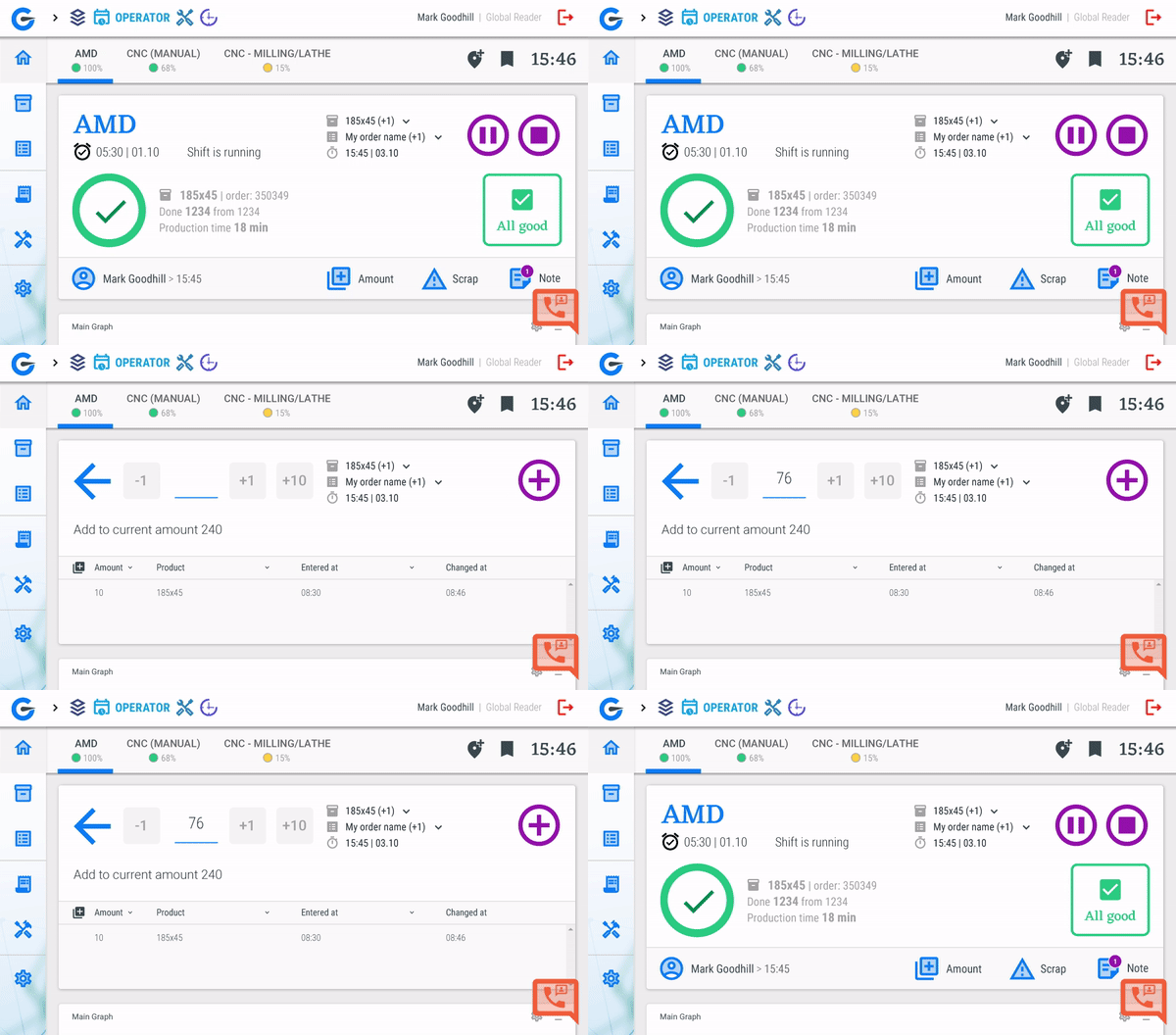
Once the first CNC machines were connected to GlobalReader, uncertainty turned into clarity. The OEE software started collecting machine signals, operators started marking downtime reasons, and gave shopfloor feedback in real time, creating a live picture of production efficiency. Literally on C-level personnel TV screens.
Within just three months, machine availability increased from 11.9% to 29.3%. At the end of the year, it reached 50% — and by the first quarter of the following year, availability climbed to an impressive 91%.
Crucially, these gains did not come from buying new machines. They came from data – and from acting on that data. The company finally understood why interruptions happened and which actions had the strongest impact on uptime.
Three Pillars of GlobalReader’s Impact
1. Real-Time OEE Tracking
GlobalReader automatically measures three essential KPIs:
Availability – how much of planned time the machine is actually running
Performance – whether the machine runs at the expected speed
Quality – what share of output is good at first pass
Manufacturers who implement real-time monitoring typically see 15–25% OEE improvement within six months. For a 24/7 factory, increasing utilization from 75% to 79.5% means 394 extra productive hours per machine per year — the equivalent of adding another machine’s worth of capacity without buying new equipment.
2. Quality Management and Cost of Quality (COQ)
Traditional quality control is reactive — it tells you what went wrong only after it is too late. Real-time measurement helps prevent waste at its source.
By combining machine signals, sensor data, and operator input, GlobalReader creates a single digital record of production quality. The system tracks defect types, frequency, and conditions, turning scattered inspection data into actionable insight. When a defect rate passes a defined threshold, GlobalReader automatically alerts process owners or maintenance teams.
Manufacturers using real-time quality and downtime tracking report 20–30% reductions in quality-related costs, driven by earlier detection of process deviations and faster corrective action.
3. Predictive Maintenance and Downtime Reduction
GlobalReader helps maintenance teams move from firefighting to proactive planning. The system builds a detailed history of unplanned stops, with accurate categorization and context. This enables root-cause analysis and proactive maintenance before failures happen.
Data shows that predictive maintenance can cut maintenance costs by roughly 25% and significantly reduce unplanned equipment failures. Plants using real-time monitoring often see 13% less unplanned downtime, and there are documented cases of up to 40% downtime reduction after introducing predictive maintenance based on real-time data.
Why GlobalReader Fits Polish Mid-Sized Manufacturers
Polish small and medium-sized enterprises (SMEs) want to digitalize, but most prefer modular, low-risk steps rather than full-blown ERP or MES replacements. This is exactly where GlobalReader stands out:
Fast deployment: connect a single machine within hours and start seeing live data the same day, instead of waiting 6–12 months for a classic MES project
No ERP disruption: GlobalReader works alongside existing systems — no replacement or risky IT project needed
Subscription model: monthly fee per machine instead of heavy CapEx; easy to start, easy to scale
Hardware included: IoT sensors and gateways are part of the solution, not a separate integration headache
Regional references: 50+ Baltic and Nordic customers with similar scale, challenges, and labour costs
Proven in your industries: wood, metal, furniture, automotive, food, plastics, rubber — the same sectors that dominate the 50–500 employee segment in Poland
Who Is the Ideal GlobalReader Customer in Poland?
GlobalReader delivers the strongest ROI for factories that look like this:
Size: 50–500 employees
Revenue: €5–100M
Machines: 20–150 across cutting, machining, assembly, finishing, packaging
Shifts: 2–3 (high downtime cost)
Export: >40% to EU markets (strong pressure on quality, delivery, and documentation)
Industries: wood and furniture, metal fabrication, automotive components, trailers, food processing, plastics, rubber
If your factory:
Lacks real-time visibility on the shop floor
Struggles to pinpoint root causes of downtime
Faces ISO/IATF/HACCP audit pressure
Needs to increase OEE by 8–15% without buying new machines
Feels growing cost pressure but wants to protect margins
…then GlobalReader is most likely a very strong fit.
Start Small, Scale Fast Once You See the Results
The recommended path is simple: start with a focused pilot, prove ROI fast, then expand.
A typical journey:
Weeks 1–2 – Discovery: identify bottleneck machines and critical lines
Weeks 3–4 – Installation: sensors, dashboards, operator training
Months 2–3 – Pilot: collect data, find quick wins, introduce targeted improvements
Month 4 – Expansion decision based on documented OEE, downtime, and quality improvements
Month 6+ - Testing other GlobalReader features and add-ons.
For most mid-sized manufacturers, a pilot on 3–5 machines is enough to show clear gains within 8–12 weeks. Expansion to 20–30 machines usually follows when the improvement is visible to management and operators.
““When factories finally see what is really happening in real time, small insights quickly turn into big efficiency gains.””
See It in Action — With Real Production Data
You don’t need a trial contract, a credit card, or a long sales call to get started.
Visit demo.globalreader.eu and explore a full GlobalReader demo environment with realistic production data and guided scenarios. See for yourself:
Live OEE and downtime dashboards
How operators log stops and reasons in real time
How production managers compare shifts, machines, and lines
How quality and scrap trends are visualized for fast decision-making
Polish manufacturing is at a turning point. The cost of doing nothing keeps rising, while the barrier to smart, real-time monitoring has never been lower. GlobalReader gives factories in wood, metal, food, plastics, and rubber the same level of visibility that global leaders already rely on — without the complexity and cost of enterprise MES.
Contact Us
Fix the causes, not just the symptoms.
See your production in real time.
Turn data into profit.