
If you are searching for an Evocon alternative, it is probably down to what changed after the acquisition. This article covers what changed at Evocon, what it still does well, and how GlobalReader, OEE monitoring built for European factories with 10 to 20 machines, compares on price, hardware, implementation, ERP integration, features beyond OEE, support and total cost.
TL;DR: Evocon is an operator-friendly OEE monitoring tool. Since the January 2026 Syspro acquisition, its list pricing runs 189 to 319 euros per machine per month on a minimum one-year agreement, plus 15 to 19 euros a month per rented IIoT device, with sensors, cables, displays, shipping, on-site visits and integrations all billed separately. GlobalReader does the same core job, real-time OEE on any machine, old or new, from 125 euros per machine per month with the Scoutbox hardware, sensors, software and support in one subscription, billed monthly with no lock-in, and adds production planning, maintenance and deeper shop-floor tooling as modules. For a European factory with 10 to 20 machines on 2+ shifts, the all-in cost difference is roughly 40 to 60 percent.
Evocon vs GlobalReader: quick comparison
| What buyers compare | GlobalReader | Evocon |
|---|---|---|
| Price | From 125 € per machine per month, hardware and support included | 189 € to 319 € per machine per month (1 year agreement) + 15 € to 19 € per month per rented IIoT device |
| Commitment | Monthly billing, no lock-in; 5% off for yearly pay-in-full | 1-year agreement minimum; discount requires 3-year term |
| Hardware | ScoutBox + all sensors and cabling included; free replacement if a device fails | IIoT device rented; sensors, cables, displays and shipping purchased separately |
| Installation | 90 minutes per machine; technician with full sensor kit, or guided self-install; 15 machines live in 2 to 3 days | Self-install without a technician; guided onboarding |
| Old and mixed fleets | Any machine, any age. Retrofit sensors (photo-eye, inductive, relay, scrap, temp/humidity, vibration) on legacy equipment, OPC UA/MQTT on modern machines | Plug-and-play device works across most machine types via machine signals |
| ERP integration | Add-on bi-directional sync fitted to your workflow (Microsoft AX, NAV, Monitor, Noom, Directo and others) | Paid add-on from Professional tier and up; reviewers cite ERP/MES depth as a recurring gap |
| Beyond OEE monitoring | Planner (scheduling on real capacity), Maintenance (runtime-based), Operator app, quality and scrap tracking, Manual Work Station logging | OEE monitoring-focused; reviewers note gaps in job tracking through the line and analytical quality entries |
| Deployment | EU-hosted cloud, or fully on-premise on your own server | Cloud SaaS |
| Data resilience | Tri-connected ScoutBox (LAN/Wi-Fi/LTE with SIM); readings buffered end-to-end, never lost | Not published |
| Languages | Support in EN/ET/LV/FI/PL; platform + operator app in 8 languages; account manager for every customer | English-first; dedicated account manager on Enterprise tier |
| Trial motion | Self-guided demo app tour or book a demo call; start small with 1 to 3 machines and expand | Guided free trial |
| Best for | European manufacturers, 10 to 20 machines, 2+ shifts, mixed fleets | Small plants wanting a guided low-risk trial; Syspro ERP users; enterprise IT requirements |
Evocon prices confirmed as of July 2026. Three-year terms reduce Evocon’s rates to 159 to 269 euros plus 15 euros a month device rental.
Why manufacturers are looking for an Evocon alternative in 2026
Two things changed this year.
Evocon was acquired by an ERP vendor. In January 2026, Syspro, a global ERP provider, completed its acquisition of Evocon. For Syspro ERP customers this is genuinely good news: shop-floor OEE data flowing natively into their ERP. For everyone else, it raises the question every buyer should ask any recently acquired vendor. Where does an independent SME account sit on the roadmap when the parent’s strategic priority is its own ERP base?
The pricing and packaging moved upmarket. Evocon’s current pricing, verified July 2026, is 189 euros a month Basic, 249 Professional and 319 Enterprise per machine on a minimum one-year agreement, with no month-to-month option. A three-year term brings rates down to 159, 209 and 269. The IIoT device is rented at 15 to 19 euros a month per machine. Per Evocon’s own pricing page, the license does not include hardware such as sensors, cables and displays, nor shipping, on-site visits or integrations. Integrations are a paid add-on available from the Professional tier, scoped case by case. A dedicated account manager is an Enterprise-tier feature. And all licenses within one company must be on the same plan, so one machine needing API access moves your whole factory to Professional.
None of this makes Evocon a bad product. It makes Evocon a different product than the one many European SMEs originally signed up for at a different price point, with a different centre of gravity.
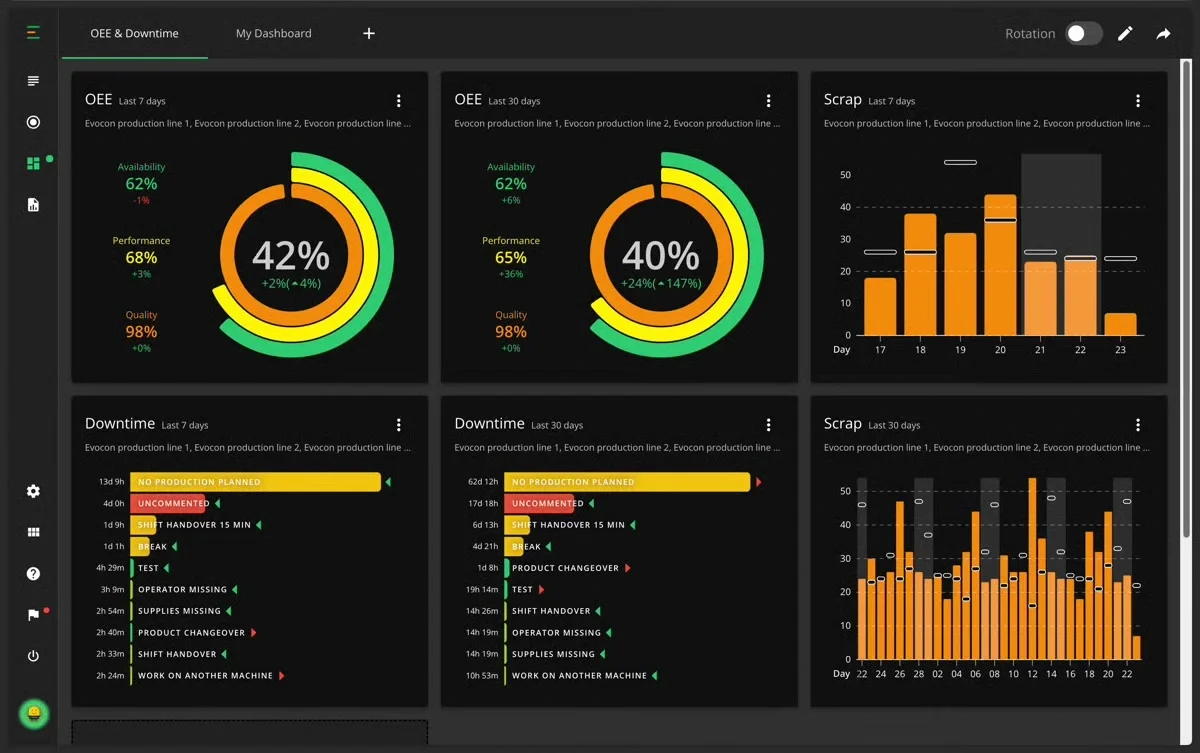
Image credit: G2.com
What Evocon does well
Operator-friendly interface. The traffic-light shift view is genuinely intuitive and reviewers consistently say operators learn it in minutes. If a polished operator experience is your top criterion, Evocon sets the bar.
Guided free trial and easy start. The rented device ships to you and connects to machine signals without a technician, and onboarding is guided by Evocon’s team. It is a low-risk way to see OEE monitoring on one or two machines.
Attentive support. Independent reviews repeatedly praise response times and the regular check-in calls.
Enterprise security stack. SSO from the Professional tier, SCIM, IP restrictions and activity logs on Enterprise. If your IT department requires these, Evocon has them and most SME-priced tools do not.
Where Evocon falls short
Integration depth. ERP and MES connections are a paid add-on available from the Professional tier and up, and reviewers describe the integrations that exist as not deep enough.
Job and quality tracking. Reviewers report there is no good way to track a single job’s progress through the production line, and that analytical quality entries and reporting are missing.
Reporting flexibility. Several reviewers describe the analyses as predefined and inflexible, and ask for automated email report delivery.
The commercial model. Since the acquisition: higher list prices, a one-year minimum, rented rather than owned hardware, sensors and cables billed separately, and integration pricing that is not published.
GlobalReader: the Evocon alternative for 10 to 20 machine European factories
GlobalReader has monitored production since 2014 for the same kind of factories Evocon originally served, but with a different model: everything needed to monitor a machine, in one per-machine price, on any machine you own.
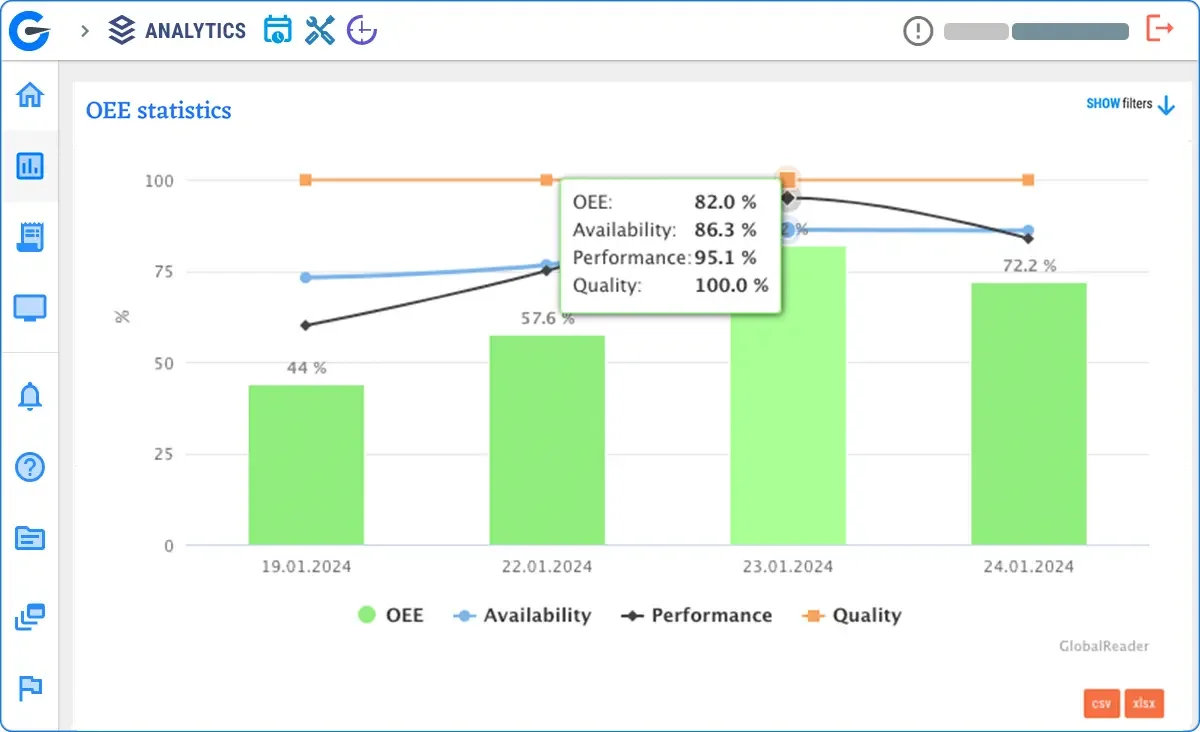
1. The subscription includes what you actually need. From 125 euros per machine per month you get the Scoutbox IoT device, the sensors it needs, the live OEE dashboard, downtime tracking, analytics, production statistics, shift details, instant notifications and support. Billing is monthly with no lock-in, yearly pay-in-full takes 5% off, there is no machine minimum and no separate platform fee. Hardware upkeep is GlobalReader’s problem: if a Scoutbox ever fails, a replacement ships at no cost. The one-time deployment fee is 137 euros per device. Full details on the pricing page.
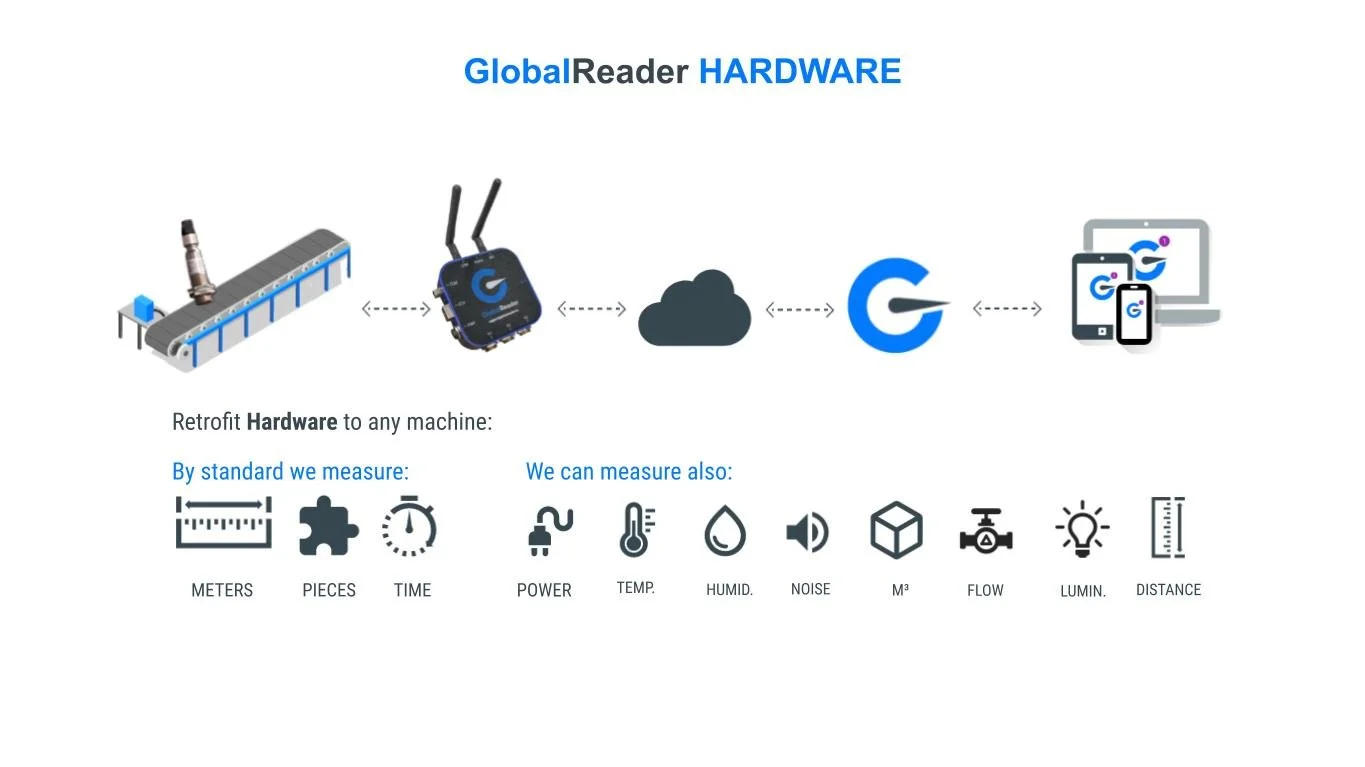
2. Live data the same day, on machines of any age. Setup takes about 90 minutes per machine, and the first machines are live and producing data by the end of day one. Where a modern machine exposes its data, GlobalReader reads it directly over open standards such as OPC UA and MQTT. Older or closed equipment that will not give up its data, hydraulic presses and decades-old machinery, gets retrofit sensors from the technician’s kit: photo-eye, inductive, relay signals, scrap, temperature and humidity, all included in the service price. Many customers install additional sensors themselves with remote guidance. At JABS Sokolka, where about half the machines are over 20 years old, the team self-installed 99% of the hardware, saying it is quite easy if you have somebody who knows how the machine works. At Balti Spoon, the plant’s own technical department fitted the sensors in groups of about five machines at a time, growing to 29 connected lines.
3. One sensor platform, nine standard measurements. Beyond production counts, the same Scoutbox measures meters, weight, work time, temperature, humidity, electricity and its cost, noise and vibration, and volume. At JABS Sokolka, per-machine amperage feeds the efficiency picture, producing more in the same hours while ventilation no longer runs for nothing. At Tere Polva, sensors across 21 locations, including specialised minus 50 degree storage sensors, made the plant BRC audit-ready in 14 days.
4. Scrap and quality based on real counts. A dedicated scrap sensor on the line, or operator-entered scrap at the workstation, so the Quality leg of your OEE reflects actual rejects rather than estimates, and the good-versus-scrap split reconciles back into your ERP for materials accounting.
5. A shop floor experience your operators will not fight. The Operator module is designed as protection and improvement of operators’ work. It is a fast and fair way to record what really happened on a shift, in their own language, with comments flowing straight to people who can act. With barcode and QR scanning, operators clock in, start an order and log downtime reasons with a single scan from a printed, icon-based, multilingual reason sheet. Your workflow does not change. GlobalReader adapts to the floor.
6. ERP integration fitted to how you actually work. Bi-directional sync with ERPs: a production order in your ERP appears as a work bubble on the operator’s screen, and when the operator marks it done the order completes in the ERP, with scrap quantities flowing back for material accounting. Every integration is fitted to your workflow, because your production is unique and you should not rebuild it for a software vendor. And if you are not ready for a full ERP integration yet, you can print a QR code carrying the order details straight from your own system and the operator’s scan creates the order in GlobalReader. See how I&T Metall went from paper and Excel to true product cost with Noom ERP. Full list on the ERP integrations page.
7. Monitoring is the foundation, planning and maintenance build on it. The Planner module schedules orders against what your machines actually do: drag-and-drop, end-to-end, re-planning when a shift drops out and showing you the consequence. Maintenance triggers preventive work from real measured running hours instead of the calendar, with shift-start checklists and operator fault reporting from the floor. Balti Spoon’s quality manager reports that the operator checklist and reporting have helped them significantly reduce breakdown points. Add live shop-floor screens and one-tap Call for Help, and the same data becomes a virtual andon system.
8. Your data survives everything and can stay in your building. Every Scoutbox ships tri-connected over LAN, Wi-Fi and LTE with a SIM, and fails over to mobile data automatically. Readings are buffered end-to-end, so a dropped connection delays data but never loses it. Servers are hosted in Europe, and if cloud is a no-go for your factory, GlobalReader can also be installed to run fully on-premise on your own infrastructure, without an internet connection.
9. The results are measured, not promised. Across 200+ European factories, measured against each factory’s own starting baseline: 27,4% average OEE improvement, 22,8% availability improvement, and 39 200 euros per machine per year in recovered production capacity. JABS Sokolka lifted daily output from 280 to 340 windows, 12 000 more windows a year with no new machines. Balti Spoon grew output on connected lines 20% year-on-year and exposed up to 8 hours a week of hidden lost time between two seemingly identical lines.
Evocon vs GlobalReader cost comparison for a 12-machine factory
| Cost line (12 machines) | GlobalReader (Monitoring service) | Evocon (Professional, 1-yr) |
|---|---|---|
| Software licenses | 125 € × 12 = 1 500 €/mo | 249 € × 12 = 2 988 €/mo |
| IIoT devices | Included | 19 € × 12 = 228 €/mo |
| Sensors, cables, shipping | Included | Purchased separately |
| Installation | 137 € one-time per device (1 644 € total) | Self-install; on-site visits not included |
| ERP integration | Custom-fitted bi-directional sync; Smart Factory API connector add-on | Paid add-on from Professional tier, quoted case by case |
| Year-one software + IIoT devices | 18 000 € (17 100 € with 5% yearly prepay) + 1 644 € one-time install (optional) | 38 592 € + hardware purchases + integration quotes |
Even on Evocon’s Basic tier, 189 euros plus 19 euros equals 208 euros per machine per month, a European SME pays roughly 70% more than GlobalReader’s 125 euros all-in, before buying sensors or scoping an integration, and with a year’s commitment either way. Evocon’s three-year agreement narrows the gap by 34 euros. GlobalReader’s monthly no-lock-in billing means you never have to make that bet at all. Want the numbers for your own plant? Run them in the factory savings calculator.
And the payback side of the ledger: at 125 euros per machine per month and factory time worth 100 euros an hour or more, recovering little more than one hour of production per month covers the subscription, which is why the average works out to about one day of production per month.
Evocon vs GlobalReader: features and capabilities
| Feature | GlobalReader | Evocon |
|---|---|---|
| Real-time OEE (availability, performance, quality) | ✓ | ✓ |
| Automatic downtime detection | ✓ | ✓ |
| Downtime reasons logged by operators | ✓ | ✓ |
| Shift-by-shift production comparison | ✓ | ✓ |
| Live shop-floor screens (TV view) | ✓ (add-on) | ✓ |
| Instant machine-stop notifications | ✓ | ✓ (Pro) |
| Measurements beyond counts (temperature, humidity, electricity, weight, noise, volume) | ✓ | ✗ |
| Energy monitoring per machine | ✓ (add-on) | ✗ |
| Custom report builder (any dimension, saved reports) | ✓ | ✗ predefined reports (advanced reports on Pro) |
| Downtime loss waterfall | ✓ Downtime broken down by cause | ✓ |
| Scheduled email reports | ✓ | ✗ |
| Planned vs actual time comparison | ✓ | ✓ |
| Operator comments to management | ✓ | ✓ |
| Digital checklists | ✓ | ✓ |
| Manual workstation tracking (packing, assembly, painting) | ✓ (add-on module) | ✗ |
| Operator accounts auto-synced from ERP | ✓ | ✗ |
| Automatic scrap capture via sensor | ✓ | ✗ operator-entered (Pro) |
| Scrap quantities flow back to ERP | ✓ | ✗ |
| Quality audit log (who entered or changed what) | ✓ (add-on) | ✗ |
| Order tracking: sales order to work orders to operations | ✓ | ✗ |
| Bi-directional ERP sync | ✓ (SmartFactory add-on module) | Paid add-on (Pro and up, case by case) |
| API access | ✓ (SmartFactory add-on module) | ✓ (Pro and up) |
| Production planning on real measured capacity (drag-and-drop) | ✓ (Planner module) | ✗ |
| Preventive maintenance triggered by real running hours | ✓ (Maintenance module) | ✗ |
| Machine fault reporting from the floor | ✓ | ✗ |
| Machine history + QR codes for mechanics | ✓ | ✗ |
| Spare parts tracking and reorder alerts | ✓ | ✗ |
| On-premise deployment available (runs without internet) | ✓ | ✗ |
| Offline data buffering (readings never lost) | ✓ | ✗ |
| Enterprise security (2FA, SSO, SCIM) | ✗ | ✓ (by tier) |
| Multi-factory management | ✗ | ✓ (Enterprise) |
| Supported languages | English, Estonian, Finnish, Latvian, Russian, German, Polish, Romanian | English, Estonian, Finnish, Swedish, Norwegian, Danish, German, French, Italian, Spanish, Dutch and 11 more |
Who should choose Evocon
You run Syspro ERP. The native integration will only get stronger.
You want to trial on one or two machines with minimal commitment of attention. The guided free trial and technician-free start are a genuinely smooth way to test it out.
Your IT department requires enterprise security controls. SSO, SCIM, IP restrictions and activity logs. Evocon’s upper tiers have them.
Who should choose GlobalReader
You run roughly 10 to 20 machines across 2+ shifts, or you are growing into that range, in discrete manufacturing: wood, metal, food, plastics and similar.
Your fleet mixes decades. A 2024 CNC next to a 1998 edgebander next to a hydraulic press older than your operators, and you want 100% of it monitored, not the third that happens to be networked.
ERP integration is a requirement, not a nice-to-have. You want shop-floor data flowing both ways into your ERP, fitted to how you actually use it.
You want one predictable per-machine price with the hardware inside it, monthly billing you can walk away from, and payback measured in days.
You want support in English, Estonian, Latvian, Finnish or Polish from a dedicated account manager who knows your factory floor, and an operator app your whole floor can read.
You want monitoring to lead somewhere: planning against real capacity, maintenance triggered by real running hours, quality from real counts.
GlobalReader is not the right choice if you are a continuous-process manufacturer, a shop on a single shift, or an enterprise MES buyer.
Switching from Evocon to GlobalReader
Evocon’s IIoT devices are rented, so they go back when you leave and there is no sunk hardware to write off. Export your historical Evocon data for reference before the switch. Scoutbox installation takes about 90 minutes per machine, so a 10 to 15 machine changeover is typically done within days, production running throughout. Your downtime reason structures and shift patterns are set up in GlobalReader during onboarding with your account manager, and many teams start with 1 to 3 machines to prove the numbers before rolling out the rest. Because billing is monthly, you are never betting a year on the decision.
“With the use of GlobalReader monitoring equipment on different machines, we now have a better insight into the efficiency of the operation of these machines.”
Production Manager, Alcantra
Sign up for a demo account and experience GlobalReader yourself, or run your own numbers first with the factory savings calculator.
Comparing more than two tools? Our guide to the 10 best manufacturing monitoring systems for European factories puts Evocon and GlobalReader next to eight other options on price, setup time and ERP integration.
How we compared Evocon and GlobalReader
This article was researched and written by the GlobalReader team in July 2026. The comparison draws on Evocon’s published pricing and feature pages, verified July 2026, verified user reviews on Capterra and G2, the Syspro acquisition announcement of 12 January 2026, and GlobalReader’s published pricing and attributed customer results. GlobalReader’s outcome statistics are averages measured against each factory’s own starting baseline across 200 client machines, May 2026. Cost scenarios state their assumptions, machine count, plan tier and agreement term, so you can rerun the maths for your own factory.
We review this comparison when either vendor makes a material change and re-verify pricing at least quarterly. If you spot something outdated, email info@globalreader.eu and we will correct it.
Frequently asked questions
What is the best Evocon alternative for European manufacturers?
For European factories with 10 to 20 machines running 2+ shifts, GlobalReader is the closest like-for-like alternative: real-time OEE monitoring with the Scoutbox sensor hardware, software and support included from 125 euros per machine per month, billed monthly with no lock-in, with local-language support in Estonian, Latvian, Finnish and Polish.
How much does Evocon cost in 2026?
Evocon's list pricing is 189 euros Basic, 249 Professional or 319 Enterprise per machine per month, on a minimum one-year agreement, or 159, 209 and 269 on a three-year agreement, plus 19 euros a month per rented IIoT device on one-year terms. Hardware such as sensors, cables and displays, shipping, on-site visits and ERP integrations are not included in the license price.
Is GlobalReader cheaper than Evocon?
Yes, typically 40 to 60 percent cheaper all-inclusive. GlobalReader's Monitoring service is 125 euros per machine per month including Scoutbox hardware, sensors, software and support, billed monthly with no lock-in. Evocon's comparable spend is 189 to 319 euros per machine per month plus 19 euros a month device rental plus separately purchased sensors, on an annual commitment.
Did Syspro acquire Evocon?
Yes. Syspro, a global ERP provider, completed its acquisition of Evocon on 12 January 2026. Evocon's team and technology became part of Syspro, strengthening Syspro's shop-floor data capabilities, particularly for its own ERP customers.
Does GlobalReader work with old machines?
Yes. GlobalReader monitors any machine regardless of brand, age or protocol: modern machines are read directly over OPC UA or MQTT, and older equipment such as non-CNC, hydraulic and decades-old presses is retrofitted with sensors from the included kit. At JABS Sokolka, half the connected machines are over 20 years old.
Which ERP systems does GlobalReader integrate with?
GlobalReader has delivered bi-directional ERP integrations for Microsoft AX, NAV, Monitor, Noom, Directo and others. Each integration is fitted to how the factory actually uses its ERP, and a QR-code paper integration lets operators create orders from printed job sheets before the full ERP connection is live.
Do I have to buy or rent hardware with GlobalReader?
No. The Scoutbox device and the sensors it needs are included in the 125 euros per machine per month subscription, with a one-time 137 euro deployment fee per device. If a device ever fails, GlobalReader ships a replacement at its own cost.
Can I get OEE monitoring without an annual contract?
Yes. GlobalReader bills monthly with no lock-in and no machine minimum, and paying yearly upfront is optional and takes 5% off. Evocon requires a one-year agreement as the minimum commitment.