
TL;DR: For most European factories running 10-20 machines, GlobalReader is the most practical manufacturing monitoring system to start with. Hardware is included from €125 per machine per month, installation takes 90 minutes per machine, and production data flows into your ERP instead of being typed in twice. Large line based food or pharma plants may be better served by Factbird or QAD Redzone. CNC shops with modern controllers should look at MachineMetrics, and single lines that want no subscription at all can consider Vorne XL.
This manufacturing monitoring systems guide is written for European factories with 10+ machines, two or more shifts, a mix of new and old equipment, and an ERP that already exists. We’ll compare the 10 best manufacturing monitoring systems on the market on price, whether they work with older machines, ERP integrations, onboarding and installation, and data safety.
If your main question is about OEE calculations specifically, our OEE software comparison goes deeper on that. If you run mostly CNC machines, the CNC machine monitoring guide covers controller level detail.
Prices and features checked in October 2026.
10 best manufacturing monitoring systems: quick overview
No single manufacturing monitoring system is best for every factory. Each excels in solving a particular problem for a particular kind of plant.
That means the most useful thing you can do before comparing tools is get clear on your own situation. Where is production time really going: unexplained stops, slow changeovers, breakdowns, or orders that leave late without anyone knowing why? How many machines do you run, how old are they, and how many shifts? Which ERP holds your orders, and who will maintain the system once it is live? Once you can name your biggest bottleneck, the shortlist gets much shorter. The right vendor is the one that solves that specific problem well, at a price and pace that fits your business.
The table below is a quick first filter, with each tool matched to the kind of factory it suits best. All prices are converted to euros and rounded. You’ll find a detailed review of each tool further down.
| Tool | Best for | Starting price (EUR) | Hardware | Data hosting | Setup effort |
|---|---|---|---|---|---|
| GlobalReader | 10+ machine European factories with mixed age machines | €125 per machine per month, hardware included | Included (Scoutbox monitoring device + sensors) | Servers in Europe, on premise option | Low90 min per machine |
| Evocon | Plants that want a polished, self serve OEE tool | About €194 per machine per month + about €21 device rental | Rented device, sensors extra | AWS, EU data centres | Low |
| Factbird | Line based food, pharma and packaging plants | About €354 per line per month + about €887 per site per month + 2% support fee | Bought separately | AWS, EU region not stated | Low |
| MachineMetrics | CNC shops with modern controllers | Price on request | Edge kit for older machines | AWS, EU region not stated | Medium |
| QAD Redzone | Large food and beverage plants focused on frontline teams | Price on request | Tablets and screens | AWS, EU region not stated | HighAbout 90 days with a coach |
| Tulip | Regulated assembly teams that want to build their own apps | About €89 per interface per month (minimum 10) | Optional kits | AWS or Azure cloud | VariesDepends on what you build |
| Symestic | Mid sized German speaking plants that want a cloud MES | €500 per month platform + €350 per machine per month | Gateway €350 to €450 extra | Microsoft Azure | Medium |
| FourJaw | UK machine shops that also want energy data | About €84 per machine per month + about €234 device | Clip on sensor | Cloud, region not stated | Low |
| Vorne XL | Single lines that want to buy once with no subscription | About €4,160 one time per unit | Included (appliance) | On premise appliance | Low |
| Fabrico | Plants where maintenance is the first problem to fix | Price on request | PLC, sensors or camera | AWS, EU | Medium |
Also considered: TeepTrak and MDCplus. Both are capable, but neither publishes pricing or has enough public information for us to assess them fairly in this round. For a feature by feature view of GlobalReader against the wider field, see GlobalReader vs competitors.
What is a manufacturing monitoring system?
A manufacturing monitoring system automatically records what every machine is doing, in real time: running, stopped, slow, or producing scrap. It ties those events to the order, the shift and the reason for each stop, so you can see where production time is lost while there is still time to act. Most systems combine sensors or machine connections, an operator screen and a reporting layer.
The labels in this market overlap, which is one of the most common reasons for confusion. This quick map helps:
| System type | Main job | Typical project size |
|---|---|---|
| Manufacturing monitoring system | Live machine status, stops and their reasons, output against plan | Days to weeks |
| OEE software | Calculates availability, performance and quality as one score (what OEE measures) | Days to weeks |
| MES (manufacturing execution system) | Runs execution end to end: work orders, traceability, quality, labour | Months |
| ERP | Orders, stock, purchasing, finance, costing | Months to years |
| CMMS | Maintenance work orders, spare parts, service history | Weeks |
OEE itself is a standardised measure. It is among the manufacturing KPIs defined in ISO 22400-2, which is useful to know when you compare how different vendors calculate it.
Right sized beats feature rich
A recurring theme in buyer discussions is the fear of buying something too big. For many 10-20 machine plants a full MES system can very well be overkill, at least as a first step. What they need first is reliable machine data, stop reasons, a view of orders against plan, and a connection to the ERP they already have. Everything else can be added once people trust the numbers.
That matches what research on larger programmes shows. McKinsey describes many Industry 4.0 initiatives as stuck in “pilot purgatory”, often because solutions are deployed without a clear link to real value. Starting small and proving value on a few machines is usually the safer path.
How we evaluated these tools
We scored each tool against the problems we hear about most from production managers, both in our own sales conversations and in public discussions. These are the eight criteria we looked at:
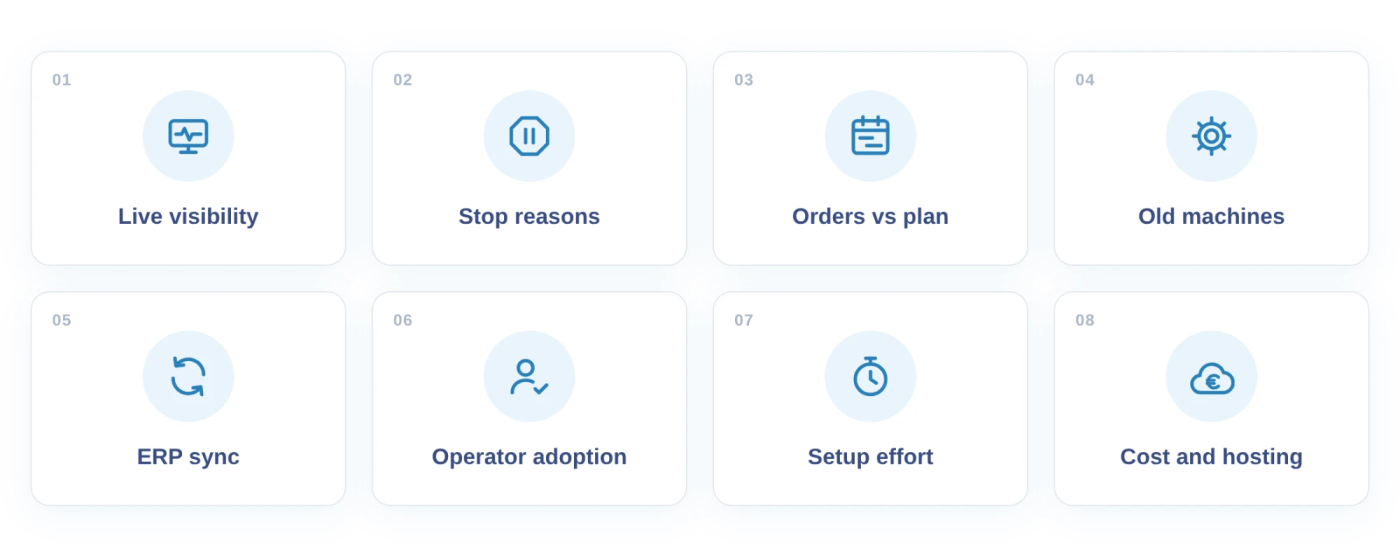
Real time visibility you can act on. A dashboard that refreshes every five seconds adds nothing if nobody checks it. What matters is whether the right person finds out about a stop while it is still happening.
Stop reasons and loss breakdown. Knowing that a machine stopped is a start. Knowing why, and how much each reason costs over a month, is what changes decisions.
Orders against plan. Can you see which order is late because of which machine, and by how much?
Works on old and non networked machines. Most European SME fleets mix new CNC machines with presses, saws and lines that are 15-30 years old.
ERP integration without double entry. In our own conversations with manufacturers, having to type the same data in twice is the most common worry.
Operator adoption. If logging a stop reason takes more than a few seconds, the data quality falls apart. We also looked at language support and whether the tool helps operators do their job, rather than feeling like it watches them.
Implementation effort. We gave each tool a score from 1 (a full IT project) to 5 (useful data in the first week).
Total cost and hosting. The pricing model (per machine, per line, per site, per user), contract length, hardware and hidden fees, and where your data is stored.
Sources: vendor pricing and product pages (checked in October 2026), user reviews on G2 and Capterra, public online forum discussions, and aggregated results from GlobalReader customers.
The 10 best manufacturing monitoring systems in 2026
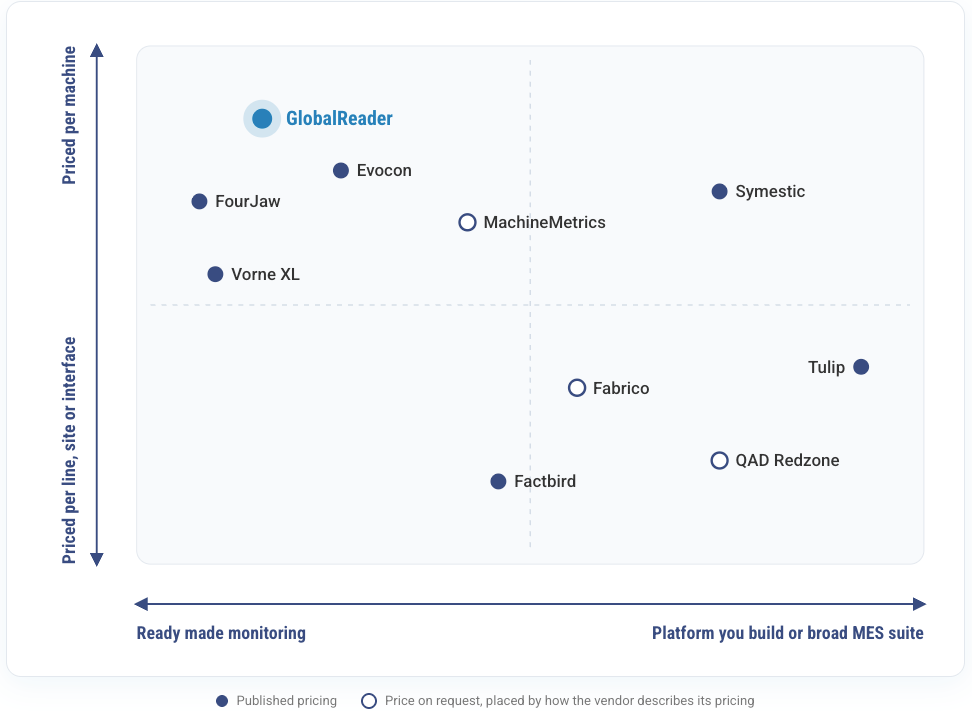
The map below places each tool by how it is priced (per machine, or per line, site or interface) and how much you get ready made versus build yourself.
1. GlobalReader: best for 10+ machine European factories with mixed age machines
GlobalReader is a manufacturing monitoring system, used in more than 200 factories across Europe. It is sold as one subscription that includes the monitoring hardware, sensors, software and support. It was designed for the factory that has a 70 year old hydraulic press next to a new CNC, and needs data from both.
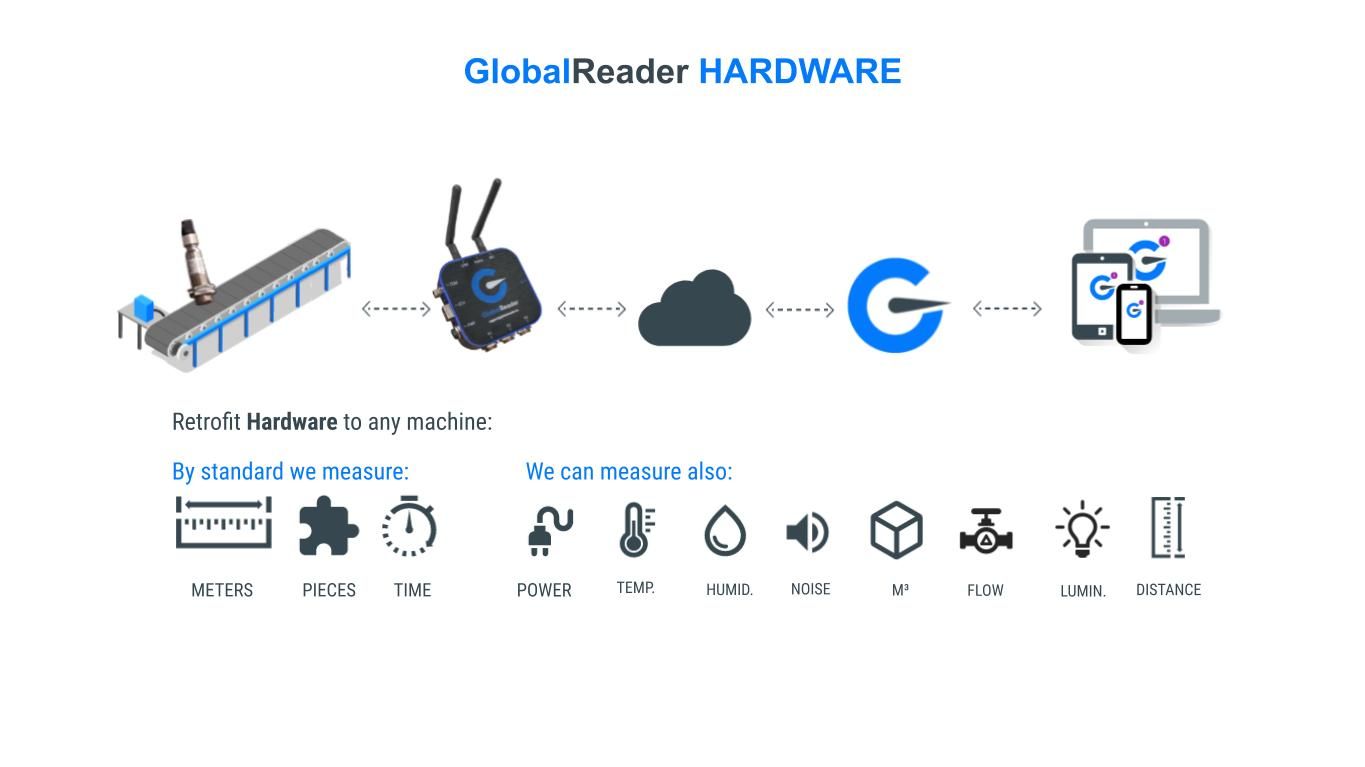
How GlobalReader collects data
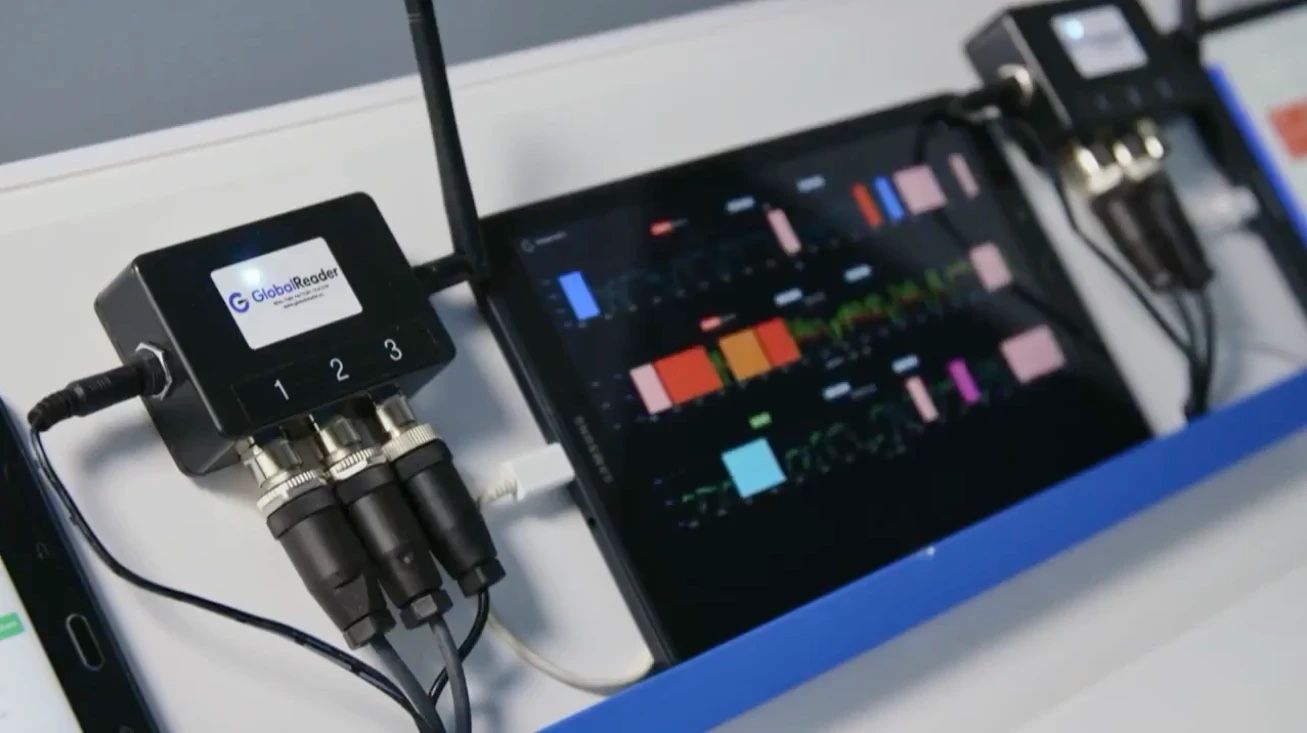
A small device called Scoutbox connects to each machine through simple sensors, most often photo eye and inductive sensors that count parts and cycles, or relay signals from the machine’s own logic. GlobalReader deliberately does not touch your PLC. Where a machine already exposes data, it can be read directly over OPC UA or MQTT. Every Scoutbox has LAN, WiFi and LTE with its own SIM card and switches automatically if one connection drops, so your factory network does not need to be ready first. Readings are buffered on the device and along the way, so if the machine is powered, what it measures is not lost.
What GlobalReader measures
Pieces, metres, running time, stops, scrap (automatically through a dedicated scrap sensor, or entered by the operator), plus electricity, compressed air, temperature, humidity, vibration, weight and volume where needed.
Operators
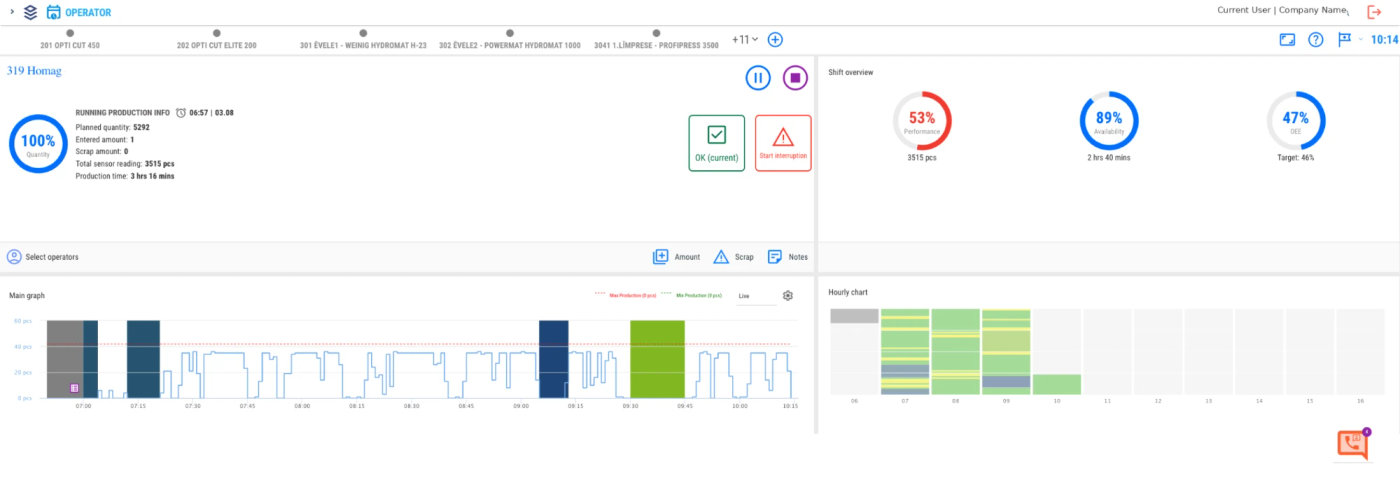
Operators log what they are producing and why a machine stopped, on a touchscreen or by scanning a QR code from a printed sheet of reasons. Their workflow barely changes, because the paper they already use gets a QR code. The operator screen is available in eight languages, including Estonian, Latvian, Finnish and Polish.
ERP integration
This is where GlobalReader differs most from simpler tools. Integrations are fitted to how each factory actually uses its ERP, in both directions. A new production order in the ERP appears on the operator’s screen (“make 50 pieces of X on machine Y”). When the operator marks it done, the order is completed in the ERP and scrap flows back for material accounting. Live examples include Monitor ERP at Avoti, Noom at I&T Metall alongside Microsoft AX and NAV, Directo and EZIIL. If your full integration has to wait, a QR code printed from your ERP can create the order in GlobalReader in the meantime.
Beyond monitoring
Optional modules extend GlobalReader past monitoring. The Planner (€171 per factory per month) plans orders against real measured machine time and plans again when a shift or a machine drops out.
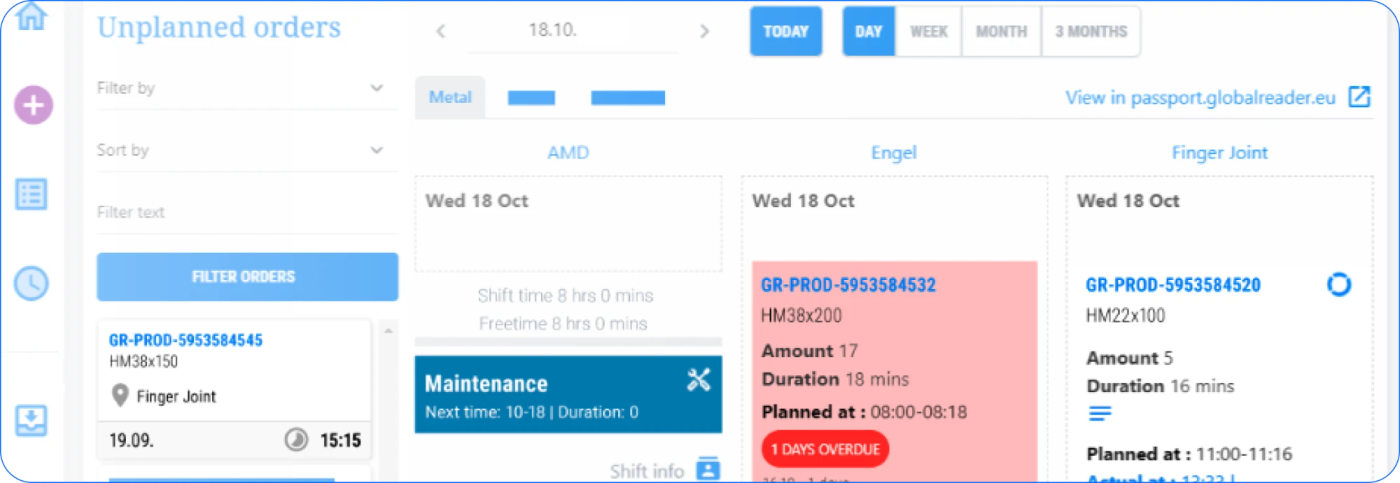
Maintenance (€171 per factory per month) triggers preventive maintenance from actual running hours.
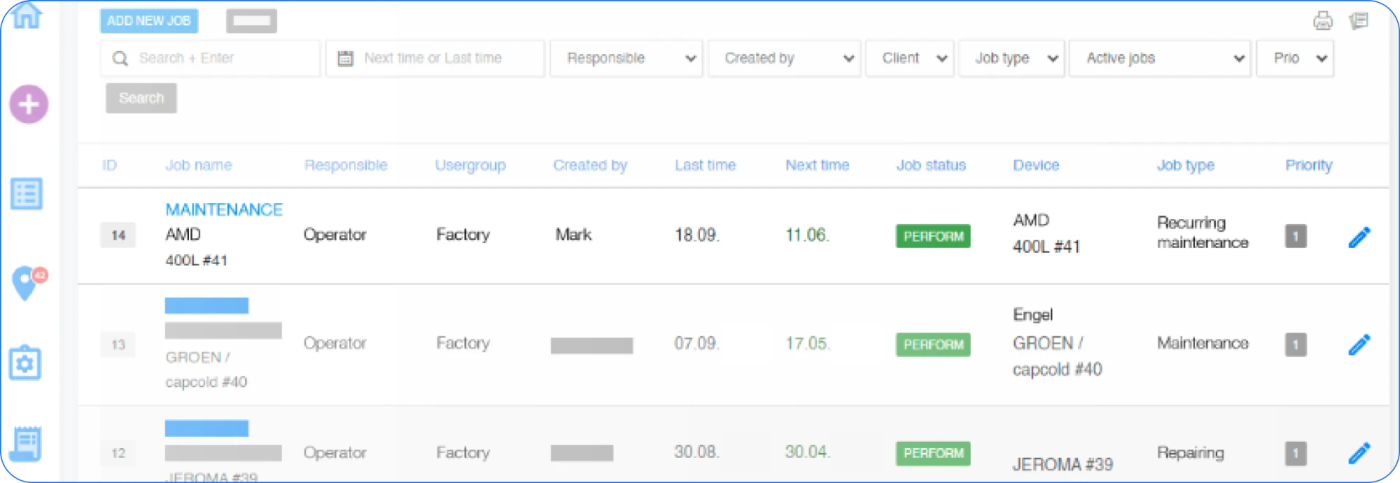
Smart LiveView puts live production on TV dashboards, and Call for Help lets an operator call a mechanic straight to the machine. A Manual Work Station option (€56 per month) covers assembly, packing or painting stations with no machine to measure.
Pricing
From €125 per machine per month for the monitoring service, including Scoutbox hardware, sensors, software, analytics and support. Broken hardware is replaced free under the subscription. Many teams install GlobalReader themselves with remote guidance, or GlobalReader’s technicians can do it for a one-off fee of €137 per device. The Operator module adds €26 per machine per month, and the Smart Factory integration connector €20 per machine per month. Custom integration work is €150 per hour. Monthly billing, with 5% off for paying yearly. See the pricing page for the full list.
Hosting and deployment
Servers are in Europe. A full on premise installation is also possible, where the whole system runs on a server at your site without an internet connection.
Setup
GlobalReader’s initial installation takes 90 minutes per machine. A 15 machine factory is typically fully live in two to three days, with around a third of machines reporting by the end of the first day. Most customers start with one to three machines and expand.
GlobalReader results
Across GlobalReader’s customers, average OEE rose by 27.4% and availability by 22.8% compared with their first four weeks on the system. At €100 of contribution per machine hour and two shifts, that is about €39,200 of recovered production per machine per year.
Who is GlobalReader not the best choice for
Continuous process plants, shops with fewer than about 10 machines on a single shift (you can probably still see everything yourself), or buyers who need formal certifications such as ISO 27001 or SOC 2 from their vendor today. GlobalReader does not use AI features or predictive analytics, and the Maintenance module is built around runtime based preventive maintenance rather than being a full CMMS.
Implementation score: 5/5
“We were also considering Evocon and Leanest, but what tipped our scales toward GlobalReader eventually was the price quality ratio.”
Quality Manager, Balti Spoon
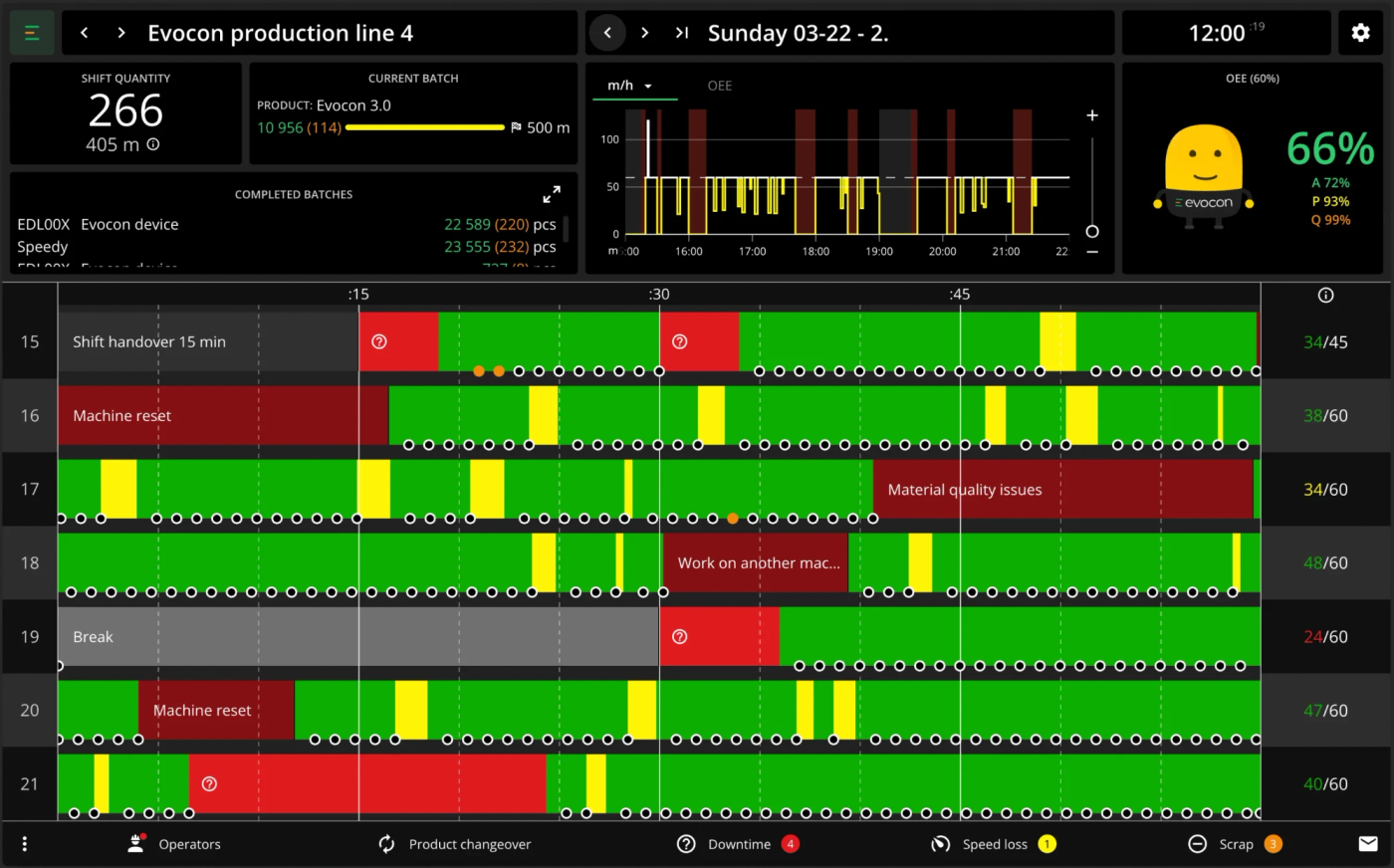
2. Evocon: best for plants that want a polished, self serve OEE tool
Evocon is an OEE and production monitoring tool, aimed mainly at small and mid sized manufacturers. A small connected device, which you rent from Evocon, picks up signals from each machine. It was acquired by the ERP vendor Syspro in January 2026.
Evocon’s strengths
Users consistently praise how quickly they get going and how clear the interface is. Support is rated highly, and downtime and root cause analysis get frequent mentions. Evocon stores data on AWS in European data centres only and holds ISO 27001 certification, which matters for buyers who need that paperwork.
Evocon’s weaknesses
Reviewers mention that some analyses are predefined and not flexible, and several ask for a connection to their ERP. Integrations are a paid add on on the Basic and Professional plans. Some features, such as alerts, an API and the orders view, start on the Professional plan.
Evocon’s pricing
About €194, €256 or €336 per machine per month for Basic, Professional and Enterprise on a one year annual contract ($219, $289, $379 list), plus about €21 per month device rental. Sensors, cables, displays and on site visits are not included.
Who is Evocon the best choice for
Factories that want an easy OEE tool, have budget for the higher price, and value ISO 27001 certification.
Who is Evocon not ideal for
Price sensitive SMEs, or buyers who need deep ERP integration on a lower plan. Our Evocon alternative guide goes into more detail.
Implementation score: 4/5
3. Factbird: best for line based food, pharma and packaging plants
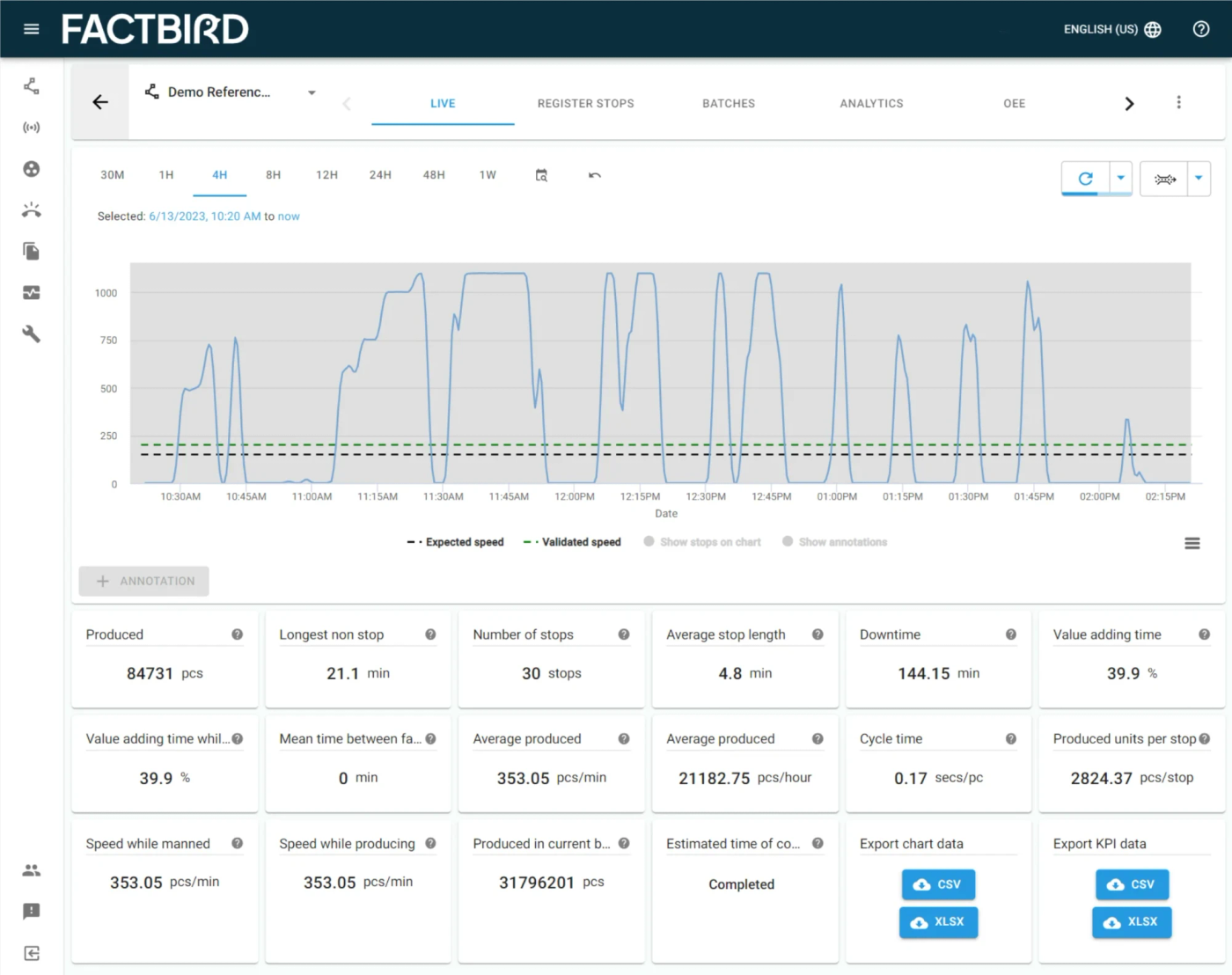
Factbird is a Danish company that became majority owned by the investor Verdane in August 2026. It has grown from OEE into a broader suite with quality and compliance modules, digital work instructions and AI assistants.
Factbird’s strengths
Fast setup, operators find it simple, and support is praised. Factbird holds SOC 2 Type II and supports compliance needs common in pharma.
Factbird’s weaknesses
Reviewers mention limited reporting flexibility and advanced analytics features compared to larger industrial platforms. Several reviewers mention the hefty price tag.
Factbird’s pricing
About €354 per line per month for each main product, plus a required platform fee of about €887 per site per month and an additional 2% support fee. A two year agreement is standard. Hardware is bought separately.
Who is Factbird the best choice for
Larger line based plants in food, pharma or packaging that need compliance features.
Who is Factbird not ideal for
Discrete factories with many individual machines, where per line pricing and the site fee add up quickly. See our Factbird alternative guide.
Implementation score: 4/5
4. MachineMetrics: best for CNC shops with modern controllers
MachineMetrics is a US company focused on CNC and discrete machining. It reads data directly from modern machine controllers and connects to many North American shop ERPs such as JobBOSS, Epicor, ProShop and Sage X3, as well as SAP and Dynamics 365. In September 2026 it launched a new platform version, MaximaOS, with AI features.
MachineMetrics’ strengths
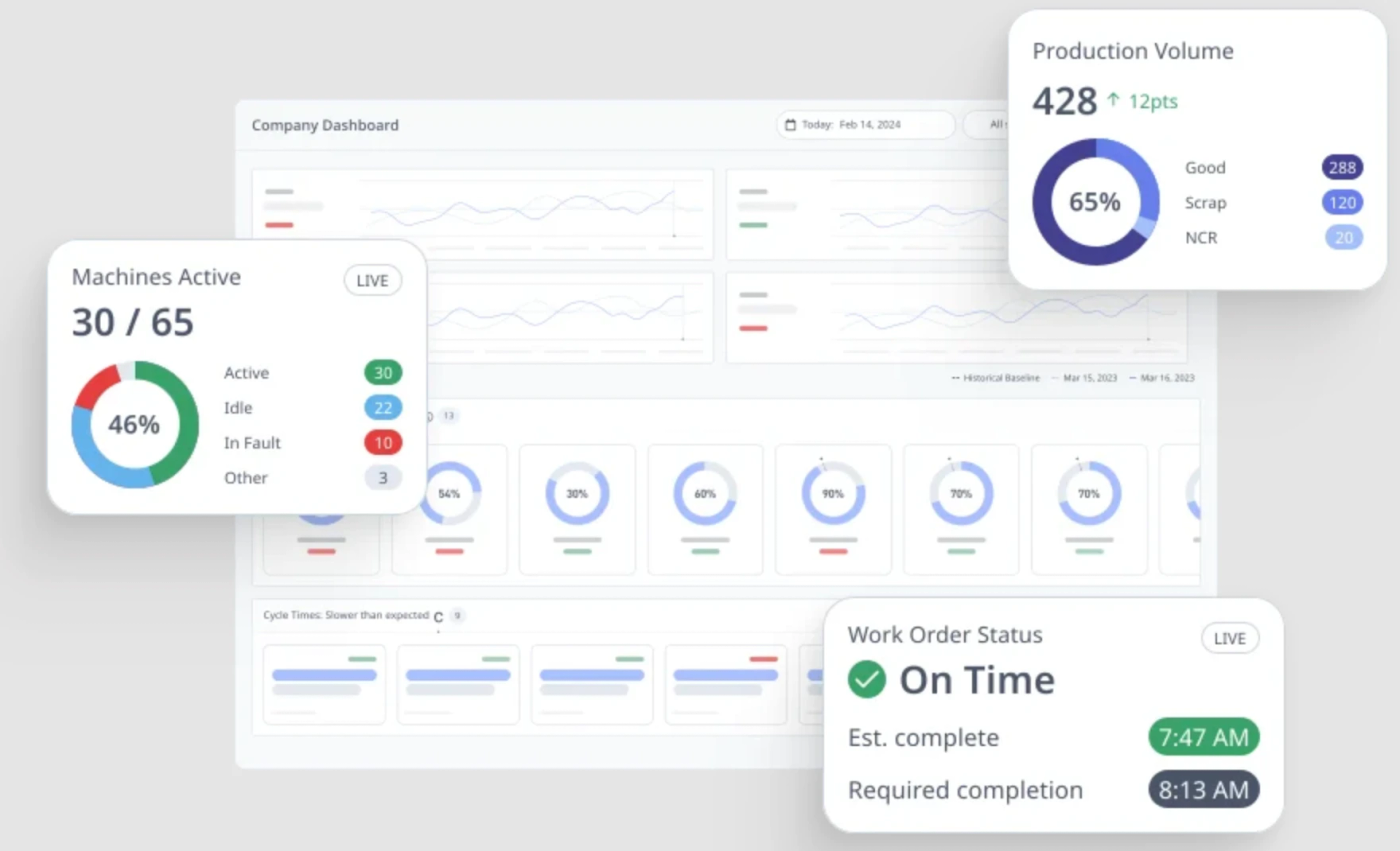
The few public reviewers praise the depth of machine data: “the diagnostic data per machine is amazingly in depth.” Real time dashboards and alerts are also mentioned.
MachineMetrics’ weaknesses
Online reviewers mention that the cost can be a little high, that the integration can sometimes be complicated, and that you may need someone with technical knowledge. Data is hosted on AWS, and we found no EU region option on its security pages.
MachineMetrics’ pricing
Not published. A third party analysis of its online hardware store puts an edge kit at about €1,260, and the hardware for a 10 machine site at about €8,000 before software.
Who is MachineMetrics the best choice for
CNC heavy shops with modern controllers and in house technical skills.
Who is MachineMetrics not ideal for
Mixed fleets with older non CNC machines, or European buyers who want local support and EU hosting.
Implementation score: 3/5
5. QAD Redzone: best for large food and beverage plants focused on frontline teams
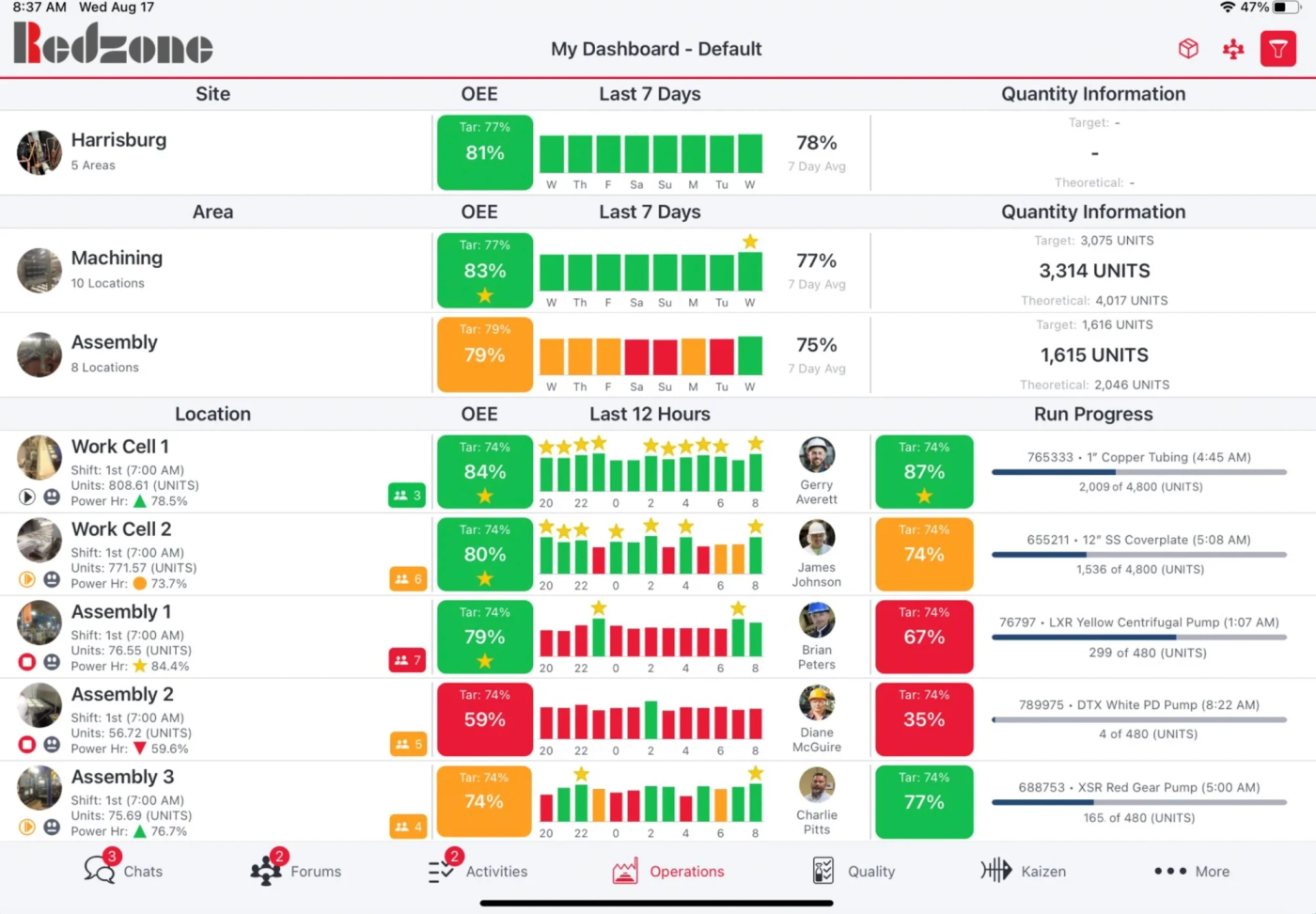
Redzone has been part of the ERP company QAD since 2023. Its focus is the frontline team: live OEE on big screens, team communication, digital checks and training, all supported by a Redzone coach during rollout.
QAD Redzone’s strengths
Plant managers like being able to very quickly see the status of the production floor, and many credit it with removing paperwork. Coaching during rollout gets a lot of praise. The interface is available in 22 languages.
QAD Redzone’s weaknesses
Rollout is a bigger undertaking. Redzone itself talks about 90 days to measurable results. Reviewers find question templates rigid and say sensor based data can be inaccurate.
QAD Redzone’s pricing
Not published; depends on sites and modules.
Who is QAD Redzone the best choice for
Large food, beverage and consumer goods plants that want a structured culture programme.
Who is QAD Redzone not ideal for
A 15 machine discrete plant that needs data next week.
Implementation score: 2/5
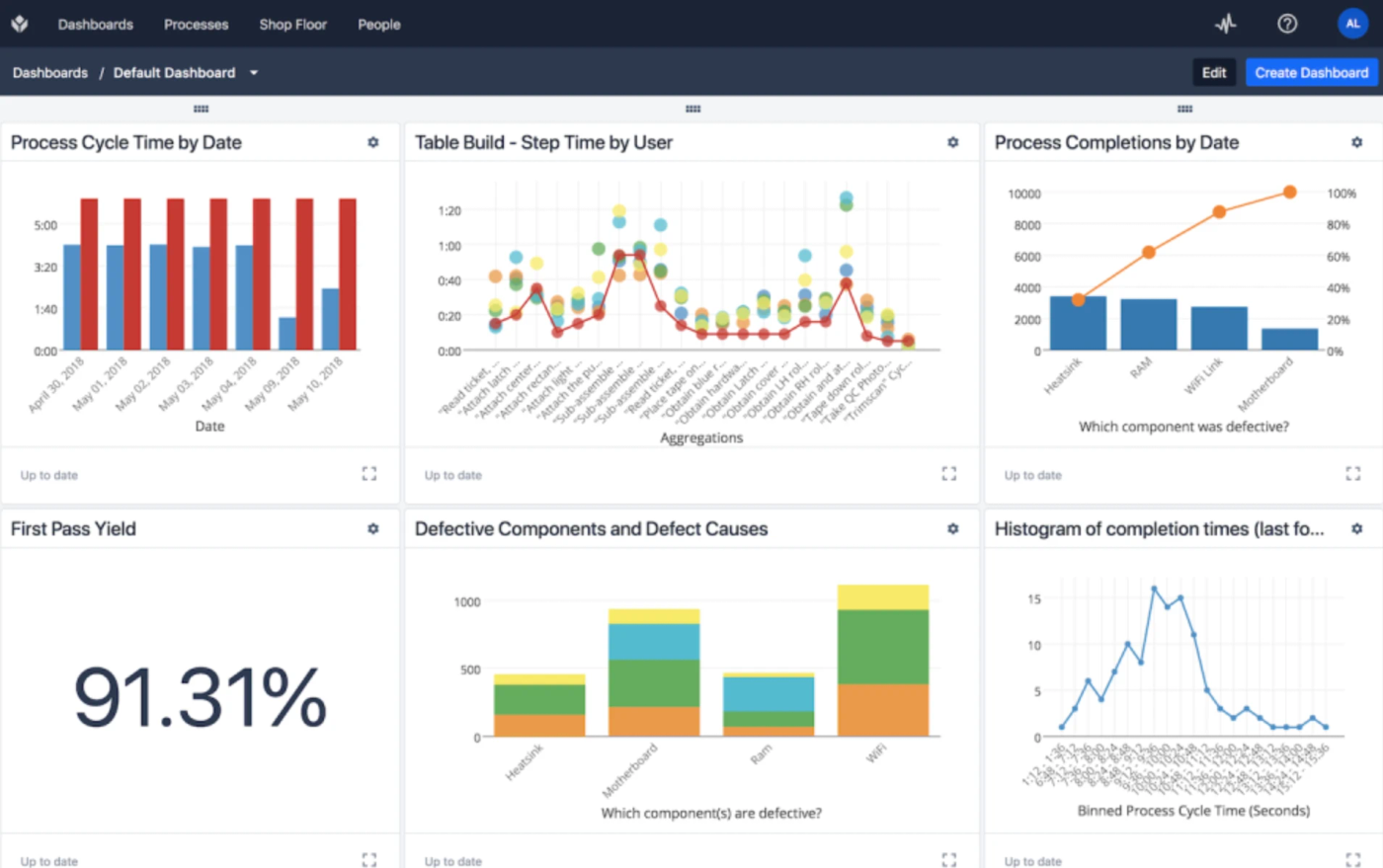
6. Tulip: best for regulated assembly teams that want to build their own apps
Tulip is a US no code platform for building your own shop floor apps, used widely in pharma, medical devices and aerospace. It raised a large investment round led by Mitsubishi Electric in early 2026.
Tulip’s strengths
If you have people who like to build, Tulip is very flexible. Integration with other systems and support get good marks. It holds SOC 2 Type 2.
Tulip’s weaknesses
Tulip is a toolkit, so someone has to design and maintain the apps. Reviewers note that complex enterprise requirements can require additional technical effort and that analytics can be limited. It runs in the cloud only; on premise hosting was discontinued in 2021.
Tulip’s pricing
About €89 per interface per month on Essentials or €222 on Professional, billed annually with a minimum of 10 interfaces. Optional machine kits cost from about €335 each.
Who is Tulip the best choice for
Teams with an in house continuous improvement or digital engineer who wants to build tailored apps.
Who is Tulip not ideal for
Factories that want a ready made monitoring system working in the first week.
Implementation score: 2/5
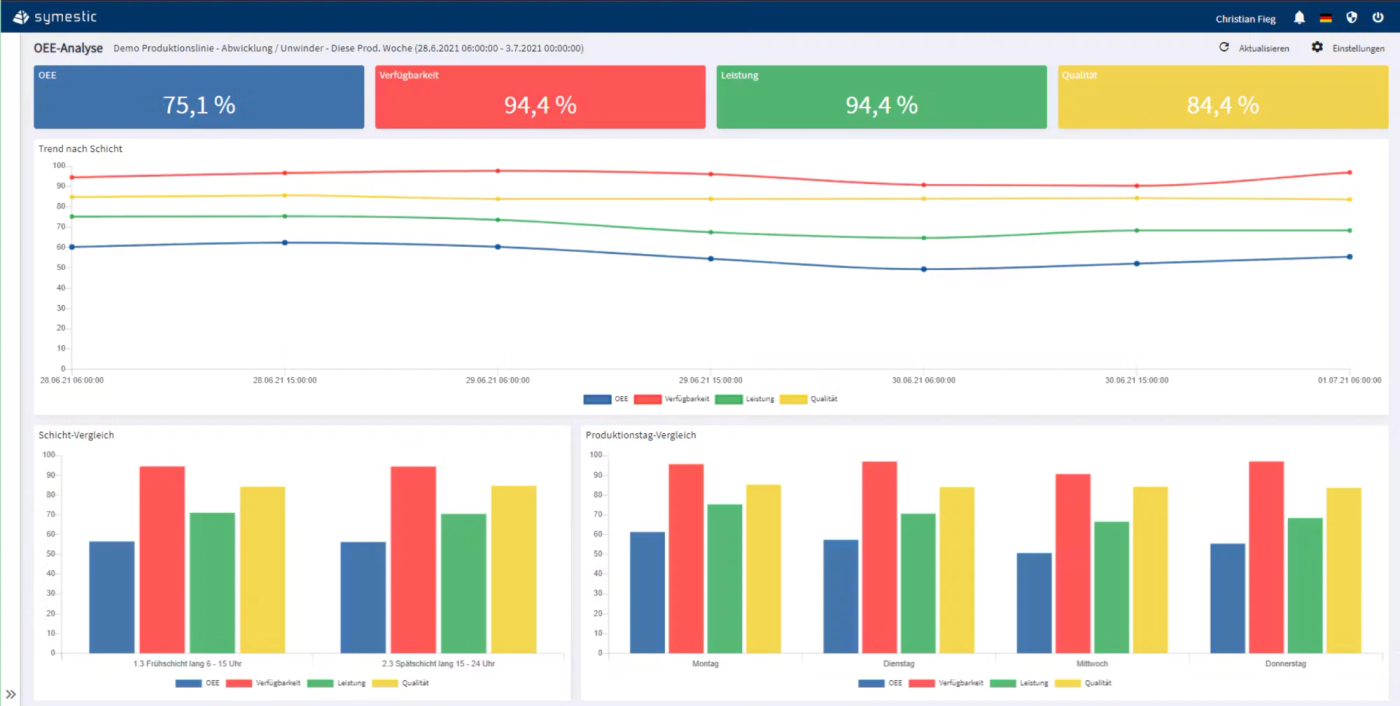
7. Symestic: best for mid sized German speaking plants that want a cloud MES
Symestic is a German cloud MES running on Microsoft Azure, with OEE, order tracking, quality and traceability. Its website is available in eight languages, including Polish.
Symestic’s strengths
Symestic publishes its prices in euros, which is still unusual in this market, and covers more MES functions out of the box than a pure monitoring tool. It connects to SAP and Dynamics 365.
Symestic’s weaknesses
The standard contract is 36 months, and hardware gateways are extra.
Symestic’s pricing
€500 per month for the platform plus €350 per machine per month on the Professional plan, billed annually on a 36 month term. Gateways cost €350 to €450 each.
Who is Symestic the best choice for
Mid sized plants in DACH that want a broader cloud MES and are comfortable with a longer commitment.
Who is Symestic not ideal for
Price sensitive 10-20 machine plants, or anyone who wants to start month by month.
Implementation score: 3/5
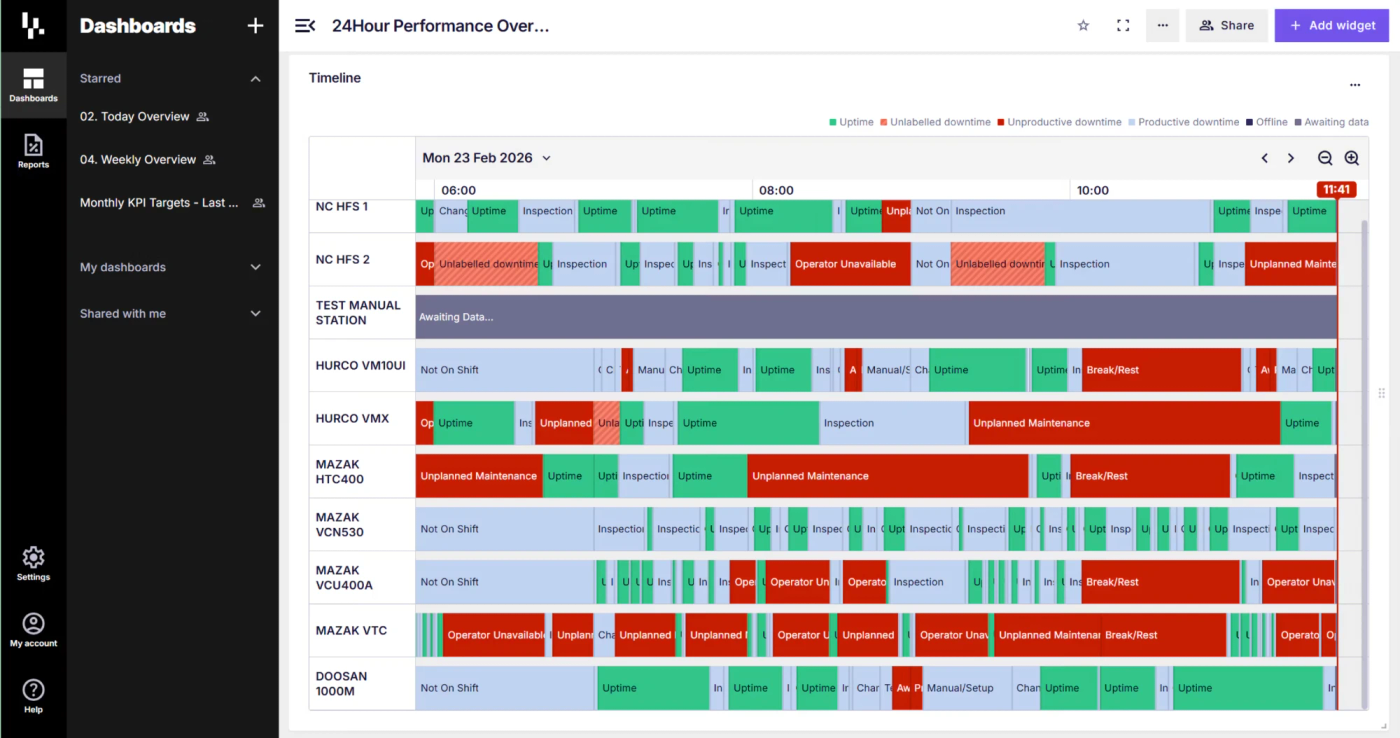
8. FourJaw: best for UK machine shops that also want energy data
FourJaw is a UK company that started as a University of Sheffield spin out. It focuses on CNC and machining, with simple clip on current sensors and built in energy monitoring.
FourJaw’s strengths
Users love the value for money.
FourJaw’s weaknesses
Reviewers mention that initial setup could be complex, and that customisation and some reports are limited. The interface is available in English and French, and sales and support are UK based. There is a five machine minimum.
FourJaw’s pricing
Standard is about €84 per machine per month paid annually (about €105 monthly), plus about €234 per device. Pro, which includes hardware, tablets and on site onboarding, is about €168 per machine per month annually.
Who is FourJaw the best choice for
UK machining SMEs that want simple utilisation and energy data.
Who is FourJaw not ideal for
Non CNC fleets, buyers outside the UK who want local language support, or plants that need deep ERP integration.
Implementation score: 4/5
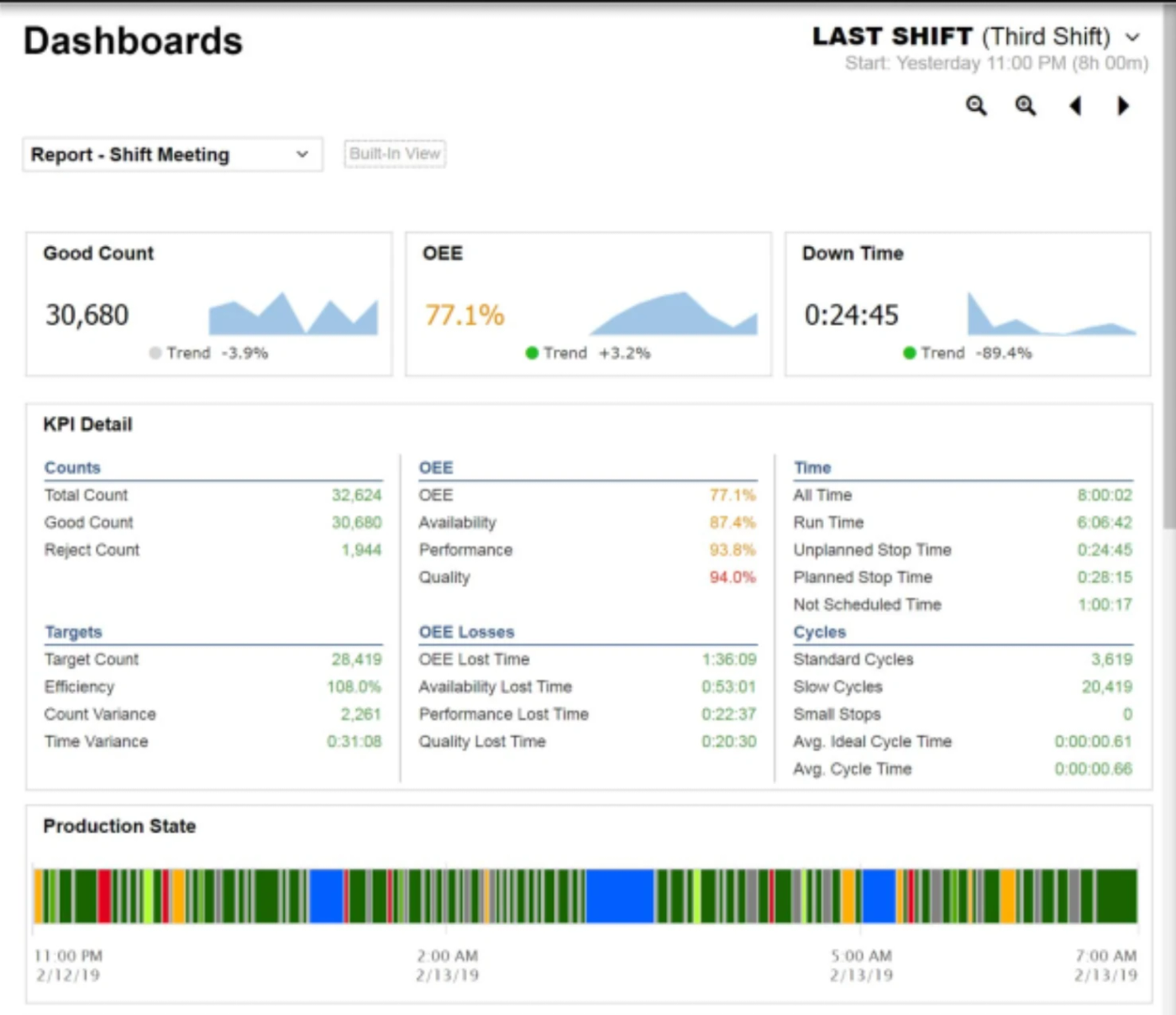
9. Vorne XL: best for single lines that want to buy once with no subscription
Vorne is a long established US company. The XL is a self contained device that sits on a production line, counts, shows a large scoreboard and calculates OEE, with no monthly fee.
Vorne XL’s strengths
Online reviewers praise the plug and play setup and exceptional technical support. No subscription makes it easy to approve as a one off purchase.
Vorne XL’s weaknesses
Users mention devices that “can be finicky communicating to servers or PLCs,” limited options for rotating shifts, and that building operator habits for data entry takes effort. ERP integration is possible through an API but needs custom work. Outside North America it is sold through partners.
Vorne XL’s pricing
About €4,160 per unit, one time, at international list price.
Who is Vorne XL the best choice for
A single line or a few lines where a one time purchase is easier to approve than a subscription.
Who is Vorne XL not ideal for
A 15 machine discrete plant, where one unit per machine quickly becomes a large upfront cost, or factories that need ERP sync and planning.
Implementation score: 4/5
10. Fabrico: best for plants where maintenance is the first problem to fix
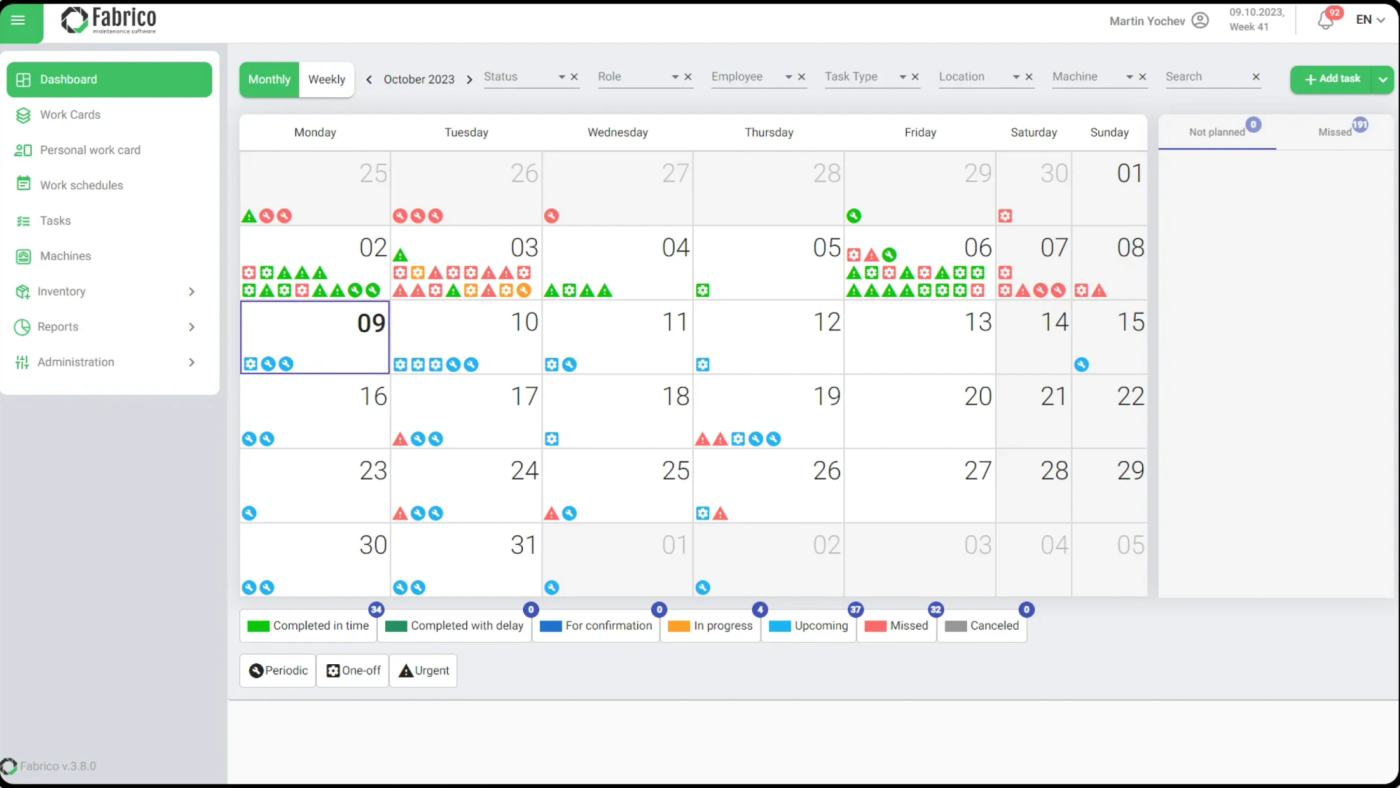
Fabrico is a Bulgarian company with an office in Warsaw. It started as a maintenance system (CMMS) and added OEE monitoring in 2025. Data is hosted on AWS in the EU and the company holds ISO 27001.
Fabrico’s strengths
Reviewers like the mobile app and responsive support. For teams whose biggest pain is unplanned breakdowns and paper maintenance logs, it covers that well.
Fabrico’s weaknesses
Users note that reports are not customisable and that the initial load of information can be time consuming. Most reviews are about maintenance work orders rather than production monitoring, and its own pages give different rollout times, from “days” to three or four months for a full OEE rollout.
Fabrico’s pricing
Not published; plans are quoted per plant and users.
Who is Fabrico the best choice for
Plants where maintenance is the problem to fix first.
Who is Fabrico not ideal for
Factories whose main need is production visibility and ERP linked order tracking.
Implementation score: 3/5
The best manufacturing monitoring system by industry
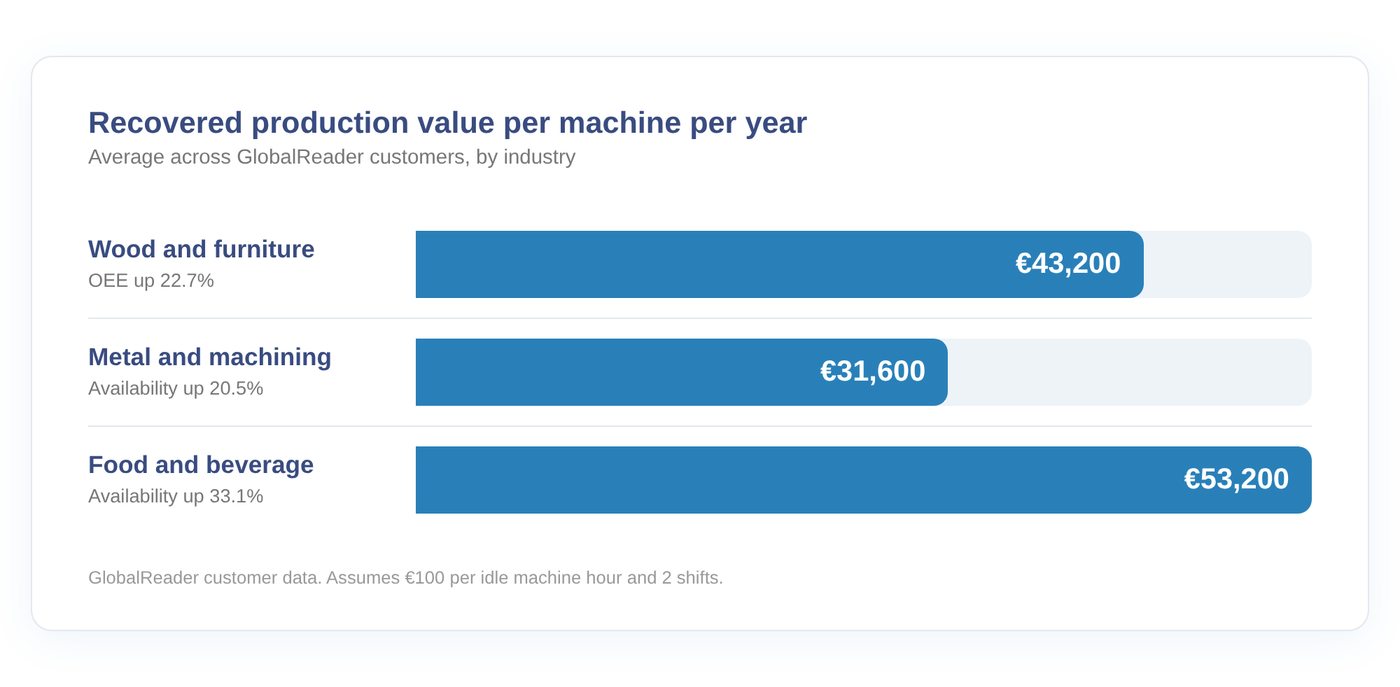
The right system depends a lot on what you make. Here is how the choice changes in the three industries we work with most. The euro figures below come from our own customer data and assume €100 of lost contribution per idle machine hour and two shifts; your own numbers will differ.
Wood and furniture
Wood plants deal with species and thickness changeovers, sawlines and presses that are often decades old, and long running lines across three shifts. Across GlobalReader’s wood and furniture customers, OEE rose by 22.7% on average, worth about €43,200 per machine per year.
At Balti Spoon, a veneer producer with 340 employees and 29 machines connected, output on connected lines rose by 20% year on year and unplanned downtime fell from 35% to 20%. The data also exposed up to 8 hours of hidden lost time per week between identical lines. Latvian furniture maker Avoti sends set up time, run time, scrap and scrap reasons straight into Monitor ERP to calculate real production costs.
Top picks for wood and furniture manufacturers: GlobalReader for mixed fleets and ERP linked costing. Evocon if certification paperwork matters more than price. Vorne XL for a single line.
Metal and CNC
Metal shops usually have a mix of CNC machines with modern controllers and older lathes, presses and welding stations, plus constant pressure to price jobs correctly. Across GlobalReader’s metal and machining customers, availability rose by 20.5% on average, worth about €31,600 per machine per year. Performance was already high in most of these shops, so the gains came from more uptime.
A metal components manufacturer started with 4 CNC machines and expanded to 21 over three years as OEE and availability improved. I&T Metall connected GlobalReader to Noom ERP so that actual working time per job flows straight into costing, replacing paper job sheets.
Top picks for metal shops: GlobalReader for mixed or older fleets and ERP linked job costing. MachineMetrics for CNC only fleets with modern controllers. FourJaw for UK machine shops. For controller level detail, see our CNC monitoring guide.
Food and beverage
Food plants deal with washdowns, frequent changeovers, line based production and strict temperature records for audits. Across GlobalReader’s food and beverage customers, availability rose by 33.1% on average, worth a conservative €53,200 per machine per year.
Tere Põlva replaced manual warehouse checks with automated temperature monitoring at 21 locations, with SMS alerts and a TV map of the factory, and was ready for its BRC audit within a two week deadline. Another dairy producer replaced an employee walking the hall with a notebook by 25 sensors. Its new setup halved the cost of environmental monitoring.
Top picks for food and beverage factories: GlobalReader for production lines plus environment monitoring under one system. Factbird or QAD Redzone for large, compliance heavy line based plants with a bigger budget.
What does a manufacturing monitoring system cost?
Most tools cost somewhere between €80 and €350 per machine per month, but the pricing model matters more than the headline number. Per line, per site and per interface pricing can look cheap on the website and add up quickly in a discrete factory with many separate machines.
Here is what the first year would cost a typical factory with 15 machines, using list prices and published hardware fees only, before any volume discounts.
| Tool | Year 1 estimate, 15 machines | What is included and what is not |
|---|---|---|
| GlobalReader | About €24,600About €29,200 with the Operator module | 15 × €125 × 12 months + €137 one time installation fee per device. Hardware, sensors and support included. |
| FourJaw Standard | About €18,800 | Annual plan plus device per machine. Volume discounts available from 10 machines. |
| Tulip Essentials | About €21,000Plus your build time | 15 interfaces plus a machine kit each. You build the apps yourself. |
| FourJaw Pro | About €30,500 | Includes hardware, tablets and onboarding. |
| Evocon Basic or Professional | About €38,800 or €50,000Plus sensors | Annual licence plus device rental. Integrations extra below Enterprise. |
| Factbird | About €32,500 to €75,8005 lines to 15 lines, plus hardware | Per line price plus an additional €887 per month site platform fee and a 2% support fee. |
| Vorne XL | About €62,400 one timeThen no yearly fee | One unit per machine at international list price. |
| Symestic Professional | About €69,500 | €500 per month platform + €350 per machine + one gateway. 36 month term. |
| MachineMetrics, QAD Redzone, Fabrico | On request | Ask for a written quote that includes hardware, installation and integration. |
Typical hidden costs of manufacturing monitoring systems to be aware of
Platform or site fees on top of the per machine price
Device rental or hardware bought separately (sensors, cables, displays, tablets)
Installation and on site visits
Integration work, and the hourly rate for it
Per user seats, especially if operators need their own logins
Minimum machine counts and contract length (two or three year terms are common)
What the price looks like when you grow from 5 machines to 25
Will a manufacturing monitoring system pay back?
At around €100 per hour of machine time, recovering just over one hour per machine per month covers a €125 subscription. GlobalReader’s customers recover far more than that on average, but it is worth running your own numbers. You can use our ROI calculator with your own hourly rate and shift pattern.
Do you even need software? Excel, DIY and full MES
Not every factory needs a monitoring system today. It helps to be honest about the alternatives.
Excel and a whiteboard
For a shop with fewer than about 10 machines and one shift, Excel can work. The manager can see most of the floor, and the cost is close to zero. It starts to break down with night shifts, when stop reasons are written up at the end of a shift from memory, and when nobody fully trusts the numbers. A line we hear often from production managers: “We thought our downtime was 1.5 hours. It was actually 4.” Studies of data quality point the same way; in a 2025 Drexel LeBow and Precisely survey, 67% of organisations said they don’t completely trust the data they rely on for decision making.
Build it yourself with Ignition, Grafana or Power BI
If you have an in house controls engineer, a platform such as Ignition can be connected to almost anything and is loved by engineers for its unlimited licensing. The trade off is cost and ownership. A realistic OEE build with Ignition and an OEE module (Sepasoft) starts at around €35,000 in licences before integrator time. Reviewers warn that without good architecture and development standards projects become difficult to maintain. People who built custom tools often describe the same pattern: excellent at first, hard to maintain once the person who built it moves on.
A full MES
Systems such as Siemens Opcenter, SAP or Plex are built for large, complex, highly regulated plants. Projects usually take over a year and need a dedicated IT team. For most 10-20 machine factories, monitoring is the sensible first step, and many never need more.
The bigger picture
Manufacturers that do invest in smart manufacturing report real gains. In Deloitte’s 2025 smart manufacturing survey of 600 US manufacturers, respondents reported 10-20% improvements in production output and 10-15% of capacity unlocked. In Europe there is still a lot of room: according to Eurostat, 71% of SMEs remain about 20 percentage points below the 90% target for basic digital intensity. And unplanned downtime is expensive at every scale; Siemens estimates it now costs the world’s 500 largest companies 11% of their revenues.
How to choose the best manufacturing monitoring system: 7 questions to ask before you sign
Will it work on our oldest machine, and how exactly will you connect it?
How many seconds does it take an operator to log a stop reason?
Can you show me the data flow with our ERP, for our ERP, in both directions?
What is the all in price for our 15 machines in year one and year three, including hardware, installation and integration?
Where is our data stored, and can the system run on premise if we need it to?
Can we start with one to three machines and expand?
Who supports us after go live, and in which language?
If you want to see how GlobalReader helps you get more out of your factory resources, you can sign up for a free demo account or book a 30 minute demo.
To sum it up
There is no single best manufacturing monitoring system for everyone, but there is a best fit for your factory.
If you run 10+ machines in Europe, with a mix of old and new equipment and an ERP you want to keep, GlobalReader gives you the fastest route to trustworthy data at a predictable price.
If you run large, compliance heavy food or pharma lines, look at Factbird or QAD Redzone.
If you run modern CNC machines and have technical staff, MachineMetrics is worth a demo.
Whichever tool you shortlist, start with a few machines, measure honestly, and only scale once your team trusts the numbers.
Frequently asked questions
What is the best manufacturing monitoring system for small manufacturers?
For European manufacturers with 10+ machines and two or more shifts, GlobalReader is usually the most practical choice: hardware is included from €125 per machine per month, setup takes 90 minutes per machine, and it connects to your ERP. Very small shops with fewer than 10 machines on one shift may be fine with Excel or a simple tool such as FourJaw.
What software can I use to track production?
You can use a manufacturing monitoring system such as GlobalReader, Evocon or Factbird to track machine status, output and stop reasons automatically. ERP production modules track orders and materials, but they rely on manual entries, so they rarely show what really happened on the floor. Many factories combine the two, with monitoring data flowing into the ERP.
What is a manufacturing monitoring system?
A manufacturing monitoring system collects data from machines in real time, using sensors or direct machine connections, and shows what every machine is doing and why it stopped. It links that data to orders, shifts and operators so managers can see where production time is lost and act during the shift.
How much does a manufacturing monitoring system cost per machine?
Published prices range from about €80 to €350 per machine per month, depending on the vendor and plan. Per line or per site pricing, platform fees, device rental and installation can change the total a lot. For a 15 machine factory, year one costs in our comparison range from about €18,800 to €75,800.
Does manufacturing monitoring work with old machines that have no PLC or network?
Yes, if the system uses retrofit sensors. GlobalReader's Scoutbox reads old and new machines through simple sensors or relay signals, without touching the PLC, and brings its own LTE connection. Tools that rely on controller data, such as MachineMetrics, need extra hardware for older machines.
What is the difference between a manufacturing monitoring system and an MES?
A monitoring system focuses on live machine data, stop reasons and output against plan, and usually goes live in days. An MES runs the whole execution process, including work orders, traceability, quality and labour, and usually takes months. Most 10-20 machine factories get the biggest return from monitoring first.
Can a manufacturing monitoring system run on premise?
Some can. GlobalReader can run fully on a server at your site without an internet connection, and Vorne XL is an on site appliance. Evocon, Factbird, Tulip, Redzone, Symestic, FourJaw and Fabrico are cloud based.
How long does it take to implement a manufacturing monitoring system?
It ranges from hours to months. GlobalReader takes about 90 minutes per machine, so a 15 machine factory is usually live in two to three days. Platform tools such as Tulip or coached programmes such as Redzone can take several months before results are measurable.
Will operators feel like they are being watched?
They might if it is introduced the wrong way. The most successful rollouts present monitoring as a way to protect operators from blame and give them an objective basis for conversations, for example by showing that a machine was waiting for material rather than that someone was slow. Quick stop reason logging by QR scan or touchscreen, in the operator's own language, also helps adoption.