Balti Spoon unlocked 20% of capacity, producing 2 million m² more veneer a year per department
Balti Spoon is a decorative veneer manufacturer, in production since 1998. It is part of the Möhring Group and makes the thin, beautiful-grain sheets that face furniture, doors, wall panels and flooring. They produce around 23 million m² veneer a year, delivered to more than 350 customers in over 40 countries. By volume Balti Spoon sits among the world’s largest decorative-veneer producers.
The factory runs roughly 40 production lines and machines across several departments: peeling, slicing, splicing and grading-logistics-warehouse department, and about half of these machines are well over a decade old. For most of its history, the plant was steered by two numbers: material yield and m³ produced per shift. Machine productivity, downtime and true working time simply weren’t measured. OEE wasn’t even a concept that carried weight on the floor.
Around two years ago, Balti Spoon started connecting machines to GlobalReader, beginning with its biggest mass-production machines and expanding department by department. Today 29 of its 40 production lines and machines are connected.
Two years on, output on connected lines is up around 20% year-on-year, unplanned downtime has fallen from 35% to 20%, OEE has gone from an unused acronym to a daily target, and decisions are now made on real machine data.
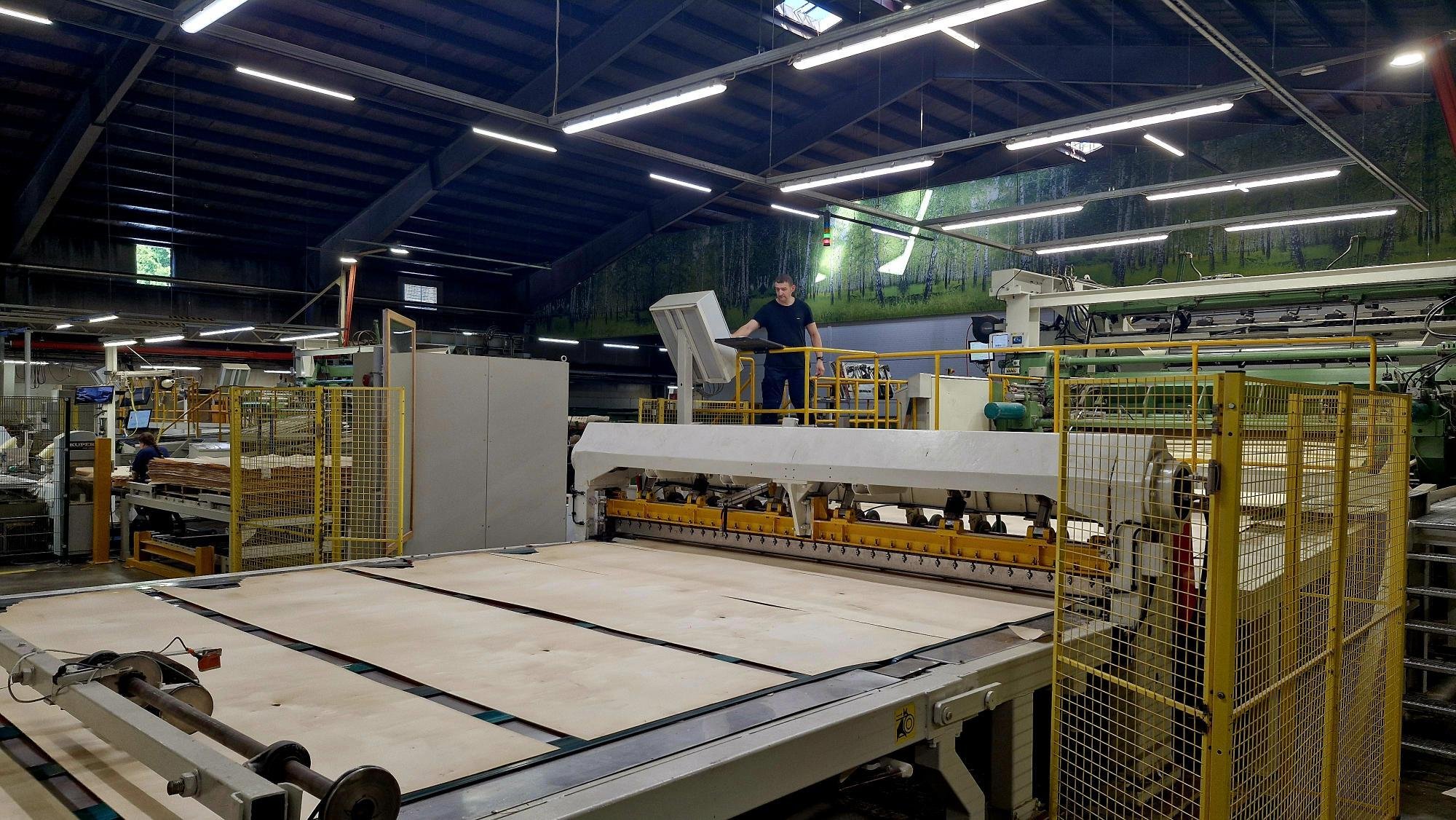
In this case study, Ingrid Luide, Quality Manager at Balti Spoon and the person who keeps the GlobalReader programme alive across the plant, explains how they ran a high-volume veneer factory before, what finally pushed them to start measuring, and how they now get materially more out of the equipment and people they already had.
Company profile:
What they produce: Premium decorative wood veneer: peeled, sliced and made-to-order spliced veneer faces for furniture, doors, wall panels and flooring
Company size: 340 employees (office + shop floor). Part of the larger global Möhring Group (Estonia, USA, Poland)
Customers: Export-led. Door, panel, furniture and flooring producers across Europe, North America and Asia.
Production volume: 23 million m² of veneer a year
Shifts per day: Up to 3 shifts. Some machines run 24 hours a day, 5 days a week
Machines: 40, half of which are older and the other half newer (peelers and slicers older, the spliced-veneer department newer)
Connected to GlobalReader: 29 machines, which make up the majority of production (planning to connect 10 more)
Most important KPIs for Balti Spoon: Material yield (veneer out per log), waste %, machine working time/availability, downtime and its reasons, product-by-product performance, and OEE
GlobalReader modules in use: Operator and Analytics, Call for Help, quality-control modules, operator shift-start checklists, and sharing production instructions and drawings
Systems landscape: GlobalReader runs alongside the plant’s field-specific ERP, Timber Plus, exchanging order data
Before GlobalReader: if it wasn't yield, it wasn't measured
Balti Spoon could account for every log with precision. They knew exactly how much wood went in and how much veneer came out the other end. Yield was sacred and tracked down to the square metre. What Balti Spoon couldn't see was everything that happened to a machine in between. Downtime lived on paper, help was summoned by walkie-talkie, and the productivity picture came down to gut feeling.
“A lot of info got lost and there was a lot of frustration. It seemed like everything was somehow very bad some days. But there was no actual data on which to prove anything or analyse it.”
None of this showed up as one dramatic failure. It all accumulated and caused misunderstanding. A stop that felt like five minutes was really fifteen. A day that felt like everything had gone wrong couldn't actually be proven, or fixed, because there was no data behind the feeling. So the plant ran on emotion: strong opinions about what was going badly, and nothing solid to argue with or act on.
The biggest bottleneck: nobody could see the difference between planned hours and worked hours
The biggest blind spot was time itself. Two machines that looked identical, ran the same schedule and were assumed to do the same work could, in reality, be hours apart every week, and no one could see it. Downtime was estimated by gut, idle time disappeared unrecorded, and because speeds were never tracked product by product, a slow product mix and a slow machine looked exactly the same. **
“There might have been five to eight hours of difference in the working hours between two seemingly identical production lines. We didn’t have any data on product-based speeds or settings. It’s not only the machine that matters, but also what we produce.”
In a plant where one stopped machine on a big line costs around €150 (when including profit loss, the cost rises to around €1000) per hour, hours of invisible lost time per line, per week, was the difference between a good month and a great one, but nobody could prove where the lost time went.
Why did Balti Spoon choose GlobalReader?
The move toward data-led production began with a change of mindset at the top. A new leadership, used to running production on data, wanted to measure the factory properly from day one, and immediately started evaluating the best tools to do it.
“We were also considering Evocon and Leanest, but what tipped our scales toward GlobalReader eventually was the price-quality ratio.”
What they wanted first was simple and concrete: real, uniform machine monitoring to replace the paper, so that every stop everywhere was registered the same way. GlobalReader ticked all these boxes for Balti Spoon at a budget-friendly cost.
“First and foremost we wanted to implement machine monitoring and get rid of all kinds of papers, so that downtimes would be registered consistently in the same format.””
Machine monitoring was what sealed the deal for Balti Spoon. What they didn't expect was a second win, just as valuable: the operator comments. It became a direct channel into the production floor that they never had before.
GlobalReader’s Machine Monitoring capabilities were what sealed the deal for Balti Spoon. But what kept GlobalReader woven into their daily production life were the things that turned out to matter once it was live. Above all, the operator comments, a channel into the floor Ingrid simply didn’t have before.
“What I like most is that you can leave comments everywhere. I can’t get to every operator every day to ask how things are going, but through those comments, I get so much valuable information”
Two more GlobalReader features quickly became part of the daily routine. At the start of every shift, operators now run a mandatory checklist that catches machine faults before they turn into breakdowns. And every two hours, a quality check pops up, prompting a deliberate look at the product.
“The operator checklist and reporting have helped us significantly reduce breakdown points.”
And underneath it all, a customer support experience that made Balti Spoon’s rollout painless.
“I really appreciate the quick responses from the GlobalReader support team. The technicians are great too. One of them was actually here again today, configuring the slicer sensors. The cooperation goes really smoothly.”
Rolling out GlobalReader across the factory
Once the team decided what they wanted to measure on each machine, their own Technical Department did the work.
“The installation itself went fairly painlessly. The first task was working out, machine by machine, what we wanted to measure and where the sensors should sit to give us the best productivity data. Once we’d figured that out, we just handed the Technical Department a work order to fit the sensors.”
Rather than wiring up all 40 machines at once, they rolled GlobalReader out in deliberate waves of around five, which kept both the data checks and the operator training manageable.
The equipment is split roughly evenly between older and newer machines, and the rollout has steadily worked through both, starting with the biggest mass-production machines (the ones running the most hours and producing the most volume) and most recently adding around ten machines in the veneer-faces department in one go. Today 29 of the 40 machines are connected to GlobalReader.
“If we’d tried to connect the whole factory at once, it would have been far more complicated. Going piece by piece, five machines at a time, let us do the system check readings and the training of the operators more calmly.”

With GlobalReader: every decision at Balti Spoon starts with data
With GlobalReader, the rhythm of the factory has changed completely. Machine performance now sits in front of the whole production and actively shapes how the week is run.
“Mondays now begin with me making weekly summaries. We put them up on screens so everyone in production can see them. Once a week we also have a GlobalReader meeting, where we discuss the downtimes and the ways we can reduce them.”
Every day, the Quality Manager reviews the data machine by machine, cleans up any logging errors, and most importantly reads the operators' comments, passing each one on to either the production or technical team. Operators have now become active participants in improving the factory, because everything they flag is now recorded and visible to the right people.
“The operators are very diligent in logging comments that I can then direct straight to the production side or the technical side.”
The biggest shift for Balti Spoon is in decision-making. The plant now knows where its real bottleneck sits, can see when two “identical” lines drift apart, and sets realistic targets product by product so a slow product mix never gets mistaken for a slow operator.
That same data also underpins capital decisions. A project to double and automate one production line is being built on GlobalReader’s proof that the existing line is already running at maximum capacity.
“The probability of squeezing two times more out of this line simply doesn’t exist. Thanks to GlobalReader we know that the operators work continuously and they don’t have long pointless downtimes.”
Balti Spoon’s results with GlobalReader: 20% more output on the same machines, and downtime cut by nearly half
Two years of diligent production monitoring with GlobalReader has added up to impressive impacts at Balti Spoon.
The numbers below are the proof, but the bigger shift is how the plant operates: machines producing at optimal level, realistic targets that keep skilled operators motivated rather than blamed, and improvements are now driven by evidence rather than instinct.
+20% more output year-on-year: in the peeling department, monthly output increased from 900,000m² (April 2024) to 1,000,000m² (April 2025) to 1,200,000m² (April 2026). To note: the number of shifts/working time has also increased in 2026.
+2 million m² of extra veneer a year from a single department (2024 vs 2025): by unlocking the capacity that already existed but was invisible.
Up to 8 hours a week of hidden lost time exposed between two “identical” lines: over 400 hours a year on a single line that no manual system would ever have caught.
Improved downtime management: downtime is now logged consistently and automatically instead of estimated on paper.
Want to try out GlobalReader for yourself?
It’s free. No financial commitment needed.
Just login using your Google Account and you’ll be quided through the demo with ease.