
Kaizen is Japanese for continuous improvement: small changes that are invisible on their own, but add up to something large over time.
The point of Kaizen is to involve everyone, from management to the operator. Inefficiency is spotted first by the person doing the work, and if their suggestion goes nowhere, that observation is wasted. That is the other half of the method: shared ownership, not just a better process.
Kaizen process overview
Kaizen usually follows the PDCA cycle, a fixed set of actions repeated:
Plan. Find the thing to improve and make a clear plan.
Do. Test the change on a small scale.
Check. Measure the result against the objective.
Act. Standardise what worked and plan the next cycle.
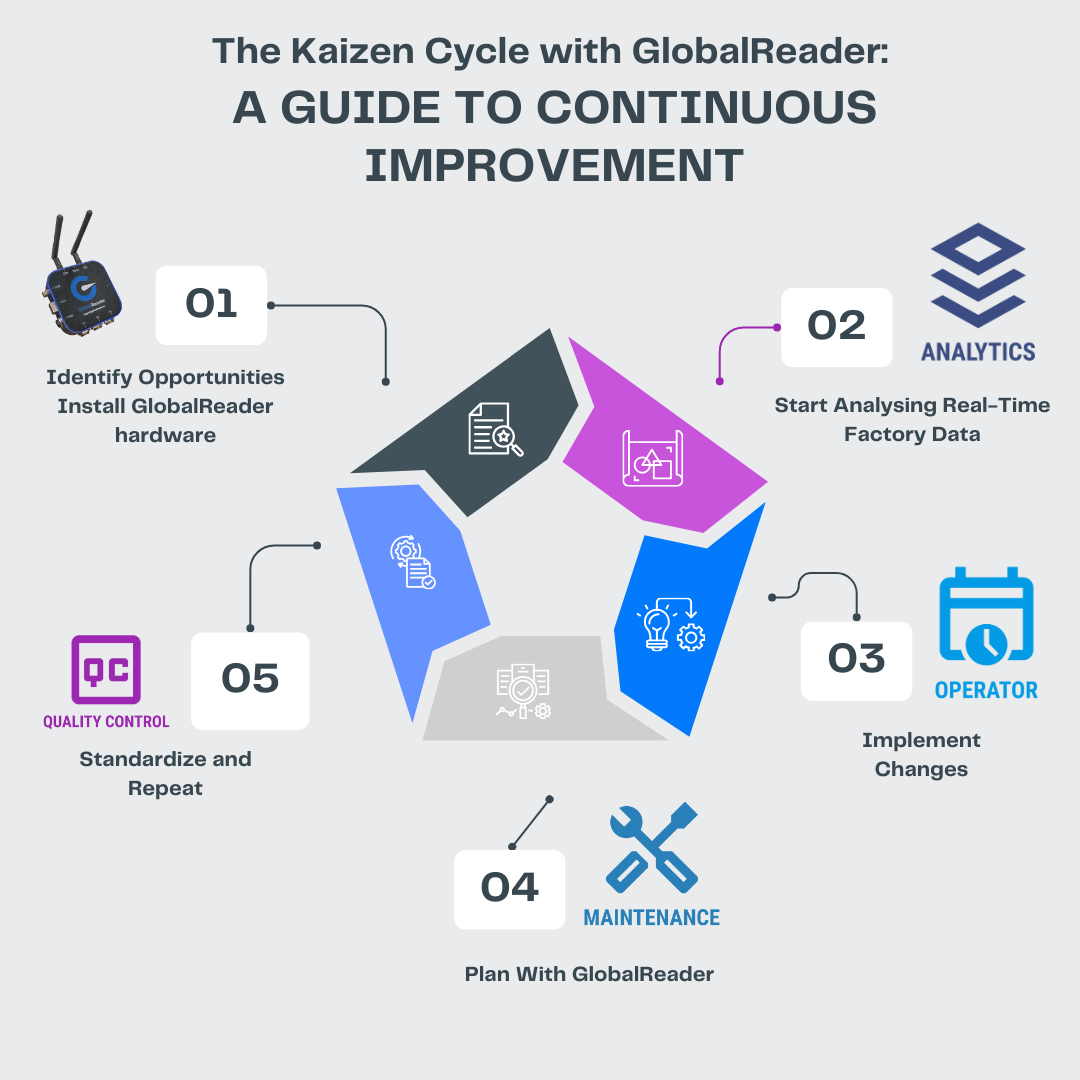
Continuous feedback and repeating the cycle are what keep an improvement in place. Without them a change tends to sink back into the old routine within a couple of months.
Kaizen is not 5S
Kaizen is often described as if it were the five-S method. It is not. 5S is one tool inside Kaizen, not Kaizen itself. Kaizen is the mindset of continuous improvement; 5S is one specific technique used within it, alongside several others.
5S. Workplace organisation in five steps: sort, set in order, shine, standardise, sustain.
Muda. The Japanese word for waste: any activity that consumes resources without adding value for the customer.
Gemba. The actual place where the work happens. A gemba walk means going to see the problem on the shop floor.
PDCA. Plan, Do, Check, Act, the cycle set out above.
Five whys. Root-cause finding, by asking “why” five times in a row about the same problem.
None of these is Kaizen. They are the techniques Kaizen is done with.
How to implement Kaizen
There has to be a standard before there can be Kaizen. Taiichi Ohno, who built the Toyota Production System, put it shortly: there is no Kaizen without a standard.
The logic is simple. If the process swings between shifts, there is no way to know whether the better result came from the change or from luck. A stable, repeatable process gives you a baseline. After an improvement the standard is updated, so the gain stays in the work and the next step can build on it.
Kaizen is often also run as focused workshops of about five days. The team analyses the process where the work actually happens, tests new methods, and locks in the ones that work.
Weeks like that produce fast results, especially somewhere like a changeover, where the loss is large and the change is tangible. Lasting growth, though, comes from everyday Kaizen rather than from occasional weeks.
Key benefits of Kaizen
Less waste in time, material and effort.
Better quality, and with it a more satisfied customer.
Lower cost and higher productivity.
A team that is more involved, because their suggestions are taken up and used.
A competitive edge that comes from adapting continuously.
Implement Kaizen with GlobalReader
Kaizen’s weak point is proof. A small improvement is by definition small, and when the measurement is manual it disappears into the noise. GlobalReader gives you real-time data on machine performance, downtime and overall equipment effectiveness (OEE). These tools let your team follow Kaizen principles:
Find the bottlenecks in production (Plan, install the GlobalReader hardware and software).
Test and measure even small process changes (Do, start measuring production in real time with Analytics).
Involve the workforce actively in improvement (Check, collect feedback from the floor with Operator).
Hold the long-term gain through continuous monitoring and reporting (Act, schedule maintenance with Maintenance).
Worth adding: MTBF and MTTR show whether the improvement also reached machine reliability.
What GlobalReader gives you for each technique
Muda. Analytics shows where the waste is and how much of it there is: which machine, shift, product or batch the scrap comes from, and how long the stops run. Looking for waste no longer starts from a guess, it starts from a list.
Gemba. Operator lets the operator log the reason for a stop at the machine, as it happens. It does not replace the gemba walk; it tells you which machine to walk to and what to ask there.
Five whys. Every “why” is answered from data rather than memory. If the first answer is “the machine stopped”, the next ones come from stop history, reason codes and cycle times.
PDCA. The cycle set out above, with a number attached to every stage of it.
Speed matters most of all. When the effect of a change is visible within the same shift, improving becomes a habit. When it surfaces a month later, it becomes a project, and projects end.
Follow the Kaizen checklist
Kaizen is more than a methodology; it is a mindset of learning, doing and improving. Supported by digital tools like GlobalReader, it gives an organisation steady, measurable progress, and that builds the foundation for long-term success in a competitive manufacturing landscape. We have put together a simple checklist to follow while implementing Kaizen principles.
The nine steps, in short:
Establish a stable operating condition. Machines in working order, trained operators present, steady material flow. Improvement needs a baseline that does not move on its own.
Document standardised work. Clear instructions and a visual map of the process, with everyone trained on them.
Analyse the current state. Walk the gemba. Collect lead times, downtime, waste points and quality data before changing anything.
Set clear targets. Specific and measurable, with a KPI and a deadline, communicated to the team.
Picture the target condition. A visual of the improved process, so everyone is aiming at the same thing.
Change one small thing. Pilot it, name an owner and a date, and involve the people who do the work.
Measure the result. Compare against the baseline and ask the operators what actually changed.
Standardise the gain. Update the work instructions and train on them, or the improvement decays.
Sustain and repeat. Keep the metric visible, run small improvements daily, and act on the ideas that come from the floor.
If you want to see where the first Kaizen in your factory could start, get in touch.
Request a quote Try our free demo
Frequently asked questions about Kaizen
What is Kaizen?
Kaizen is Japanese for continuous improvement. It is a mindset where production is improved through small, constant steps rather than occasional large projects, and where suggestions are expected from everyone, from management to the operator.
Are Kaizen and 5S the same thing?
No. 5S is one tool inside Kaizen, not Kaizen itself. Kaizen is the mindset of continuous improvement; 5S is a five-step method for organising the workplace that is used within it, alongside muda, gemba, PDCA and the five whys.
What is the PDCA cycle?
Plan, Do, Check, Act. Find the thing to improve, test the change on a small scale, measure the result against the objective, and standardise what worked. Then the cycle starts again.
What does gemba mean?
Gemba is the actual place where the work happens. A gemba walk means going to see the problem on the shop floor instead of discussing it in a meeting room. Real-time data does not replace that walk; it tells you which machine to walk to.
Why is a standard a prerequisite for Kaizen?
If the process swings between shifts, there is no way to tell whether a better result came from the change or from luck. A stable, repeatable process gives you the baseline an improvement can be measured against.
How do you start Kaizen in manufacturing?
Start by making the operating condition stable and the standard work documented. Then measure the current state, pick one specific loss, change one thing on a small scale, and compare the result against the baseline. If the change works, update the standard.